There is no single ADU permit fee in the Phoenix area. Phoenix calculates the building permit from project valuation under its January 20, 2026 schedule starting at $703 for the first $50,000 plus $9 per $1,000 above that, while Scottsdale lists a $131 ADU development-review staff-approval fee as only one component of a larger fee package.
Popular advice still tells owners to grab one national average, or a flat city charge, and drop it into the construction budget. That shortcut fails on a Scottsdale, Paradise Valley, Arcadia, or Biltmore lot. Luxury home builders and teams running luxury whole house remodeling treat permitting as a worksheet tied to events, not a headline. A casita, guest house, or multigenerational suite picks up charges when someone files, when plans are checked, when the permit is issued, when inspectors show up, and when a utility connects. Ignore that sequence and the soft-cost number you approved in design will not match the bill at the counter.
Why There Is No Single ADU Permit Fee
Search results still promise one price. Neither Phoenix nor Scottsdale publishes a single ADU-specific charge you can copy into a spreadsheet and forget. Both cities treat the unit as a residential structure. The total is assembled from line items, and each line item answers to a different decision about size, value, site work, and how clean the drawings are.
Phoenix runs a valuation-based building permit. The declared or city-assigned construction value drives the permit, and plan review rides on top of that permit amount once the project clears a value threshold. Scottsdale splits the file. A planning staff-approval charge for the accessory dwelling is not the building permit, and the building permit is not the inspection or utility package. Transfer a guess from one city to the other and you will miss the model that applies to the lot.
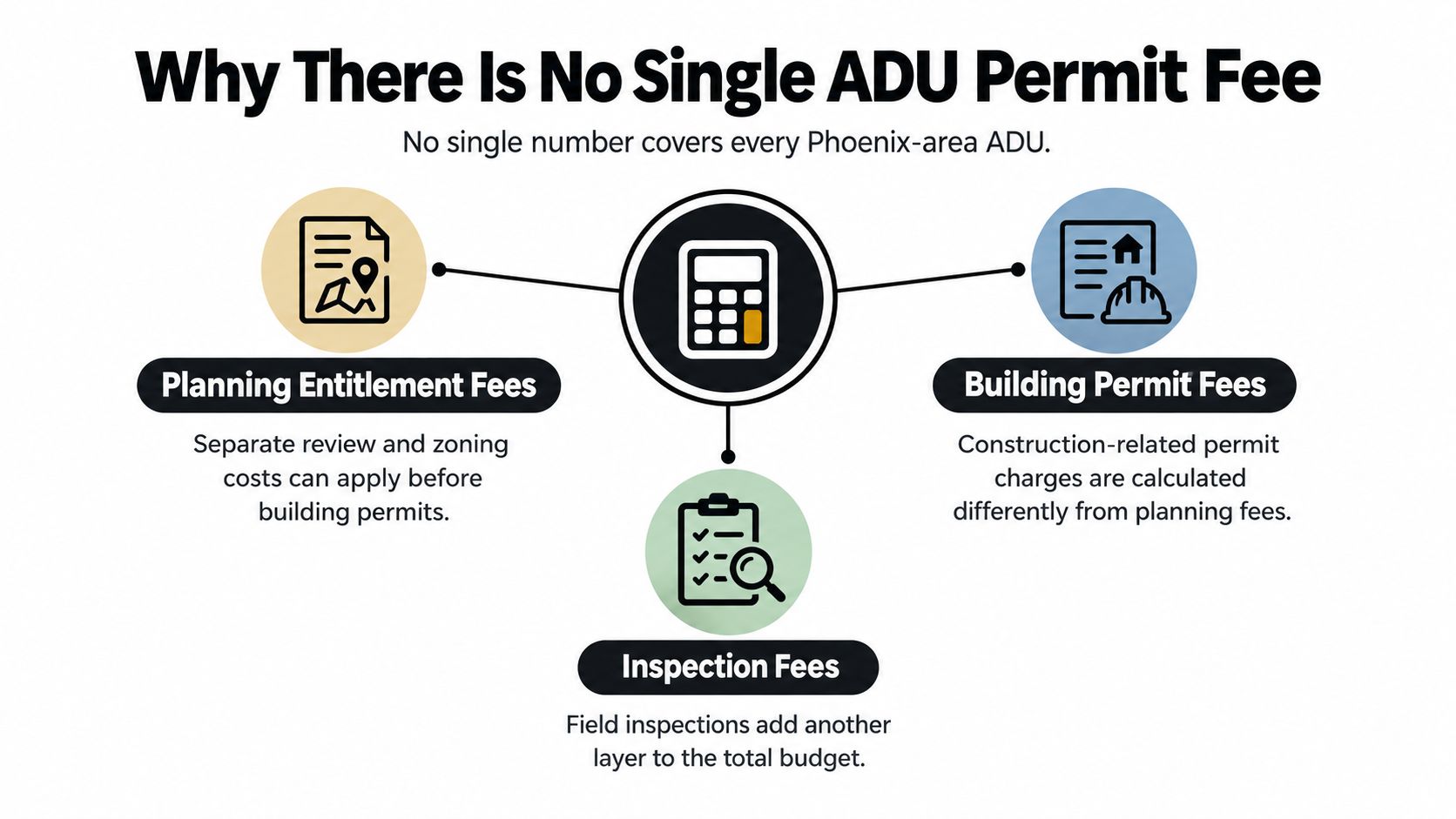
The municipal building-permit charge is only the middle of the stack. The full fee package can include plan examination, inspections, fire review, utility meters, and impact or in-lieu charges where they still apply. Map the project against the event that creates the bill.
- Development review: zoning or staff approval before, or alongside, the building set.
- Plan examination: the check of construction documents after submittal.
- Permit issuance: the building permit itself, often due when the city releases the card.
- Inspection: field visits, and reinspections if a correction fails.
- Utility service: meters and agency charges that sit outside the building counter.
A defensible permitting budget names the triggering event for every dollar, then asks which of those events this casita will actually hit.
The Fee Components That Make Up an ADU Budget
A defensible ADU fee worksheet ties each charge to the event that triggers it. That makes it easier to see which project decisions affect the bill and which charges belong to another agency.
Plan review is billed when construction drawings are submitted. Custom detailing and complex building systems can lead to more review comments and resubmittals, so include room in the schedule and budget for revisions.
The building permit is generally due at issuance. Its calculation follows the city's residential fee rules. Design costs, utility charges, and other agency fees sit on separate lines.
Inspections occur during construction. Standard visits are part of the process; failed corrections can mean additional visits and charges.
Fire review applies when the project is referred to the fire authority. Confirm whether your site or scope triggers a separate review.
Development impact or in-lieu fees may apply when a new dwelling affects public facilities, subject to applicable exemptions and size rules. They are separate from the building permit.
Utility meters and connection charges arise when you request new or upgraded service. A detached suite with its own meter can carry different charges from one served through the existing house connection.
Outside agencies may bill directly. School, water, and sewer charges do not always pass through the building department.
Who collects what
| Fee Component | Triggering Event | Typically Collected By |
|---|---|---|
| Plan review | Drawing submittal | Building or development services |
| Building permit | Permit issuance | Building department |
| Inspections and reinspections | Field visits and failed corrections | Building department |
| Fire review | Fire-authority referral | Fire authority |
| Impact or in-lieu fees | New-dwelling assessment, if not exempt | City or outside district |
| Meter and connection charges | New or upsized utility service | Utility or the city acting for it |
For Phoenix and Scottsdale homeowners, the practical takeaway is to budget for the full set of applicable reviews, permits, inspections, and service charges, not just the building-permit line. The city's fee worksheet and the utility providers' requirements determine which charges apply to your property.
Practical rule: Give every worksheet line a triggering event and a collecting agency. If neither is clear, confirm the charge before treating it as a project cost.
How Phoenix Calculates ADU Permit Fees
Phoenix does not sell a flat ADU permit. It prices the unit as a residential building-permit project. Under the January 20, 2026 development-fee schedule, the permit fee comes from the declared or city-determined construction valuation. The schedule starts at $703 for the first $50,000 and adds $9 per $1,000 for higher valuations inside the applicable band.
That is why a luxury casita and a bare-bones unit do not share a permit number. Raise the assigned value and the permit line rises with it. Finish level, added baths, and a larger footprint can all push valuation, even when the marketing name of the building stays "casita."
What stacks on the permit
For residential projects valued above $50,000, plan review is 80% of the permit fee. A $98 plot-plan review and additional utility-meter charges of $98 may also apply. Those three items are not optional footnotes. On a higher-value build, plan review alone is most of another permit fee. Plot review and meters are smaller, but they are separate checks, and they show up because the site and the service change, not because someone picked a round ADU number online.
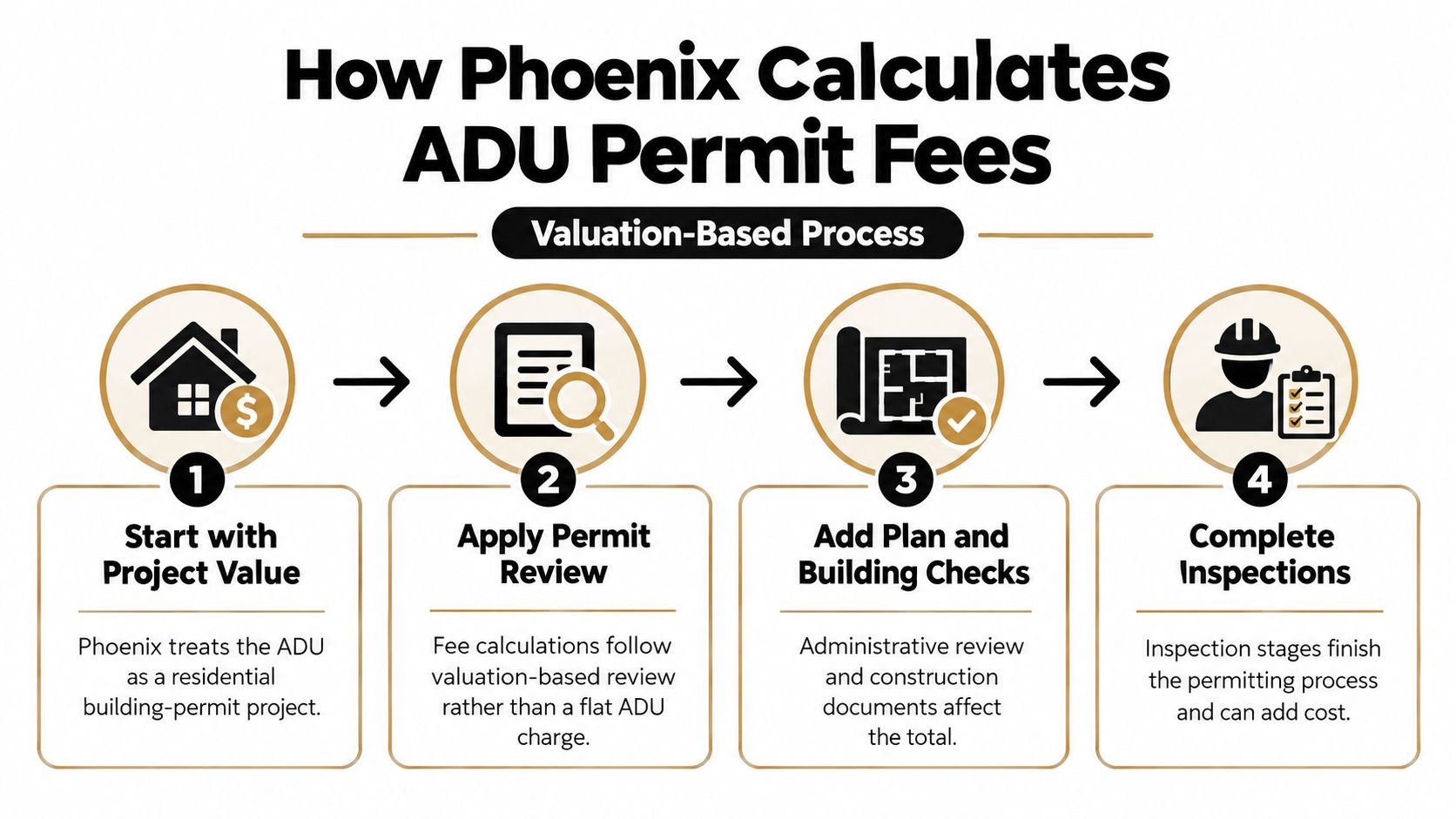
Phoenix also states that its Planning and Development Department collects fees through permitting and plan-review processes, so the approval cost is several payments, not one, as described on the city's ADU residential building page. Consumer explanations rarely hand you a worksheet that already includes permit, plan review, plot-plan review, meters, impact exposure, and reinspections.
The city's valuation method may not match your construction contract. A contract can bundle allowances, owner-supplied finishes, or separate site work that the city either includes or leaves out. Ask, before submittal, what valuation Phoenix will assign to this specific ADU, and which charges are due at submittal versus at issuance. Complexity and corrections can move the total as much as square footage does.
How Scottsdale Structures ADU and Residential Fees
Scottsdale will not let you treat planning entitlement and the building permit as one number. The FY 2026/27 application schedule lists a $131 staff-approval development-review fee for accessory dwelling units. The same schedule lists $131 for a pre-application, $2,309 for development review of new construction, and $237 for a residential variance on a single-family lot. Those are different actions. An ADU that stays inside staff approval is not the same file as new-construction development review or a variance.
The $131 figure is an administrative and planning component. It is not the cost of permitting the building. The city points applicants to its permit-fee calculator and a fee-request process for building permits, plan review, development fees, and civil permits. A detached casita can still pick up valuation-based building review, civil or utility work, site constraints, and resubmittal cost. Scottsdale's fee-change notes also identify the ADU charge as a newly introduced state-mandated case type, which means the schedule can move even when construction prices do not. Verify it at kickoff.
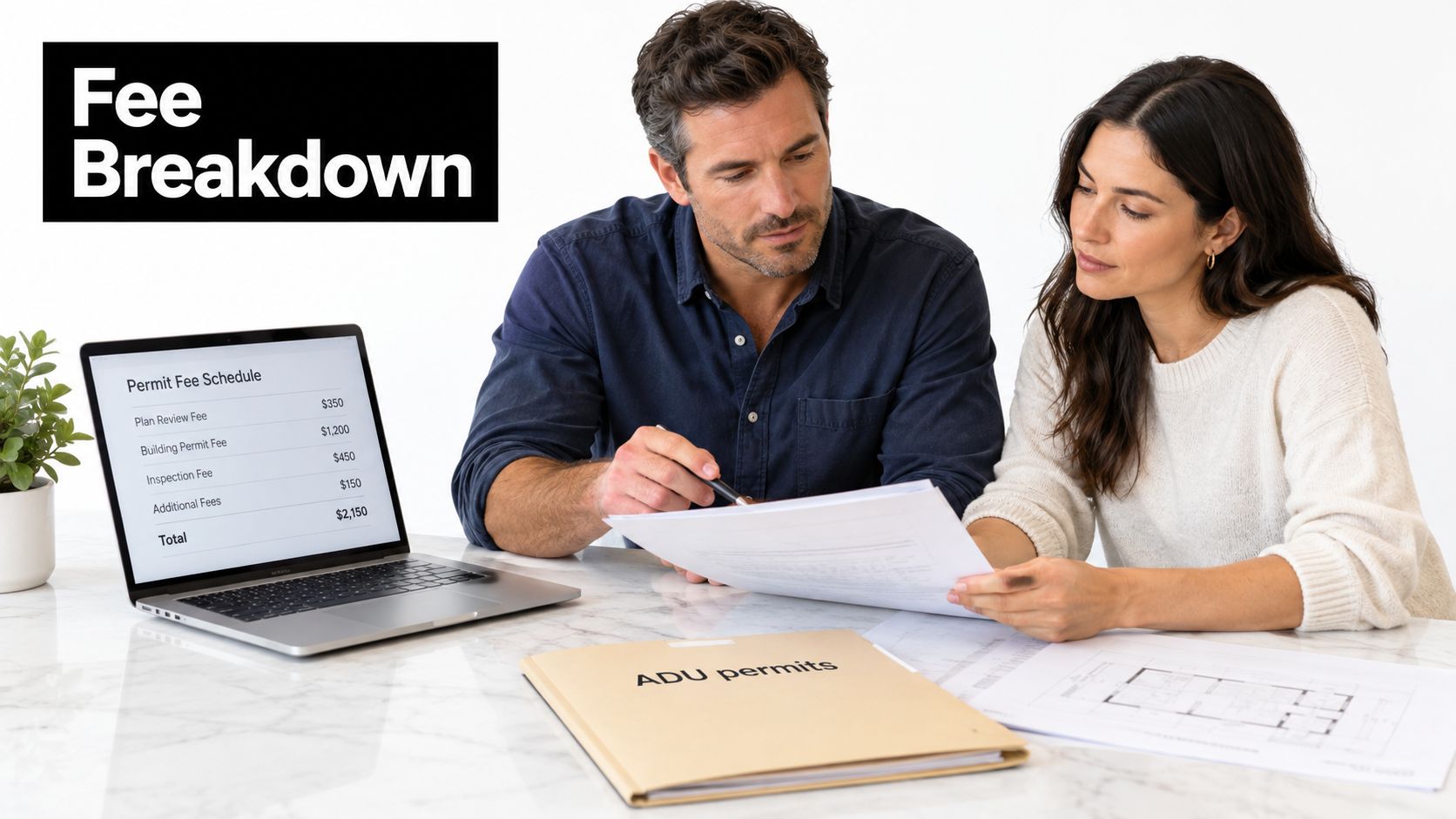
The residential permit baseline
Owners pairing a casita with luxury whole house remodeling need the residential schedule, not only the ADU application line. On the FY 2026–27 residential permit schedule, a single-family custom permit starts with a $237 base fee, then adds $0.94 per square foot of livable air-conditioned area and $0.54 per square foot of covered non-air-conditioned area. A single-family remodel uses the same $237 base, but the air-conditioned livable component is 30% of the $0.94 rate, while covered non-air-conditioned area stays at $0.54 per square foot.
The schedule also lists a $195 certificate-of-occupancy fee, a $379 GIS fee, and a $363 lowest-floor-certificate review where that review applies. The city says the schedule is not all-inclusive. Classify each area as remodel, addition, custom construction, or another category before the budget is locked. Misclassify a wing and the per-square-foot math is the wrong math.
Phoenix and Scottsdale ADU Fees Side by Side
Do not crown a cheaper city from a blog. The same casita drawings can produce different fee exposure because the calculation engines are different. Phoenix lets declared or assigned construction value drive the building permit, so a higher-finish luxury scope moves the permit and, above the value threshold, the plan-review percentage that sits on it. Scottsdale puts a modest planning-review charge next to a separate residential building permit that follows its own schedule, calculator, and fee request.
| Criteria | Phoenix | Scottsdale |
|---|---|---|
| Core method | Valuation-based residential building permit | Planning review separated from the building permit |
| What scales the permit | Declared or city-determined construction value | Residential schedule, calculator, and fee request |
| Plan review | Percentage of the permit fee above the value threshold | A distinct review path, not included in the ADU staff-approval line |
| Site or plot review | Separate plot-plan charge may apply | Civil or site approvals can be additional |
| Utility connections | Separate meter charges may apply | Utility and civil work can be additional |
| When you pay | Multiple departments and payment points | Application fees, then permit charges through the city's process |
| Schedule risk | Corrections and valuation disputes | Resubmittals, and a lapsed permit that must be reactivated |
A homeowner should not carry an estimate across the city line. Ask which model applies to the lot, whether the ADU is only a staff-level planning case or something larger, and which charges are due at submittal versus issuance. Site constraints, a new meter, or a variance can matter more than which city letterhead is on the form.
If the worksheet does not say which city's rules produced each line, it is not a budget yet.
What Actually Drives Your ADU Fee Higher
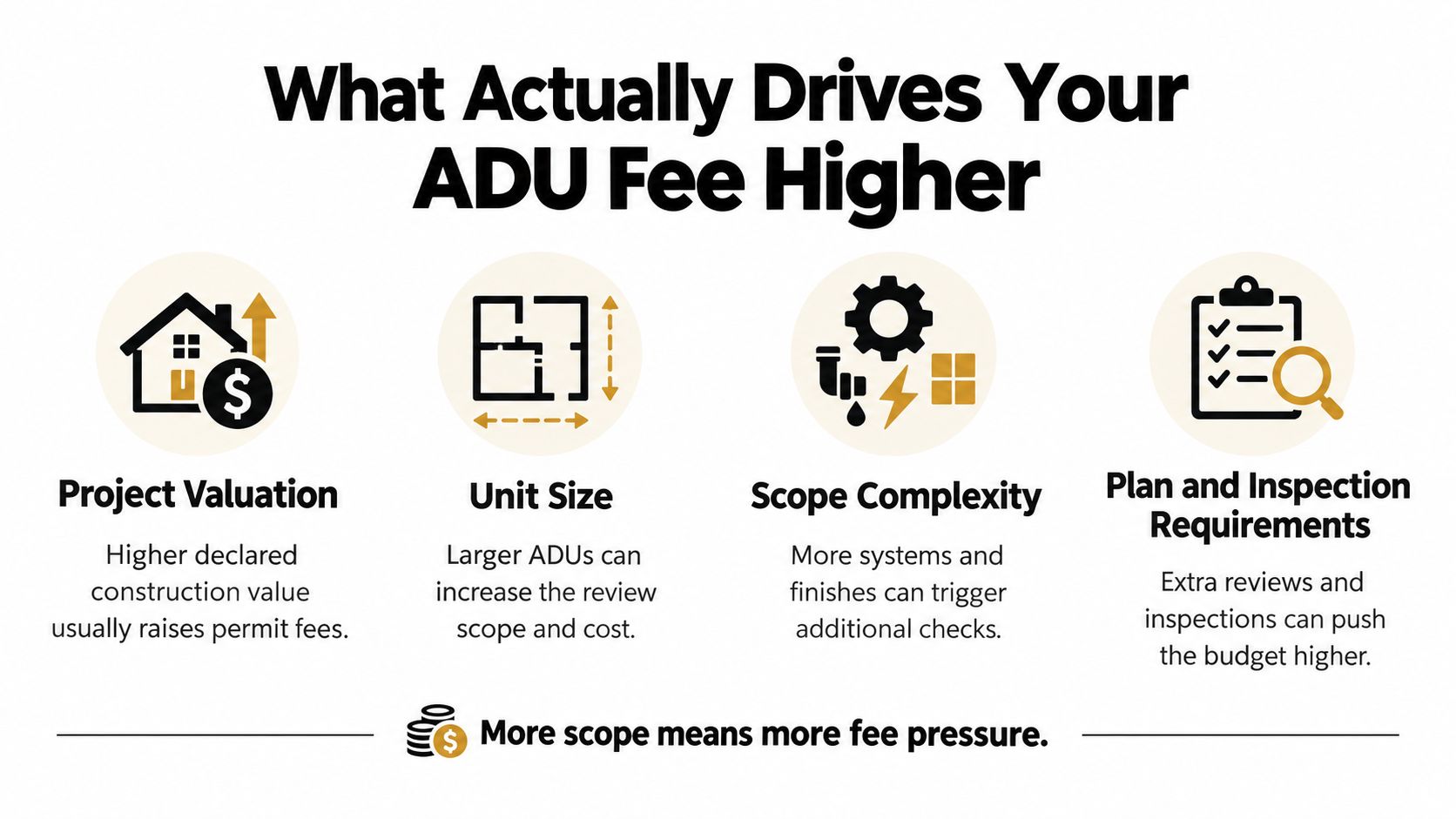
Valuation is the first driver in Phoenix, because the permit and the plan-review percentage both follow assigned value. Scope is the practical version of that driver. More baths, a full kitchen, a separate mechanical system, and custom finishes give the city more to value and more to check.
Unit size is the second driver, and it is not only a construction-cost issue. California's experience is the clearest policy illustration we have. Reforms beginning in 2016 sped up approvals, limited parking rules, reduced certain utility and impact-fee burdens, and restricted local barriers, and 2019 reforms authorized junior ADUs with a simplified nondiscretionary path, as documented in research on California's ADU reforms. ADUs under 750 square feet, and junior ADUs, are exempt from development impact and in-lieu fees. Larger ADUs may be charged in proportion to the primary dwelling. Even after those reforms, California permit-related fees commonly run from about $1,500 to more than $7,000, excluding construction, design, and utility costs.
The production response was large. Cities and counties issued only a few hundred ADU permits a year from 2013 through 2016, then permitted more than 24,000 ADUs in 2022, about 19% of all housing units permitted in California that year. Earlier, permits rose from 5,911 in 2018 to 15,571 in 2019. Fee policy changed behavior. A modest change in programmed area around an exemption threshold can change both the design and the fee exposure. That is a programming decision, not a rounding error.
Utility agencies, civil work forced by the site, and revision cycles are the quiet drivers. A failed comment round can cost as much attention as another hundred square feet. The same discipline belongs on a primary residence. Owners combining a suite with a full remodel should read the city's categories against a real luxury renovation and remodel scope before they freeze square footage.
More scope means more fee pressure, and corrections can matter as much as area.
Budgeting for ADU Permit Fees Without Surprises
Build the fee worksheet before design is frozen. Separate the building permit and plan review from site review, utility connections, and inspection-related charges. Confirm current amounts with the city before submitting; fee schedules can change independently of construction pricing.
Ask the jurisdiction to answer four questions in writing:
- Assigned value: What valuation will the city use for this ADU, and how does it compare with the construction contract?
- Due dates: Which charges are due at application, permit issuance, inspection, or final approval?
- Permit category: Will the work be reviewed as an addition, custom construction, a remodel, or a civil permit?
- Outside bills: Which school, water, or sewer charges are billed separately from the building permit?
Scottsdale's filing path
Scottsdale accepts permit applications and payments through its SPUR planning and permitting portal. Check the city's permit services page for current application and payment instructions. If a permit expires while the project is paused, confirm the reactivation requirements and any applicable fees with the city before setting a restart date.
Assign one person to maintain the worksheet, track payment deadlines, and confirm which charges are included in each estimate. Emery Lane Homes can prepare a lot-specific fee worksheet as part of preconstruction planning for casitas and larger residential projects. Owners considering a custom built-to-suit residence should request that review before their plans and scope are finalized.
Your Next Step Toward a Permitted ADU
ADU permit fees are a package of charges tied to events. They are not one published price, and they are not the national average a search result puts in bold. The step that cuts budget risk is a project-specific fee analysis before you commit to a plan.
Bring the intended size, whether the unit is attached or detached, the target city, and whether the main house is also in a luxury whole house remodeling scope. Those four inputs change the worksheet. A Scottsdale, Paradise Valley, Arcadia, or Biltmore owner planning a casita, guest house, or multigenerational suite should have that conversation before drawings harden. Permitting discipline protects the construction budget because it stops soft costs from arriving as a surprise after design is already loved. Start with the accessory dwelling planning path and put the fee events on paper first.
Emery Lane Homes builds custom luxury homes, leads luxury whole house remodeling, and delivers casitas and multigenerational suites across Scottsdale and the surrounding Phoenix neighborhoods, with permitting and pre-construction budgeting handled inside the same design-build process. If you want ADU permit fees mapped to your lot before design is locked, visit Emery Lane Homes and start that worksheet with the team.