
Arcadia luxury homes typically sit around $1.26 million to $1.5 million, but the better question is which submarket and lot type matches your goals for privacy, renovation scope, and resale. If you start with price alone, you'll miss the real decision: Arcadia Proper, Arcadia Lite, and the broader Arcadia area behave like different markets.
What looks like one polished luxury district from the street is really a set of very different acquisition paths. Some lots support a careful remodel, some justify a teardown, and some only make sense if the land and the setting are already doing the heavy lifting.
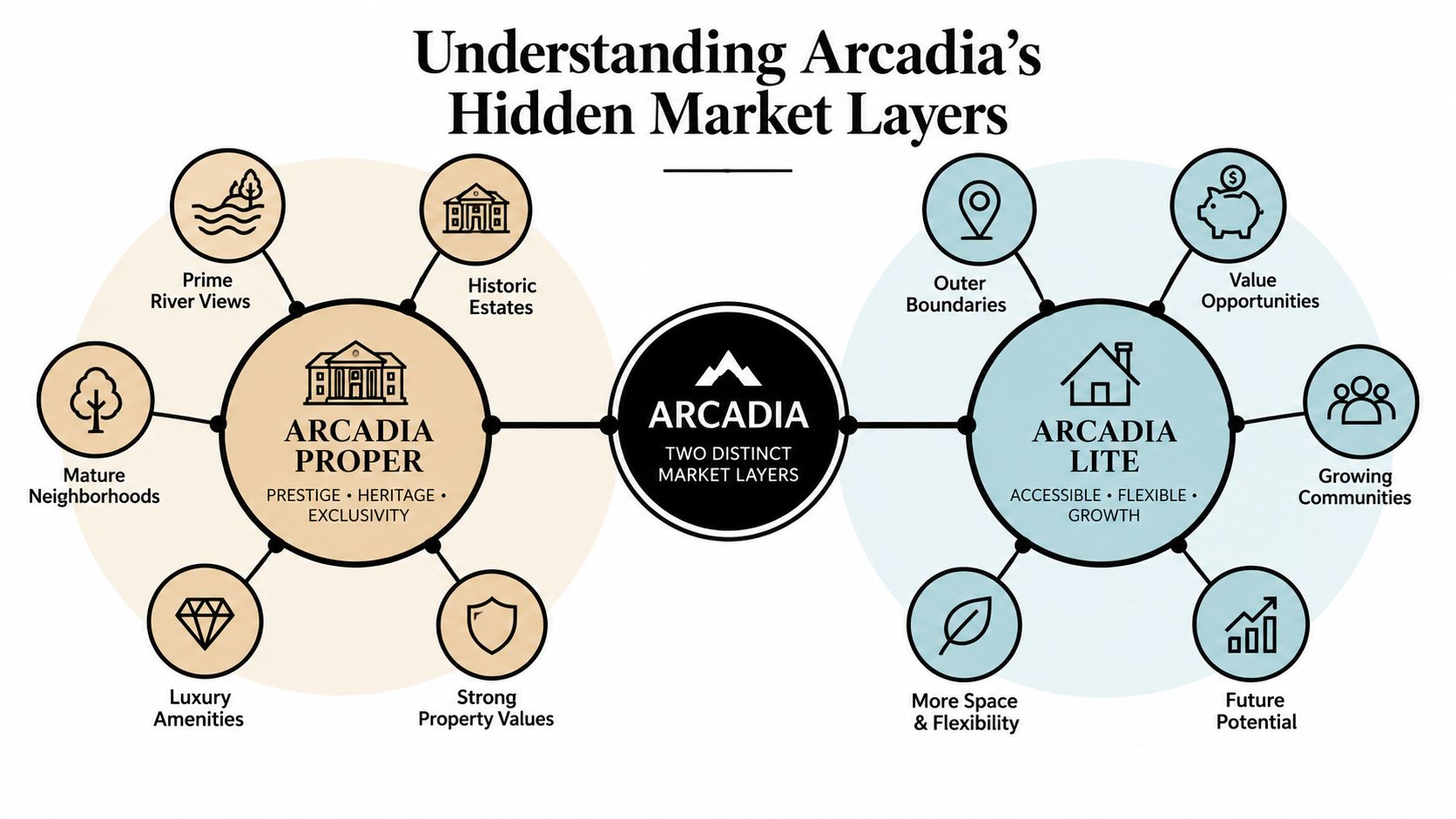
Understanding Arcadia's Hidden Market Layers
A lot of buyers come into Arcadia expecting one simple formula. They see citrus groves, mature trees, and elegant ranch homes, then assume every address plays the same way. That's not how the market works on the ground.
Proper and Lite do not price the same way
Arcadia Proper tends to hold the strongest premiums because the lots, setting, and resale story are usually better aligned with luxury expectations. Arcadia Lite often has smaller lots, older housing stock, and lower entry points, which changes whether a remodel can justify itself or whether the site should be treated as a rebuild candidate. In practice, the premium is often attached to the land and the location tier, not just the interior finish package.
Arcadia's roots explain why the neighborhood still feels unusually site-driven. It was first developed around citrus agriculture, the Arcadia Water Company was founded in 1919 to bring irrigation from the Arizona Canal, and by 1924 it had built several pumping stations and 15 miles of concrete piping. The area stayed primarily agricultural until the mid-1950s, when suburban ranch homes replaced much of the groves (Arcadia history)).
Practical rule: if the lot is weak, the finishes have to work much harder. If the lot is strong, a restrained remodel can outperform a flashy rebuild.
Why the market layer matters before you hire anyone
A buyer who wants quiet privacy, a broad outdoor living zone, and a generous future resale audience usually wants different terrain than someone chasing a fast cosmetic upgrade. Arcadia Proper is where the strongest lifestyle story often lives. Arcadia Lite can still be a smart buy, but only if the pricing leaves room for the right scope of work.
That distinction is what separates a good purchase from an expensive compromise. If you know which layer you're in, you can decide whether to preserve, expand, or start over with far more confidence.
Arcadia Luxury Homes Market Trends and Price Context
Arcadia sits near the top of Phoenix's residential market for a reason. One neighborhood profile reports a median real estate price of $921,800 and a vacancy rate of 13.7%, while other neighborhood profiles place home values around $1.39 million (NeighborhoodScout). Those numbers tell you this is a premium district, not a standard suburban price band.
Headline pricing is only the first filter
The luxury submarket behaves differently again. One current source reports a median listing price of about $1.5 million with 67 luxury homes for sale, while another shows a median listing home price near $1.26 million, 104 active listings, 86 days on market, and $574 per square foot (Arcadia luxury homes market data). That spread matters because value in Arcadia is usually driven less by raw square footage and more by land scarcity, remodel quality, and location premium.
A dated ranch on a superior lot can outperform a newer home on a weaker site. That's the part many buyers miss when they compare finishes only. In Arcadia, the land can be the asset and the house can be the variable.
Buyer's lens: carry cost, absorption speed, and discounting matter because they change the real cost of a luxury build or remodel. A long marketing period can erase a lot of design upside.
What the numbers suggest for buyers
One recent market summary places Arcadia around a $1.324 million median sale price, 56 days on market, and a 95.7% sale-to-list ratio (Arcadia market report). That doesn't read like a blanket frenzy. It reads like a market where condition, lot quality, and pricing discipline still create room for negotiation in some segments.
For buyers, that means the right question isn't “Is Arcadia expensive?” It's “Which properties absorb quickly, which need patient positioning, and which deserve a full redesign?” Once you answer that, the purchase strategy becomes much clearer.
Move-in-Ready Luxury Versus Custom Design-Build
Some buyers want to close, furnish, and move on with life. Others want the plan, the circulation, and the outdoor connection to fit the household instead of forcing the household to adapt to the house. Arcadia supports both paths, but they don't deliver the same kind of value.
The trade-off is speed versus specificity
Move-in-ready luxury reduces timeline risk. You know what you're buying, you avoid months of design churn, and you can see the finished condition before you commit. The downside is that many finished homes still need selective upgrades, because “luxury” on paper doesn't always mean the kitchen workflow, storage, or outdoor transition is functionally effective.
Custom design-build gives you control over layout, privacy, and site use. It also gives you the chance to correct common issues in older Arcadia stock, like awkward circulation or underused yard space. The trade-off is permitting, construction exposure, and a longer path to completion.
The right answer usually depends on how strong the lot is and how long you plan to stay. If the land is outstanding and the current structure is fighting the site, custom work can make more sense. If the home already aligns with your lifestyle and the lot is sound, a selective renovation may preserve more value.
Whole-house remodeling only works when the structure deserves it
A well-executed remodel can deliver a lot of utility without starting from zero. It can also go sideways if the plan ignores the bones of the house, the lot, or the neighborhood context. In Arcadia, the smartest remodels usually respect the original site logic instead of trying to force a generic luxury template onto a specific property.
For buyers comparing options, the most useful filter is simple:
- Strong lot, weak house: consider rebuild potential.
- Strong house, moderate updates: consider a whole-house remodel.
- Weak lot, expensive wish list: be careful, because overbuilding can hurt resale.
- Premium setting, limited scope: move-in-ready may be the cleanest path.
If you're evaluating homes and want to see how real inventory is positioned, review current for-sale homes with that lot-versus-layout lens in mind. For a high-end buyer, that shift in perspective usually matters more than paint colors or staged furniture.
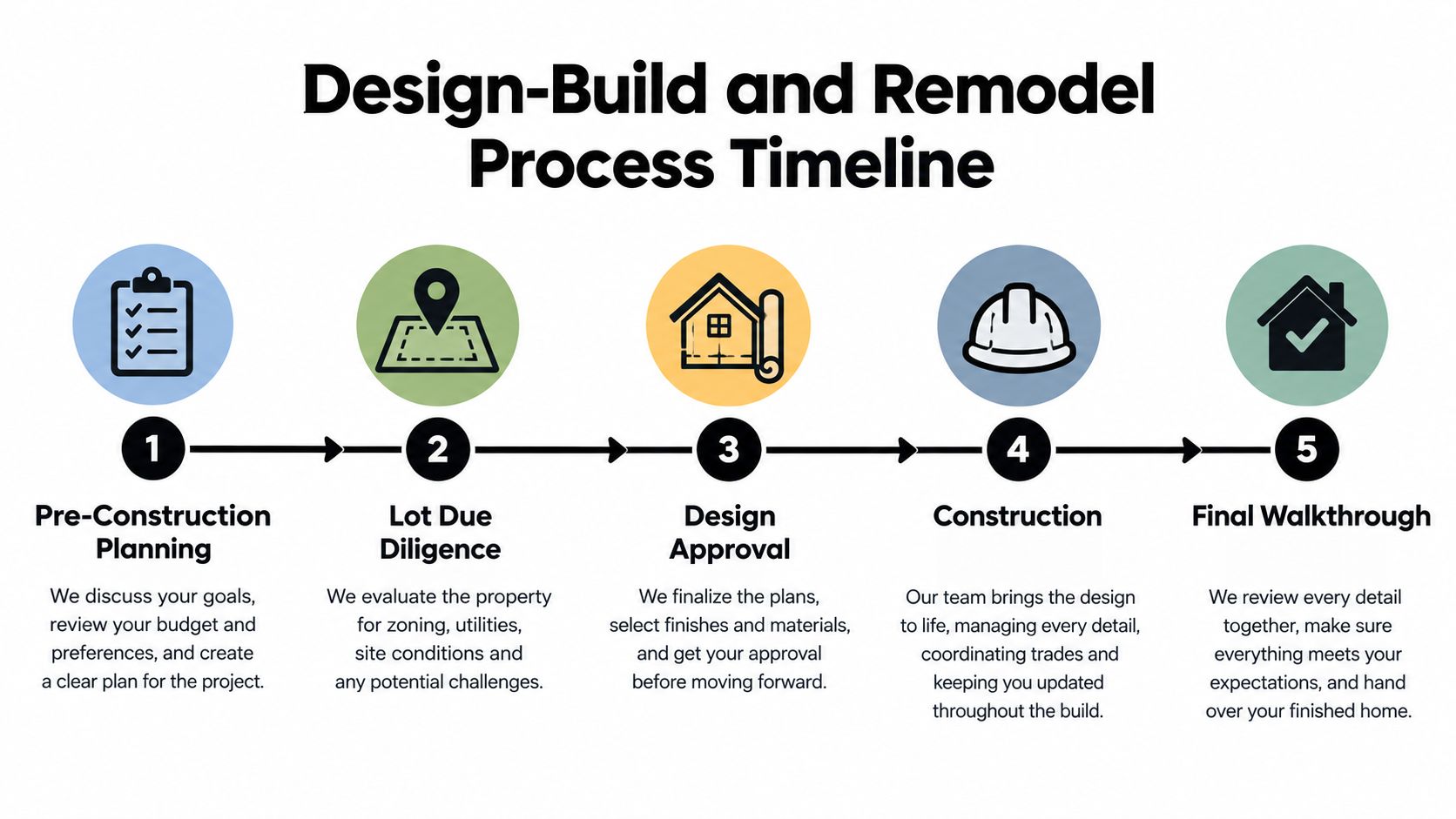
Design-Build and Remodel Process Timeline
Successful luxury work in Phoenix starts long before construction crews show up. The biggest mistakes happen when buyers treat planning as a formality and permits as an obstacle instead of a framework. The better projects move in sequence, with each decision reducing risk for the next one.
The order matters more than most people think
The first pass is pre-construction planning. That means defining the program, checking the site, and deciding whether the project is a remodel, addition, or new build. It also means being honest about budget boundaries before the drawings get too pretty.
Next comes lot and home due diligence, where setbacks, drainage, grading, trees, and existing conditions affect what can be built. Then design approval pulls the site strategy into a buildable set of documents. Construction follows, then the final walkthrough, punch-list completion, and warranty support.
Phoenix requires construction permits for both new homes and remodels or additions, including garage or carport conversions and porch enclosures (Phoenix residential building permits). That matters because permit timing can reshape the schedule and, in some cases, the entire design.
A luxury project gets expensive when the team designs first and asks about feasibility later.
What keeps the job on track
Budget discipline and schedule discipline are the two pressure points that decide most outcomes. A good team controls both by tightening the scope early, documenting the plan, and making decisions in the right order. HOA coordination also needs to happen early if the property sits under neighborhood review.
For homeowners considering a major renovation, luxury renovations and remodels should be treated as a managed process, not a sequence of guesses. The team that handles design, permitting, and construction with the same level of care usually protects both the timeline and the final result.
Arcadia rewards careful execution. The properties are too valuable, and the lots are too constrained, to let the process drift.
ADU and Multigenerational Living Feasibility
Arcadia buyers increasingly want flexibility. Sometimes that means a guest suite for family, sometimes a private space for aging parents, and sometimes a casita that supports long-term household planning. The challenge is that feasibility depends on lot geometry and local rules, not just desire.
Lot shape decides what fits
Arcadia lots range from smaller infill parcels to legacy tracts that were originally much larger, and that difference changes what you can realistically build. A generous site can support detached living space, a more complex courtyard arrangement, or multiple structures without crowding the yard. A tighter parcel usually forces sharper trade-offs between footprint, circulation, privacy, and outdoor living.
That's why some homes can absorb an addition cleanly while others start to feel overbuilt the moment the plan grows. The land has to support the massing, the drainage, the setbacks, and the daily movement through the property. If it doesn't, even a beautiful concept can become an awkward house.
Scottsdale's rules show how specific ADU planning can get
Scottsdale's ADU framework is a useful benchmark for the kind of rule-driven analysis that high-end buyers need. The first ADU on a qualifying single-family lot is capped at 1,000 square feet or 75% of the size of the existing main residence, whichever is less, and it must be separated from the main home by at least 10 feet (Scottsdale ADU rules). Scottsdale has allowed ADUs since January 1, 2025, and a qualifying lot may include one attached ADU and one detached ADU, with a possible third detached unit on lots of at least one acre if it qualifies as a Restricted-Affordable ADU (Scottsdale ADU FAQs).
Those rules matter beyond Scottsdale because they show how much site size and configuration can limit the program. If you're planning multigenerational living or income-oriented space, you need a team that reads zoning, setbacks, and lot coverage before anyone draws a pretty casita elevation.
Accessory dwelling options only work when the property can support them physically and administratively. That is the true filter, and it is where a lot of speculative ideas fall apart.
What works best in practice
Homes with room for separation tend to be the best candidates. So do sites where the existing structure can stay intact while the new program is added thoughtfully. On constrained lots, the smarter play may be a selective remodel that improves the main house instead of forcing a second structure onto the property.
For high-net-worth households, the goal is usually not maximum square footage. It's usable privacy, family flexibility, and a property that still feels coherent ten years from now.
Resale Dynamics and Choosing Your Builder Partner
Arcadia resale favors homes that feel calm, functional, and tied to the site. Buyers respond to privacy, efficient outdoor living, and spaces that work in daily use, not just in listing photos. When a project overbuilds a small infill lot, the result can look impressive and still be hard to exit cleanly.
The exit path should shape the build path
Some sites are better candidates for a renovation. Some are better candidates for a rebuild. Some should be sold to a builder-developer instead of forcing an expensive compromise into a property that doesn't deserve it.
That's where contractor selection becomes more than a style decision. You want a builder who understands local resale patterns, lot constraints, permit mechanics, and how to keep the home functional instead of just ornate. In a market like Arcadia, those details affect both the living experience and the eventual sale.
Arizona's contractor framework also puts real protection around the hiring decision. A General Residential Contractor license requires at least four years of hands-on and/or managerial experience, and residential customers may have access to the Residential Contractors' Recovery Fund with up to $30,000 per property owner for qualifying claims (Arizona ROC requirements). That's not a footnote, it's part of risk management when you're trusting a luxury-rated contractor with a major project.
What to expect from the right partner
A strong builder should be able to talk through the lot, the plan, the permitting path, and the resale logic in plain language. They should also be able to coordinate design, construction, and warranty work without making the homeowner manage every handoff.
Emery Lane Homes works across Paradise Valley, Scottsdale, Arcadia, and the Biltmore corridor, with design-build services for new homes, luxury whole-house remodeling, and ADUs. For buyers who want one team handling the moving parts, that kind of integrated structure can reduce friction from concept through closeout.
If you're hiring for arcadia luxury homes, choose the team that can explain what the lot will tolerate, what the code will allow, and what the market will support. That's the difference between a house that merely looks expensive and one that performs well.
If you're planning a custom build, whole-house remodel, or ADU in Arcadia or the surrounding Scottsdale area, Emery Lane Homes can help you evaluate the lot, shape the scope, and manage the work from planning through warranty. Visit Emery Lane Homes to start a conversation about your property and the right next step.