

What goes with black furniture? Most answers stop at a paint chip. They hand you a warm white, a greige, maybe a sage, and call it solved. Then the room gets built, the late sun rakes across a west-facing great room in Scottsdale, and the black walnut console reads as a flat dark hole instead of a deliberate anchor.
The paint was never the problem. Black is a finish, not a color story. It needs companions that do specific work: something that reflects light back into the room, something organic to break the hard edges of a rectangular piece, and something warm enough to keep the palette from turning cold and corporate. Cover those three jobs and black furniture becomes the easiest thing in the house to live with. Miss them and no wall color rescues it.
The eight pairings below hold up in high-end desert homes, and each one comes with the detail that decides whether it works in a finished room: the sheen, the undertone, the substrate, and the construction reality behind it. Some can be specified today. Others have to be planned before drywall goes up, which is a different conversation than the one most color advice prepares you for.
1. Warm Brass and Aged Gold Metal Accents
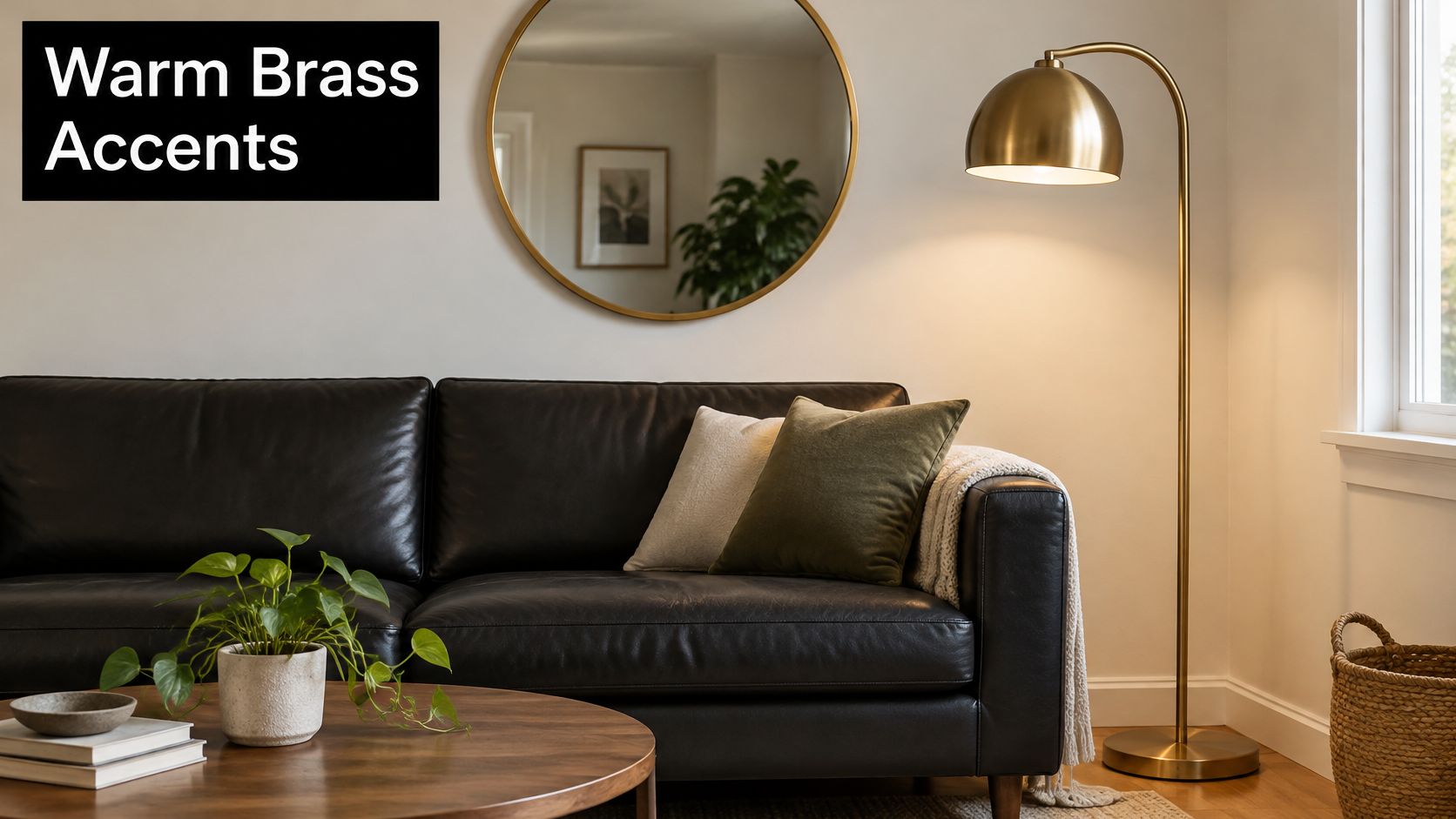
Black furniture absorbs light. Brass gives it back. That exchange is why the pairing works room after room: metal catches daylight from a west window or the glow of a lamp and throws it across a dark surface, so the black piece reads as rich rather than heavy.
It suits desert architecture in particular. Warm metal sits comfortably beside earthy stucco, white oak floors, and the amber cast Arizona light carries into a room by late afternoon.
Where it works best
The living room version is a black leather sofa flanked by brass floor lamps with a brass-framed mirror on the wall behind it. In a kitchen, a matte black island with unlacquered brass pulls and one brass pendant reads warmer and more custom than the same island in polished nickel.
Spec note: Lacquered brass keeps its factory finish in air-conditioned interiors. Unlacquered brass patinas with handling, which suits cabinet hardware and door pulls far better than a light fixture you'd rather not polish.
- Repeat it two or three times: lighting, hardware, and one accent table. A fourth brass point starts to look like a theme rather than a finish.
- Stay in one tone family: brushed, satin, or aged across a single sightline. Polished and antique brass in the same room reads as an accident.
- Favor satin over mirror polish: high-gloss brass against glossy stone and black lacquer tips a room toward loud fast.
For proportion cues on metal-base tables, you can browse brass tables in Bloomington to see how a thin brass frame holds its own beside heavier dark pieces.
2. Warm Plaster and Limewash Walls
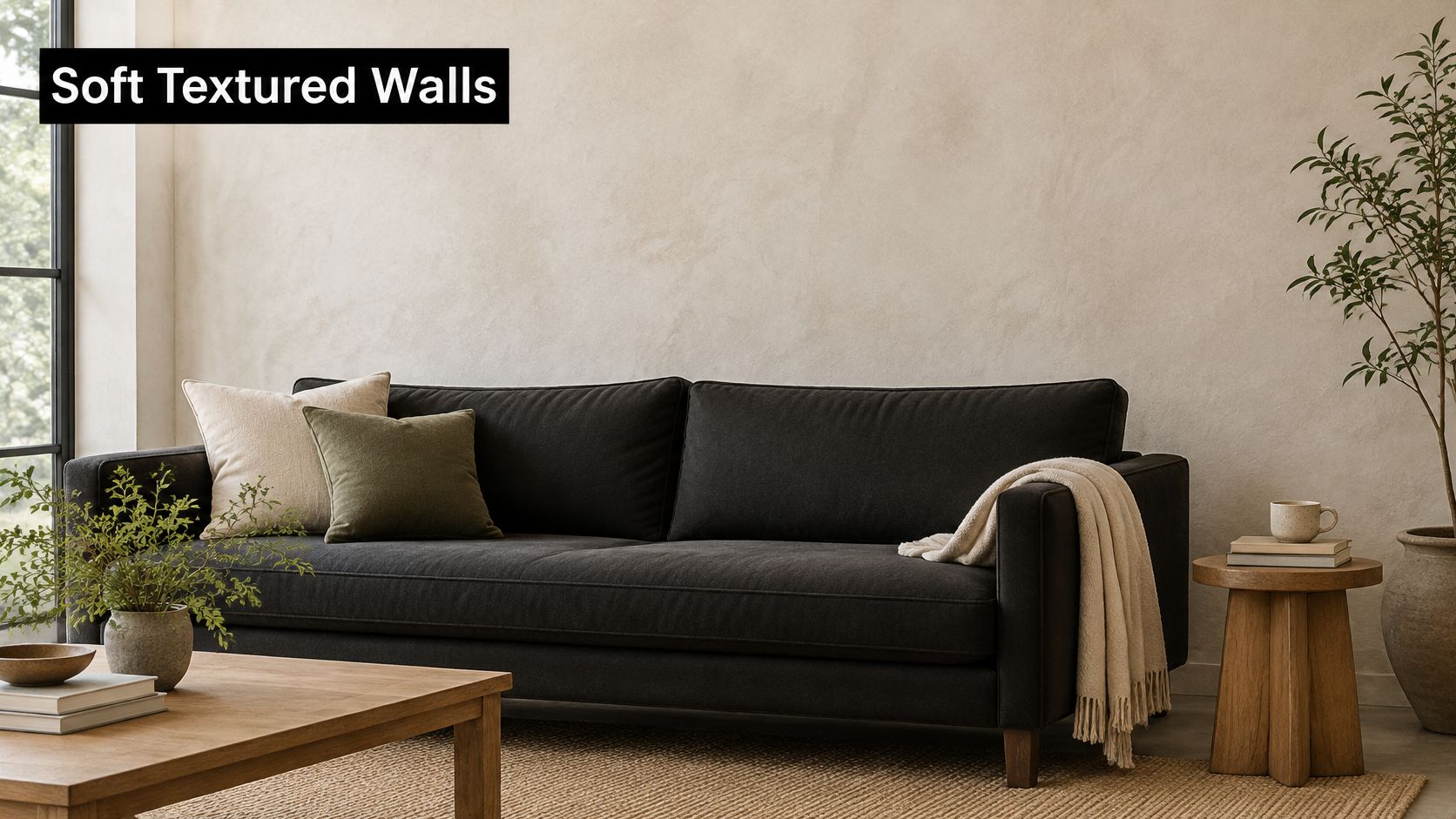
Flat paint next to black furniture gives you a hard edge and nothing else. Limewash and troweled plaster are mineral finishes with depth and movement, so the wall shifts through the day and the black sectional in front of it stops looking like a slab.
Black earns that kind of wall. A 2017 Harris Poll conducted for Sherwin-Williams surveyed 2,201 U.S. adults and found that 32% selected black as a favorite color, and the figure rose to 41% among millennials (Sherwin-Williams color preference insights). People who choose black furniture aren't shopping for a plain white box.
What the finish actually does
Limewash is thin, chalky, and mottled. It reflects light unevenly, which is exactly what a black headboard or a black dining table needs behind it. Troweled plaster goes further, with a physical surface that catches raking light and hides the seams a painted wall can't.
Sample on the actual wall, not in the sample book. A warm putty that looks perfect in the studio can turn pink at 5 p.m. on a west-facing wall in Phoenix, and gray on a north wall under an overhang.
- Choose a warm undertone: cream, bone, or clay. A cool gray-white beside black is the fastest way to make a room feel like a showroom.
- Start with one feature wall: a full-room plaster application is a real line item, and one wall behind the seating group delivers most of the effect.
- Sequence it before trim: plaster changes wall thickness at the reveal, so casings and baseboards get detailed around it, not after it.
Wall work at this level usually lives inside a bigger scope, and luxury renovations and remodels is where that sequencing gets settled before a plasterer is ever booked.
3. Natural Stone with Dramatic Veining
Stone separates a black room that feels expensive from one that just feels dark. A veined marble, a honed travertine, or a book-matched onyx carries soft cream, gray, or gold movement, and the black lounge chair in front of it gets a luminous backdrop instead of a flat one.
The market treats black as an accent for the same reason. In the 2025 U.S. Houzz Kitchen Trends Study, black was selected for 18% of contrasting island countertops, a share that fits a focal element rather than a default (Houzz kitchen trends study).
Honed or polished in a desert house
Honed finishes on islands and dining tables hide the fine scratches that show up on polish and knock down glare in rooms with hard afternoon sun. Polished slabs still belong on a bathroom vanity or a fireplace face where nothing slides across them.
- Pick slabs in person: veining is the design, and photographs hide both the good movement and the ugly seam.
- Balance drama with calm: one dramatic stone per sightline. Pair it with linen, matte wood, and quiet upholstery.
- Watch outdoor stone: in full Arizona sun, dark stone gets hot enough to be unusable barefoot. Keep exterior surfaces light and ventilated.
A typical composition puts black dining chairs at a honed marble-top table in an open kitchen, with a lighter stone on the island so the two surfaces don't fight. On a built-to-suit project, these slabs get chosen before cabinet drawings are final, because the counter edge detail depends on the material. If you're specifying a black stone-top coffee table, stone table advice from Critelli Furniture covers base and top proportions.
4. Warm Natural Wood Tones
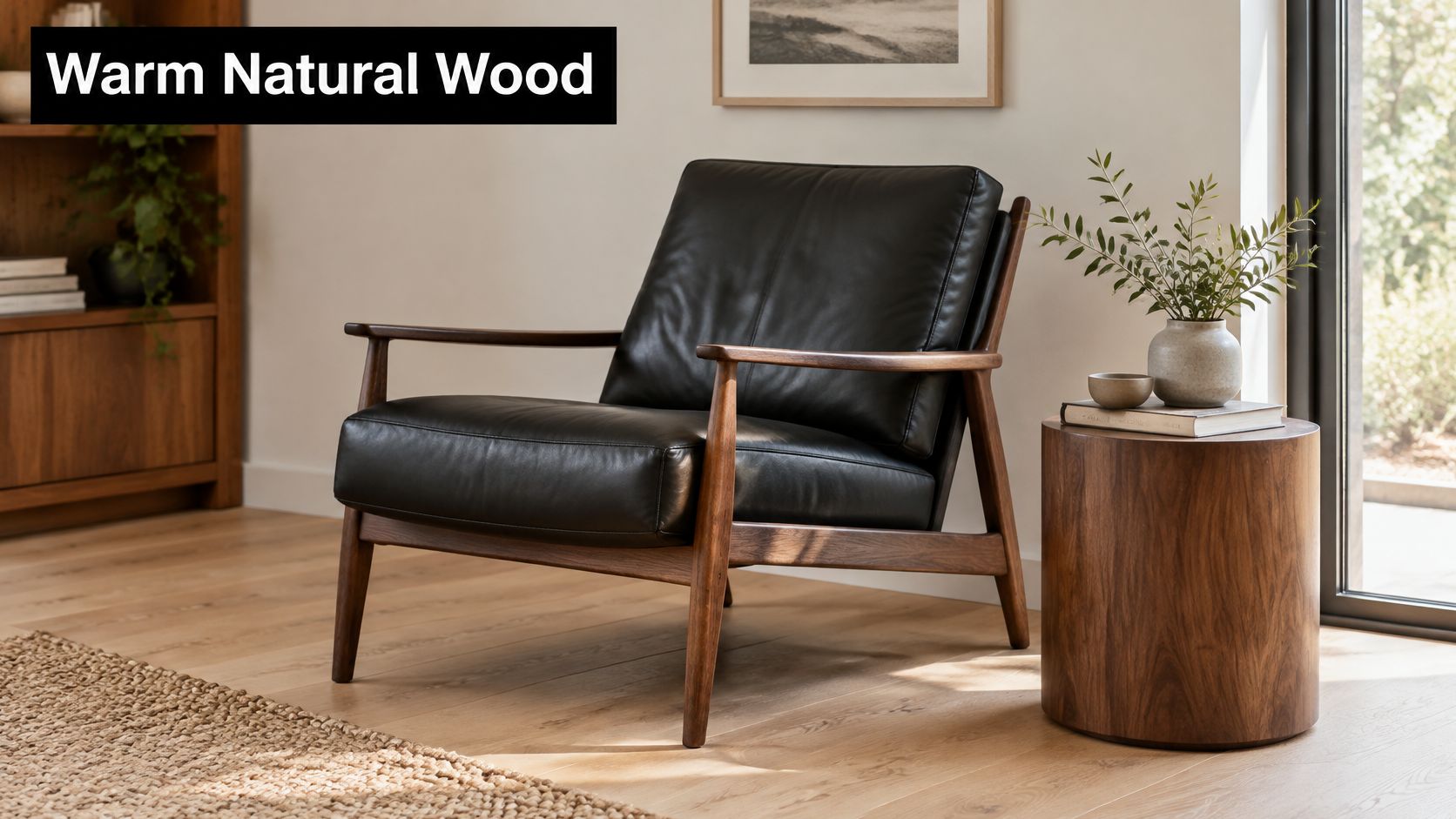
Wood is the most forgiving partner black has. Grain gives the eye something to travel along, warmth offsets the cool cast of a matte black finish, and the organic irregularity stops a room from feeling engineered.
Designers are moving further in that direction. Chocolate brown was planned by 33% of surveyed professionals for 2026, nearly double its 17% share in 2022, while white, slate gray, and black fell into single-digit preference levels (1stDibs interior design trends 2026). Warm browns generally soften black more readily than cool gray does, because they add warmth without competing with the furniture's contrast.
Match the black, not just the wood
A blue-black finish wants cool companions: pale ash, soap-finished oak, gray stone. A brown-black or espresso finish sits naturally with walnut, bronze, caramel oak, and cream limestone. Getting that undertone match right matters more than the species.
Desert light makes a mismatch easy to spot. Arizona afternoon sun pours across floors at a low angle and exaggerates color temperature, so a cool ash floor under an espresso frame reads wrong within minutes. Check samples in the actual room at 3 p.m., not under showroom LEDs.
Trade-off: Walnut is gorgeous and it moves. In a room with big west glass and Arizona summer heat, specify a stable engineered core or a rift-sawn veneer on a quality substrate, or plan on seasonal gapping.
- Limit to two species per room: white oak and walnut, or oak and ash. Three reads as a furniture showroom.
- Warm wood with matte black: warm woods next to matte black is the combination that holds. Warm wood next to mirror-gloss black can look dated.
- Use wood in built-ins: walnut shelving behind a black media console does more for the room than another chair would.
5. Layered Luxe Textiles: Bouclé, Cashmere, and Velvet
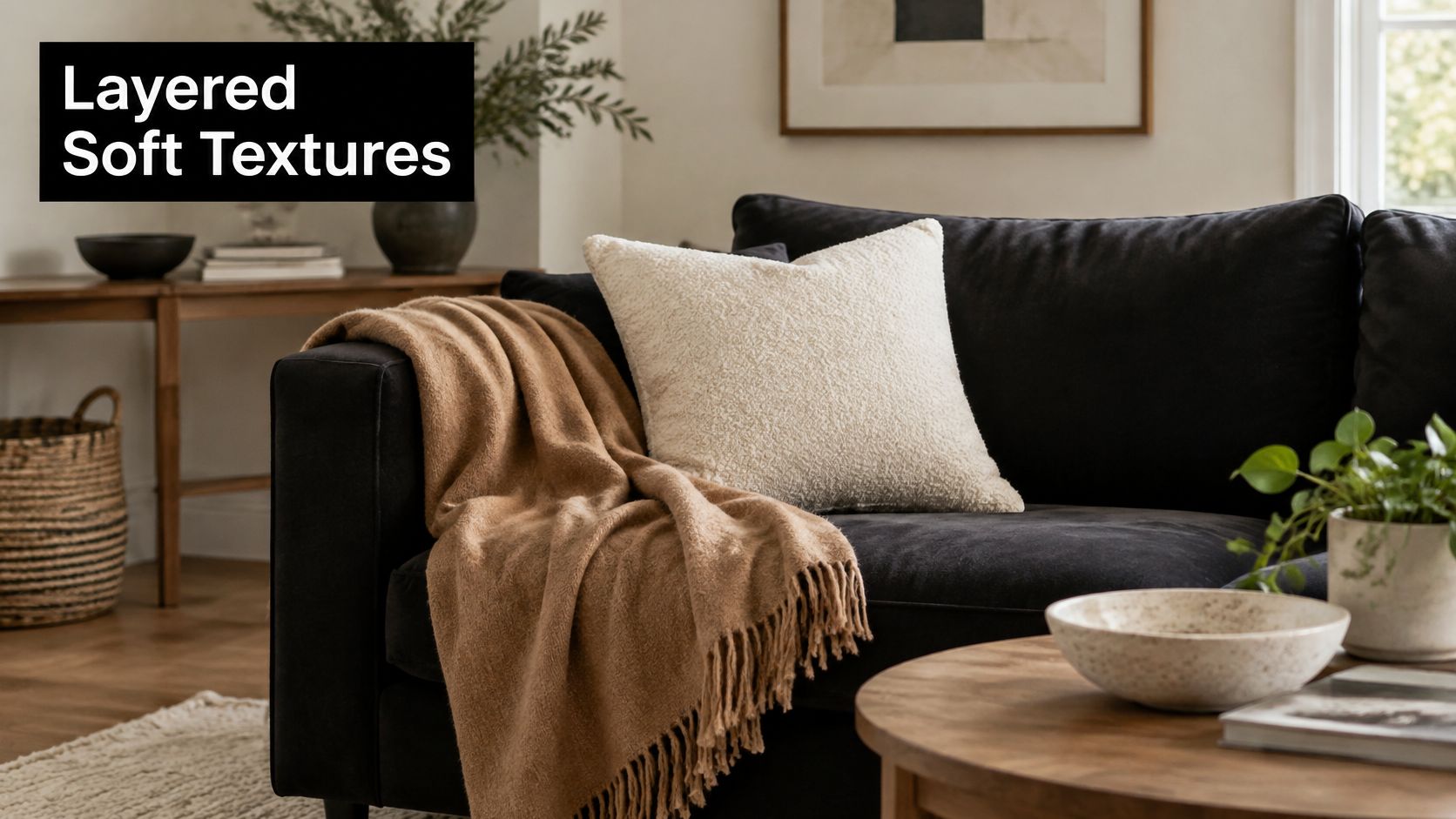
Upholstery is where black furniture is judged comfortable or severe. Ivory bouclé, camel cashmere, oatmeal linen, and taupe velvet give the eye somewhere soft to rest, and they make a black sofa feel like a piece you'd sit on for an evening.
The neutral direction has broad support. In 2024, 61% of 131 interior designers surveyed expected camel and beige tones to appear prominently (Apartment Therapy's designer survey). That's the palette black wants around it: warm, low-contrast, tactile.
Texture does the work color usually does
Bouclé is nubby and reflects light in small points. Velvet absorbs it and glows at the fold. Linen wrinkles, and that slight crumple is what keeps a black room from looking staged.
Trade-off: velvet is the fastest route to expensive-looking black upholstery, and it fades fastest in a sun-blasted room. Solution-dyed acrylics and high-performance blends now read close enough to wool that the swap is worth making on any piece facing west glass.
- Hold the palette to three or four neutrals: ivory, oatmeal, camel, taupe. More than that and the room loses its calm.
- Vary the scale: one smooth surface, one nubby, one soft pile in each seating group.
- Specify performance where it counts: family rooms and anything within a few feet of a pool door.
6. Sculptural Statement Lighting in Brass, Glass, and Stone
Light is the variable most homeowners under-budget and most color advice ignores. Light Reflectance Value runs from 0 for absolute black to 100 for pure white, and Benjamin Moore Black sits at just LRV 2.48, meaning it reflects very little light (Benjamin Moore color specification). A black console under one ceiling fixture and a black console lit from three directions are not the same object.
Arizona interiors make this split obvious. A great room washed in western sun carries black furniture beautifully until dusk, then goes flat the moment the light drops. The rooms that work after dark are the ones where lighting was treated as a finish selection, with the same weight given to flooring or stone.
Layer the light, then place the fixture
Ambient, task, and accent sources at different heights. Warm-white lamps flatter black surfaces, and pale stone, mirrors, cream upholstery, or satin metal bounce light back into the room. A dim room calls for a lighting hierarchy that was designed rather than assembled, and black furniture rewards that effort more than any lighter finish does.
Practical rule: on a remodel, rough-in and dimmer locations get decided on paper. Adding a circuit for a chandelier after drywall is a patch, not a plan.
Material choice does the second half of the job. An arc lamp arching over a black lounge chair in a reading corner, or alabaster pendants above a black dining table, both work because glass, alabaster, and stone diffuse light instead of pointing it. Diffused light wraps around a black frame and shows its silhouette. A bare downlight just erases it.
7. Organic Greenery and Large-Scale Botanicals
Nothing softens black like something alive. A sculptural olive tree or a wide fiddle-leaf fig throws irregular leaf shapes against the straight lines of a black credenza, and the green reads as a color even when the rest of the room stays neutral.
What survives an Arizona interior
Light level decides the plant, not the photograph. Olive trees want a bright, south or west exposure with airflow and a large root run, which means they belong in a great room or a courtyard-facing corner, not a hallway. Fiddle-leaf figs tolerate interior conditions better but sulk in a draft from a supply vent.
- Plan drainage into the build: a large planter needs a liner, a saucer, and a floor that can take occasional water. Set that detail during design, not on move-in day.
- Echo the architecture: stone or matte ceramic planters that pick up the same travertine or limewash as the walls.
- Go preserved where light is low: a preserved botanical arrangement on a black entry console holds its shape for years with no water and no sun.
A great room with black leather seating and steel-framed doors to a courtyard gets its best result when the outdoor planting is chosen with the interior palette.
8. Curated Gallery Art and Jewel-Tone Accents
Art gives a black room a focal point and a personality, and it solves a problem color alone can't. A large canvas above a black sofa draws the eye up and away from the mass at floor level, and a deep emerald or sapphire accent adds richness without lightening the base.
Homeowners are more cautious than designers about dark anchors, which is why the art and accents matter. In a 2016 Better Homes and Gardens survey of nearly 400 homeowners, 43% said black was among the colors they were least likely to use for home decorating, yet 36% preferred neutral walls with colorful furnishings or accessories (Home Accents Today coverage of the 2016 color survey). Black furniture plus strong accents is a mainstream preference, not a niche one.
Scale and hanging height
Hang a piece so its center sits at eye level for a standing adult, roughly 57 to 60 inches from the floor, and scale it to the furniture: about two-thirds of the sofa width reads balanced. A sapphire-toned Persian rug under a black dining table, or emerald velvet pillows against black upholstery, gives one dominant tone and one supporting accent.
Where it goes wrong: gallery walls of small matching frames above a substantial black piece look like decoration rather than collection. One large work beats six small ones.
For homeowners building a collection, our gallery shows how art and finishes are resolved together in finished rooms.
Eight Pairings for Black Furniture at a Glance
| Pairing | Main Effect | Best Room Fit | Key Consideration |
|---|---|---|---|
| Warm Brass and Aged Gold Metal Accents | Adds warmth, contrast, and a soft glow | Living room or kitchen | Repeat a consistent brass finish in a few accents |
| Warm Plaster and Limewash Walls | Softens black furniture with subtle texture | Living room or bedroom | Skilled application is costly; test warm-toned samples in the room |
| Natural Stone with Dramatic Veining | Adds luminous contrast and a sense of luxury | Kitchen, dining room, or fireplace area | Stone can be costly and may need sealing and careful maintenance |
| Warm Natural Wood Tones | Brings organic warmth and visible grain | Living room or media room | Limit wood species and account for movement in dry climates |
| Layered Luxe Textiles: Bouclé, Cashmere, and Velvet | Adds softness, comfort, and tactile depth | Living room or family room | Keep colors restrained and choose durable fabrics for frequent use |
| Sculptural Statement Lighting in Brass, Glass, and Stone | Creates focal points and adds atmosphere | Reading corner or dining room | Check fixture scale, installation needs, and dimming options |
| Organic Greenery and Large-Scale Botanicals | Softens geometric lines and brings a natural feel | Great room or entry hall | Choose plants suited to indoor light and Arizona's dry climate |
| Curated Gallery Art and Jewel-Tone Accents | Adds personal color and a striking focal point | Living room or formal dining room | Use a restrained color palette and scale art to the furniture |
Bring Your Black Furniture Palette to Life
The rooms that work combine two or three of these layers in one composition: brass against warm oak, limewash behind bouclé and cashmere, veined stone under an alabaster pendant. In strong Arizona light, black furniture reads sharper than it does in a showroom, so the surrounding finishes need enough warmth and texture to keep the room grounded.
Keep the movable pieces flexible and commit the fixed ones early. Paint, pillows, art, and plants can change in year three. A plaster feature wall, a relocated chandelier circuit, or a wall moved for a stone-clad fireplace carries demolition, electrical, and permitting consequences.
That timing matters in Scottsdale. A luxury whole-house remodel generally requires permitting when the work changes walls, adds or relocates electrical, plumbing, or mechanical systems, involves structural improvements, or includes demolition, while cosmetic work with no structural change may be exempt (City of Scottsdale home improvement guidance). Projects under 1,000 square feet limited to a single story may qualify for the minor addition/remodel submittal process, though moving walls or adding electrical or plumbing still requires permits at that scale (Scottsdale permit services).
For a luxury whole-house remodel or custom build in Scottsdale, Paradise Valley, Arcadia, or the Biltmore corridor, Emery Lane Homes provides design-build services around those early decisions. The company will collaborate with your existing designer or its curated network of experienced architects and interior designers, lets you select or approve finishes, fixtures, flooring, cabinetry, countertops, and other design elements depending on the phase of construction, and designs to a philosophy of no wasted space and no unnecessary luxury. Full furnishing sits outside its core scope, but it can connect you with trusted staging and interior furnishing partners from past projects.
Bring the black furniture you already own into the plan before finishes are locked. Room dimensions, sightlines, lighting locations, stone, and wood tones should be specified around it so the palette arrives as one finished room. Start the conversation at Emery Lane Homes.