

Almost every buyer asks how long the warranty lasts. Almost none ask what the warranty will be able to prove. That second question decides whether a claim gets honored, and the answer gets written into the construction record long before anyone picks up a phone.
Read the warranty as a description of how the house was assembled: which systems were permitted, which inspections were signed off, which components the builder agreed to stand behind and for how long. Framed that way, the question of what does a new home warranty cover stops being a mystery clause in a closing folder and becomes a map of your home's construction decisions.
What a New Home Warranty Covers at a Glance
A new home warranty generally covers defects in workmanship and materials on permanent components installed during construction. The Federal Trade Commission's guidance on new home warranties distinguishes this protection from a service plan that repairs or replaces aging appliances. Coverage periods and covered items depend on the written warranty, so use the table as a general guide, then compare each row with your contract.
| Coverage category | Typical period | Components included |
|---|---|---|
| Workmanship and materials | 1 year | Windows, siding and stucco, doors and trim, drywall and paint, concrete floors |
| Plumbing, electrical and HVAC systems | 2 years | Plumbing lines and fixtures, electrical wiring, heating, ventilation and air-conditioning |
| Major structural defects | Up to 10 years | Conditions such as structural failure or a roof at risk of collapse that make the home unsafe |
The periods form a rough ladder: shorter coverage often applies to visible finishes, while longer periods may apply to systems or structural conditions. For example, the first tier may address a sticking window or separating trim. The systems tier may apply to plumbing, wiring, or heating and cooling components. Structural coverage is narrower in scope, even when its period is longer.
Where the clock actually starts
The written warranty sets the start date. It may be tied to substantial completion, a certificate of occupancy, or delivery of the warranty document, so don't assume it begins at closing. Find the start date and expiry for each tier, then record them alongside the home's construction documents.
A habit worth building early: In your first week in the home, mark each coverage expiry on a calendar and set a reminder 60 days ahead. That gives you time to report a developing issue before the applicable period ends.
A warranty file is more useful when its dates sit beside the records that explain how the home was built: plans, permits, approvals, and inspection documents. When weighing a ground-up build against a major renovation, ask each builder when the coverage schedule and inspection record are established relative to the plans. For a custom home, Emery Lane Homes' built-to-suit process is one option to explore.
Defects Versus Normal Wear Explained
Coverage turns on one question, and it isn't whether something broke. It's whether the condition reflects defective workmanship, defective materials, or a failure to meet an applicable construction standard. HUD's warranty form describes the builder's obligation as correcting equipment, material and workmanship defects supplied by the builder or its subcontractors when they fail to meet acceptable trade-practice quality standards, within a one-year period in that federal program. Trade-practice quality is the yardstick, not perfection.
That yardstick is easier to use than it sounds. A grout joint that opens up in a shower within the workmanship period because it was mixed or applied wrong is a covered defect. The same joint that fails because a shampoo bottle was dropped on it is owner damage, and the warranty won't pay. A floor drain that backs up because yard debris blocked an exterior line is a maintenance matter. Water staining that appears below a shower pan because the liner wasn't properly tied in is a construction defect, and the record of how that pan was installed is what settles it.

The test to apply before you call
Ask two things in order. Would a qualified installer have done this correctly the first time, working to accepted trade practice? And does the condition trace to how the home was built, or to something that happened after handover? If the first answer is yes and the second points to construction, you have a claim worth writing up. If either answer goes the other way, you have a repair to schedule.
Small settlement cracks in brick, tile, cement or drywall sit in a grey zone that's usually resolved by tolerance language in the document, often excluded when they stay within expected limits for a new structure. A crack alone doesn't prove a defect.
The condition has to be tied to construction, not to time. A warranty that pays for aging would be an insurance policy, and builders don't sell those.
What a defensible claim needs is boring and decisive: prompt written notice, dated photographs, and a precise link between what you're seeing and how the home was built. Vague complaints about "settling" get closed. A dated photo of a stain under a specific shower pan, paired with the inspection record for that pan, gets inspected.
Common Exclusions That Surprise Homeowners
Homeowners are rarely blindsided by what's covered. They're blindsided by what isn't. Read this table as a pre-flight check on your own expectations, then go find the matching language in your document.
| Situation | Usually covered? | Why it matters |
|---|---|---|
| Defective window installation | Yes, within the workmanship period | Installation error is a construction defect |
| Small settlement cracks in tile, cement or drywall | Often excluded or within tolerance | Expected movement of a new structure |
| Temporary housing and moving costs during repairs | Usually no | Consequential expenses are commonly excluded |
| Appliances with manufacturer warranties | Not under the builder warranty | Manufacturer or separate home warranty may apply |
| Damage from owner neglect or missed maintenance | No | Owner-caused damage is not a construction defect |
Claims are uncommon in aggregate. WarrantyWeek's annual industry report recorded an average warranty claims rate of 0.74% of sales and an average accrual rate of 0.76% for U.S. homebuilders in 2023. When a claim does land, the exclusion list decides the outcome, which is why disputes cluster there.
Consequential costs, the exclusion nobody reads
The builder may be obligated to repair the defective work and nothing else. Temporary housing, moving expenses and other costs you incur while the repair happens are commonly treated as consequential expenses and excluded, even when the underlying repair is fully covered. Budget for the possibility that a covered repair still costs you a week in a hotel.
Cracks measured against a tolerance
Tolerance language is where reasonable people disagree. A hairline crack in a slab or a grout line is often quantified in the warranty, and the builder will measure against that number rather than argue about how it looks. Ask during the walkthrough how your builder measures and documents a tolerance decision, and whether you'll receive the measurement in writing. That answer tells you more about the warranty's real behavior than the marketing summary does.
Appliances sit outside the builder warranty entirely, since the manufacturer's warranty governs the product and the builder's covers installation. Register every appliance and HVAC unit with its manufacturer on move-in day, before anything fails.
Go through the exclusions section with a pen before closing. Mark the three items that would matter in your household, and ask the builder how each one is applied in practice.
Permit Records and a Claim From Start to Finish
Permitting in Scottsdale follows the scope of work, not the price tag. The City of Scottsdale's permit services page states that projects involving construction, structural improvements, demolition, or adding or relocating mechanical, electrical or plumbing systems require permits, with examples that include remodels and additions, swimming pools and spas, patio covers, accessory buildings, guest homes, exterior alterations, and work on electrical wiring or plumbing and gas systems. Cosmetic work with no structural change and no skilled trades generally doesn't need one. Applications go through Scottsdale SPUR and start with plan review against the adopted codes.
That distinction is the warranty's backbone. Permitted structural, electrical, plumbing, mechanical and building-envelope work should live in its own file, separate from finish-only improvements, because those permitted items are the ones a warranty manager can trace and inspect.
Eight months after move-in, a stain
A homeowner finishes a whole-house remodel near Paradise Valley and moves in. Eight months later, a water stain spreads across the ceiling below the primary shower pan. The sequence that follows is the whole lesson.
She photographs the stain at two distances with the date visible, checks the warranty document, and finds plumbing carries the two-year period. Within the same week she sends written notice through the channel the document specifies, attaching the photos and the plumbing rough-in inspection record pulled from her permit file. The warranty manager inspects, confirms the leak traces to installation rather than use, and schedules the repair. Her hotel stay during the work isn't reimbursed, which is the standard consequential exclusion.
Two decisions carried that claim. Written notice went out in week one, while the evidence was fresh and the tier wide open. And the permit file showed exactly what was installed and inspected, so the conversation was about a documented installation instead of competing memories. On our projects, we manage all permitting, city and HOA approvals, and construction oversight from start to finish, and that file is handed over as part of the closeout package.
Passing a city inspection doesn't convert every later problem into a warranty claim, and a warranty never substitutes for pulling the required permit. The two records do different jobs, and you want both.
How to Document and File a Warranty Claim
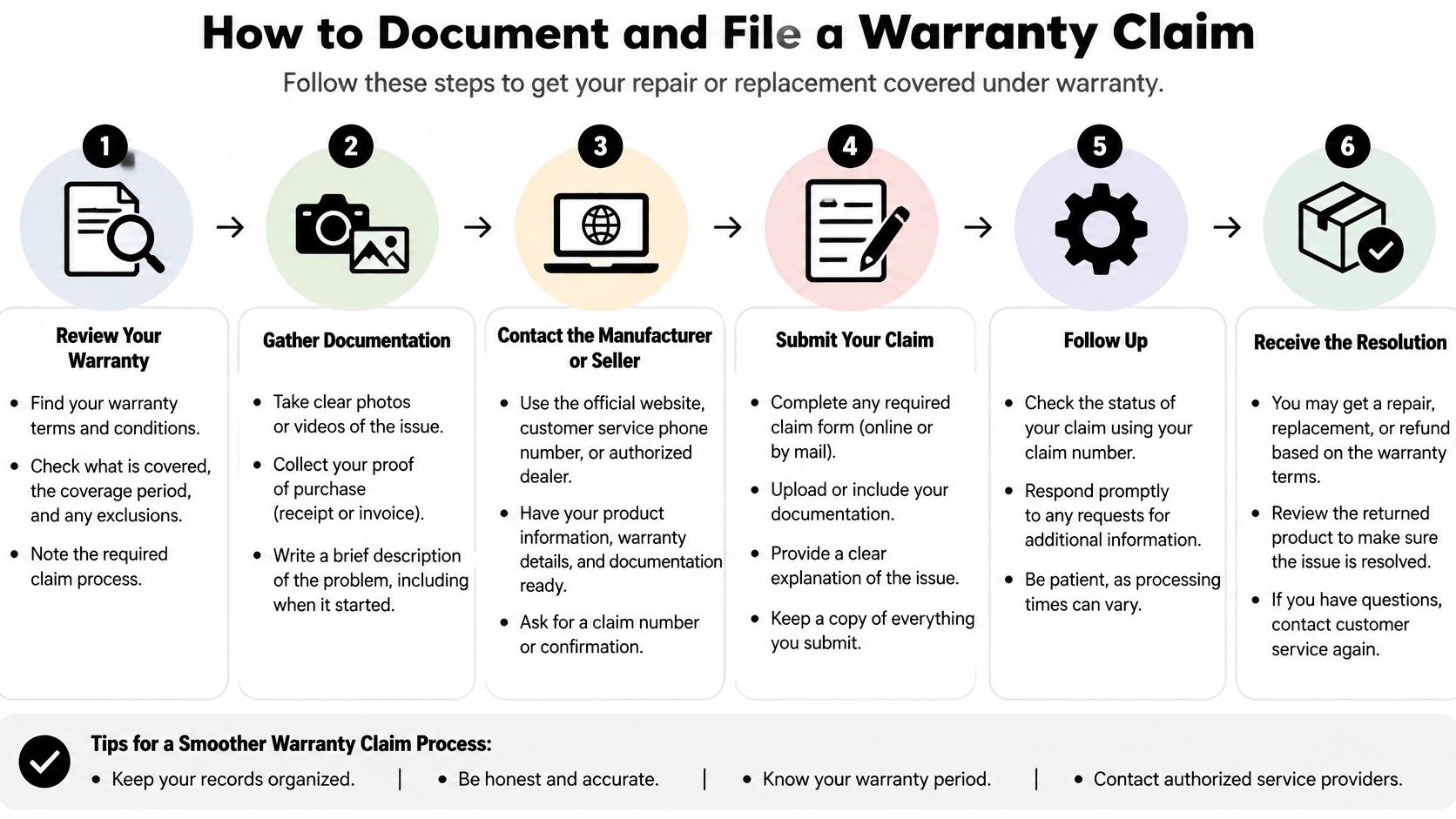
What turns a reported problem into a claim the builder can assess? A clear record links the condition, its timing, and the relevant construction details. Keep one file, organized from first observation through repair.
- Read the written warranty before closing. Record the coverage start date and the required claim procedure. The deadline and notice channel determine how a claim must be filed, so make them easy to find before a problem arises.
- Log the problem when you notice it. Note the date, room, and a plain description in a running document. This gives you a clear timeline, especially if the coverage period is approaching its end.
- Take photographs at two distances. Use a wide shot to show where the condition is and a close shot with a coin or tape measure for scale. The wider view records context; the detail can help show how the condition changes.
- Send written notice through the channel named in the warranty. A call may start a conversation, but written notice creates a dated record. Keep the sent email or portal confirmation with the file.
- Gather maintenance records. Keep service receipts, filter-change records, and notes showing that you followed the care instructions. These help clarify whether maintenance may be relevant to the reported condition.
- Describe the possible construction connection. Identify the affected material or installation, and explain what you observed without assuming the cause. Construction records and permits can help establish what was installed and inspected, much like labels in a project log.
- Save every message and report. Keep inspection findings, builder responses, and copies of your notices together. A complete timeline lets each person reviewing the claim see what was reported and when.
- Record repairs and report a failed fix in writing. Note the repair date and what was done. If the condition returns, send a new dated notice with updated photographs so the follow-up is documented.
When the builder denies the claim
Reply in writing through the warranty's specified channel. Refer to your dated notice, photographs, and relevant maintenance or construction records, then ask for the reason for the denial in writing. Keep the file until the issue is resolved or you have followed the dispute steps in the warranty. A written explanation identifies the exclusion or term the builder is applying, which gives you a specific point to review.
If you want to understand reporting and response procedures before a problem arises, read the frequently asked questions about the warranty process.
Keep one folder for dates, photos, construction records, messages, and repairs. It makes the claim's timeline easier to establish and review.
Confirm Your Warranty Terms Before You Close
Six items belong on a checklist you complete before signing, not after:
- Start date for every tier. Confirm in writing when each coverage period begins and when it ends.
- Covered components. Match the schedule to your actual selections, including stucco, roofing, windows, and each mechanical system.
- Claim procedure and channel. Know the email address or portal, and whether verbal reports count for anything.
- Repair standard. Ask what standard the repair must meet, and who verifies it.
- Exclusions list. Read every line and ask how the tolerance and consequential items get applied.
- Manufacturer warranties. Confirm which products, appliances and equipment carry their own coverage instead of the builder's.
Get the document in hand before closing rather than reading it at the signing table, when you have no time and no room to negotiate. A clear warranty package and a project binder listing coverage make verification a fifteen-minute task instead of an afternoon of guesswork.
That's the standard we hold ourselves to. Every client receives a full warranty package and a project binder outlining warranty coverage, every build comes with a two-year warranty, and a dedicated Warranty Manager is involved from the final walkthrough, handles warranty requests, and follows through until issues are resolved. Paul Drake serves as our Warranty Manager, which means the person who walks the house with you at completion is the same person who owns your request afterward. If you're comparing homes, browse our move-in ready luxury homes and ask each builder for the warranty documents in writing before you sign.
Emery Lane Homes builds custom luxury homes and delivers whole-house remodels across Scottsdale, Paradise Valley, Arcadia and the Biltmore corridor, with a documented warranty package and a project binder handed over at closeout so every coverage period, inspection and permitted system is traceable. A dedicated Warranty Manager, Paul Drake, walks each home with you at the final walkthrough and stays on your file until any issue is resolved, backed by our two-year warranty. If you want warranty coverage you can prove, visit Emery Lane Homes and ask us to walk you through the exclusions and the claim steps before you commit to a contract.