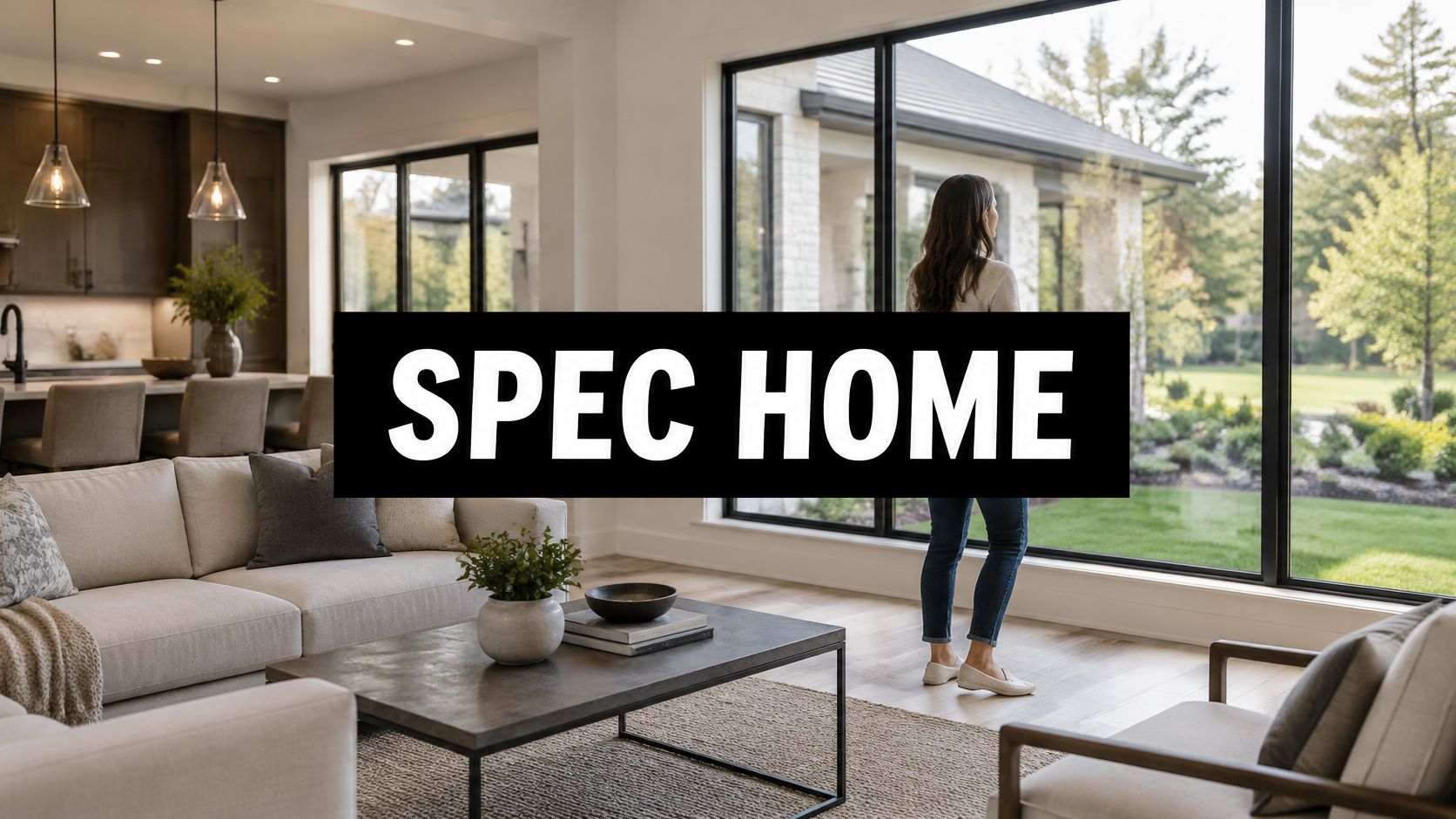
You're standing in a finished kitchen, opening drawers and looking toward the backyard. The house feels ready for your family, but you didn't choose the floor plan, the appliances, or the builder's construction decisions. Before you make an offer, you need to understand what you're buying, what you can still change, and what deserves more scrutiny than the beautiful finishes.
What a Spec Home Means and Why Builders Start Early
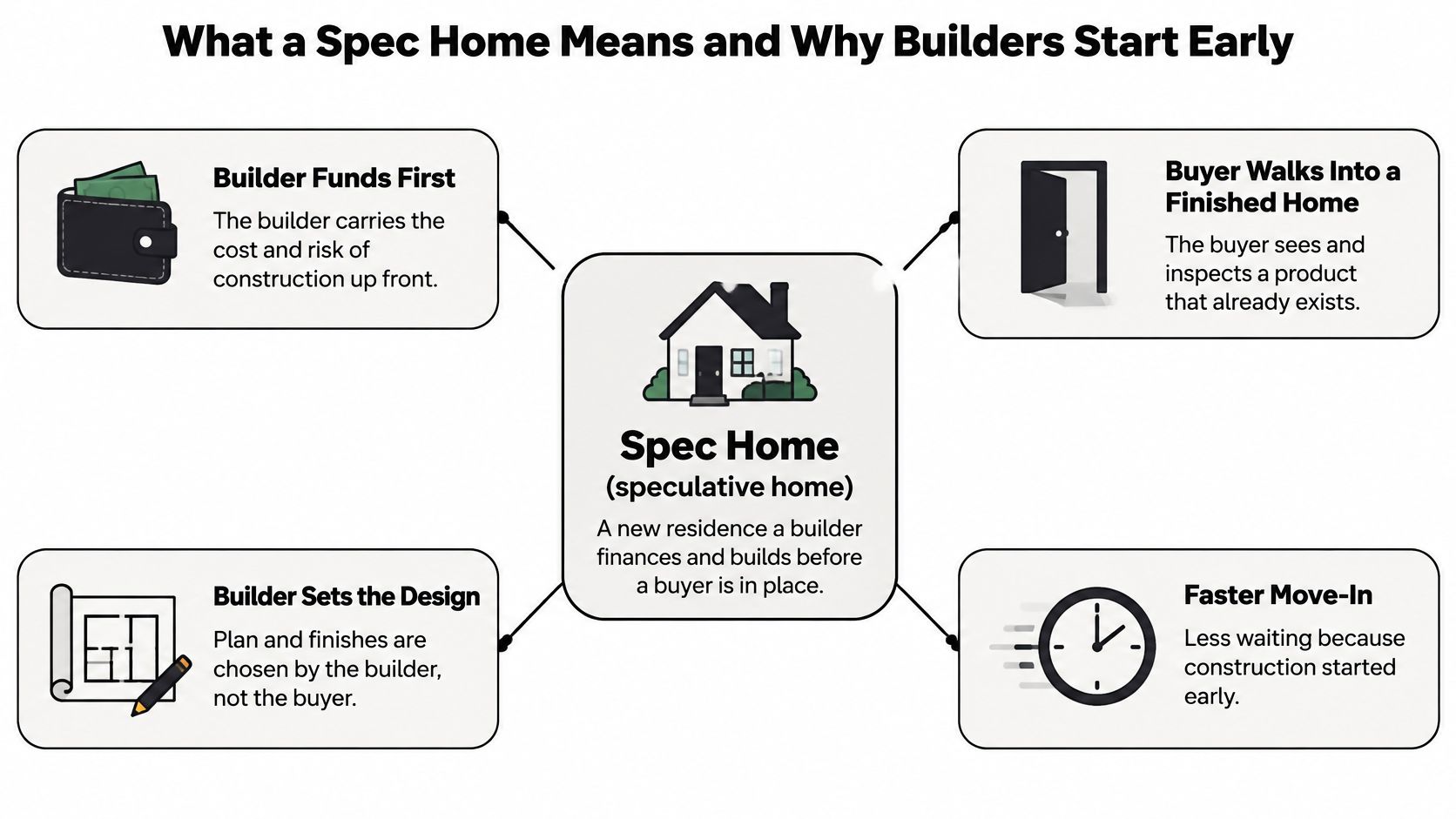
That kitchen might belong to a spec home, short for speculative home: a new residence a builder or developer finances and builds before a specific buyer has committed to it. The builder starts early because they expect someone will want the finished property.
Think of a custom build as a suit cut to one client's measurements. A spec home is closer to a designer's collection produced ahead of the season. The designer makes the choices first, then customers decide whether the finished work suits them.
The builder selects the lot, floor plan, exterior architecture, materials, fixtures, and construction schedule. Instead of responding to one household's instructions, the builder anticipates what buyers in that location will value.
Spec describes the business model, not the quality
A residence can have distinctive architecture, carefully selected stone, advanced mechanical systems, and an exceptional neighborhood setting while still being a spec home. Luxury and spec aren't opposites. The defining question is whether construction began without a committed end buyer.
Nor must the property be finished before it sells. The U.S. Census Bureau and HUD's new residential sales reporting distinguishes new houses by sales status and construction stage, including completed homes and properties still under construction.
The builder commits capital before receiving the eventual purchase proceeds. For a plain-language introduction to that financing structure, LendingXpress's ground up construction loans explained offers useful context for understanding how construction gets funded before a home is ready.
Listing test: Ask when construction started and who chose the plan. Those answers tell you more about whether a property is a spec home than its price or architectural style.
Spec Home Versus Custom Build Side by Side
A spec home prioritizes speed and a visible finished product; a custom build prioritizes your control over the design.
Spec home versus custom build at a glance
| Factor | Spec home | Custom build |
|---|---|---|
| Who selects the lot and floor plan | Builder | Buyer, working with an architect or designer |
| Design changes during construction | Limited to the builder's options | Buyer-directed, with change orders |
| Who carries financial risk until sale | Builder | Buyer, through lot and construction financing |
| Time to move in | Finished or nearly finished homes can be toured and bought now | Typically months to over a year from planning to completion |
| Price certainty | Fixed price on the finished product | Budget set in planning, can shift with scope changes |
| Resale appeal | Broad design aims at a wide buyer pool | Personal features can narrow the buyer pool |
Read the timeline row first
If you need to relocate soon, start with homes you can physically evaluate. Walk from the garage to the pantry, test furniture placement in the living room, and check whether bedroom separation works for your household. You're deciding whether an existing arrangement fits, not drawing a new one.
A completed spec home also lets you assess daylight, ceiling proportions, and the relationship between indoor and outdoor rooms without translating drawings into an imagined experience. But changing an awkward hallway or relocating a bathroom may mean dismantling finished work.
A custom buyer can address those questions before construction. That control comes with responsibility for decisions, approvals, and the financial exposure associated with the lot and construction arrangement. A signed scope doesn't eliminate the consequences of later changes.
For buyers exploring a built-to-suit approach, the useful question isn't whether more choices sound appealing. It's whether a specific design requirement justifies the additional planning and coordination.
Read the resale row against your holding plans
Say your family wants a large hobby studio instead of a conventional secondary living area. That could be exactly right for daily life, but a future buyer might prefer another bedroom or gathering space.
Personalization isn't a mistake. It should be intentional, especially if you expect to sell rather than stay indefinitely. Consider whether a specialized room can serve another purpose without major reconstruction.
Among luxury home builders, evaluate who can explain these trade-offs without treating either path as automatically superior. If your deadline is firm, weigh readiness first. If your layout requirements are firm, weigh design control first. Don't buy a finished house assuming a substantial redesign will be quick or inexpensive.
How a Spec Home Moves From Lot to Move-In
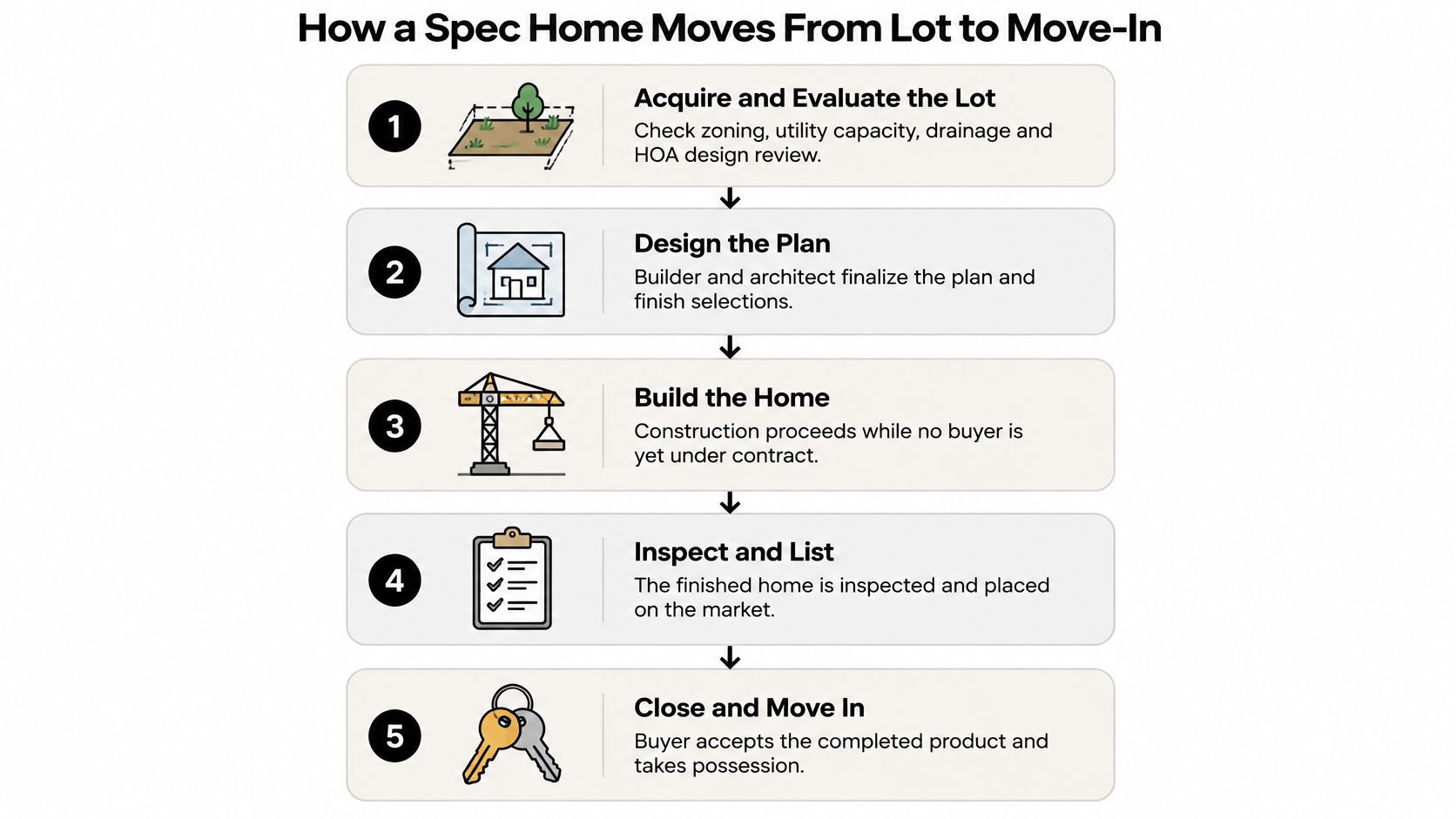
You tour a house that already has cabinets, a covered terrace, and a proposed closing date. Those rooms are the product of choices made before you arrived. A spec home works like a car built on the line before your order: the builder selected the lot, the plan, and the systems, then moved the project through review. Speed is what you gain. Design control is what you give up. Acceptance is the work that remains: confirm contents, permits, and how the house performs.
Follow the six stages in order. Each one settles decisions a late buyer cannot cheaply reopen.
Acquire and evaluate the lot. The builder checks zoning, utility capacity, drainage, access, and any HOA design review before committing to a plan. A desirable address does not mean every footprint or outdoor feature will fit. Until the builder buys the lot, that site risk sits with the builder, not with a buyer who has not yet appeared.
Design the plan and architecture. The builder and design team set circulation, room sizes, privacy, and indoor-outdoor connections for an intended buyer group. A gathering room beside a covered terrace may fit that market better than a formal room that sits empty. Once those walls are drawn for a hypothetical buyer, your later preference for a different layout is a change order, not a blank page.
Coordinate engineering, site planning, and budget. Structure, grading, equipment locations, and outdoor planning have to share the same site instead of competing for it. Emery Lane Homes develops the detailed budget after the design and architectural phase, once plans and specifications are available, and typically before permitting begins. That budget prices a defined scope. It does not price a redesign you have not yet requested.
Submit plans for permits. The City of Scottsdale's single-family construction process uses the Scottsdale SPUR portal, with plans reviewed against adopted codes and ordinances before permits are issued. Match the property address and the proposed work to the permit details. A general claim that “everything is approved” is not the same record.
Build and inspect in phases. Crews work in a set sequence. Permitted work is inspected against the approved plans, and inspections are scheduled within the permit's time limits. Many buyers enter after permitting or during construction. Ask which work is finished, which inspections remain, and whether a finish change would open completed walls. Depending on the phase, you may still select or approve finishes, fixtures, flooring, cabinetry, and countertops. You generally cannot redraw the plan without paying for work already in place.
Complete final acceptance and close. Confirm final inspection status, collect the certificate of occupancy and closeout documents, and then coordinate the sale. “Nearly complete” or “move-in ready” describes a sales stage. It does not replace a written list of what is left before possession. Treat this stage like accepting delivery of that finished car: walk the systems, compare them with the approved drawings, and keep the paperwork that proves the city signed off.
Match the listing to the public record
Scottsdale's permit system lets users view permit details, track inspection information, and obtain documents such as permits and certificates of occupancy. Read those records before you rely on a proposed closing date.
A finished-looking room shows that construction has moved forward. Required approvals and corrections are a separate question, answered by inspection results and the certificate of occupancy.
Keep the address, permit identifiers, approved drawings, and final documents in one property file. Sales emails describe the house. The permit file shows what was authorized.
The Market Risk Behind Every Spec Home
A spec home is an inventory bet made before demand is known. The builder spends money expecting a future buyer to pay enough to cover the project and produce a return.
In April 2025, the U.S. Census Bureau and HUD estimated 504,000 new single-family houses for sale, against a seasonally adjusted annual sales rate of 743,000, equivalent to approximately 8.1 months of supply. That calculation divides inventory by the annualized sales pace and multiplies by the months in a year.
In plain language, listed inventory would theoretically last that long if buyers continued purchasing at that pace. A higher supply figure means more inventory relative to current sales, not a guaranteed waiting period for an individual house.
Carrying costs continue after construction stops
Truist's third-quarter 2026 building-products newsletter describes unsold new-home supply near 9.3 months, a post-2009 high, and builders curtailing speculative construction during the first half of 2026. That national context helps explain builder caution, but it doesn't establish the negotiating position of a particular Scottsdale property.
The builder's exposure includes land, labor, materials, construction-loan interest, taxes, insurance, utilities, and maintenance. A completed home can still consume cash while the builder waits for a buyer.
As The Detroit News explains in its coverage of unsold spec homes, standardized plans and preselected finishes can reduce construction coordination, while unsold inventory creates continuing financial pressure. Once permits, framing, and mechanical rough-ins are established, late customization can undermine that efficiency.
The buyer faces a different risk: paying for upgrades that future purchasers won't value equally. Expensive selections aren't automatically evidence of equivalent resale value.
Census reporting by region and construction stage helps distinguish completed inventory from homes still in the pipeline. For anyone considering luxury residential investment participation, project feasibility should include the potential holding period, not just the proposed sale price.
Before judging a spec price, ask:
- Local absorption: How quickly are comparable homes selling?
- Competing inventory: What alternatives will buyers compare with this property?
- Expected holding period: How long could you own it before needing to sell?
How to Verify a Move-In-Ready Spec Home
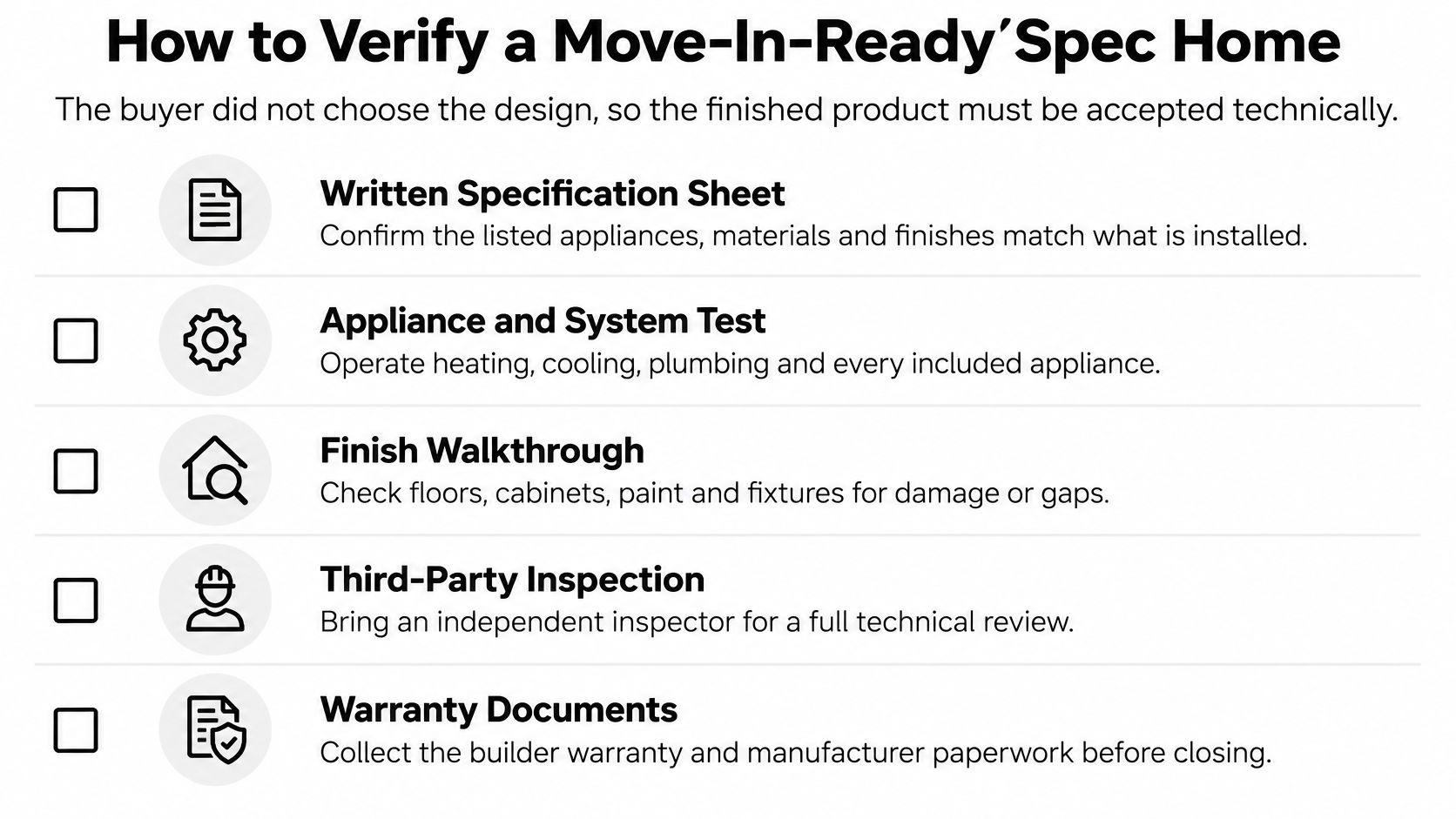
You didn't direct the design, so your job is technical acceptance of the finished product. That means checking what the contract promises, what's installed, how the systems perform, and what documentation transfers at closing.
Chase's guide to buying a spec house explains the builder-led model and the importance of evaluating the property and its specifications. Treat the purchase as more than a finish walk-through, even when everything appears new.
Contract and contents
Start with a written specification sheet attached to, or clearly incorporated into, your agreement. Compare it with the actual house, not just the brochure or furnished photography.
Move-in-ready spec home verification checklist
| Item | Why it matters |
|---|---|
| Written specification sheet | Defines what the advertised price actually includes |
| Permitted material substitutions | Shows where the builder can change details after you sign |
| Appliances, lighting and window treatments | Confirms named fixtures are installed, not just shown |
| Landscaping and smart-home equipment | Prevents disputes over items that may be treated as extras |
| Drainage, roofing and waterproofing | Affects long-term ownership more than finishes |
| HVAC sizing, insulation and window performance | Drives comfort and operating cost for years |
| Independent inspection | New construction is not automatically defect-free |
| Approved plans, permit history and inspection records | Helps verify the build against the permitted design |
| Certificate of occupancy and final acceptance | Documents applicable occupancy and closeout approvals |
| Warranties, lien or title checks and service path | Clarifies post-closing protection and ownership status |
Ask whether a substitution must match a named performance standard, not merely a similar appearance. Record model numbers for included appliances and equipment so there's no ambiguity about what you're purchasing.
Listing photographs also need context. Pinnacle Property Media's questions to ask property photographers can help you frame questions about how images were produced, but the contract and physical inspection determine what's included.
Performance and independent inspection
Commission an independent inspection before accepting the home. Have the inspector identify accessible system concerns and recommend specialist evaluation where needed rather than expecting a visual walk-through to verify concealed construction.
- Water management: Review grading, drainage outlets, roof details, and waterproofing concerns because water damage may begin outside the most visible rooms.
- Comfort systems: Request HVAC sizing and equipment information, insulation documentation, and window specifications rather than judging comfort from a brief showing.
- Operational testing: Run included appliances, operate plumbing fixtures, and test heating and cooling under appropriate conditions with qualified guidance.
- Finish acceptance: Mark damaged flooring, cabinet alignment issues, paint defects, and incomplete fixtures on a written punch list.
Financing and closing
Ask your lender how the appraisal evaluates the builder's contract price and whether comparable sales support it. Confirm the closing date, the completion obligations tied to that date, and the contract conditions governing any deposit refund.
Before signing closing documents, collect approved plans, permit and inspection records, applicable occupancy documentation, product warranties, and title or lien information reviewed by the appropriate closing professionals. Require a dated punch list identifying who completes each item and how completion will be confirmed.
When reviewing available luxury homes, keep a separate acceptance file for each property. Finish with a pre-closing orientation and a written service path identifying whom to contact, how to submit a warranty issue, and what documentation to retain.
Common Myths About Spec Homes
Misunderstandings about spec homes often come from treating a financing and development model as a quality label. Mansion Global's explanation of spec homes describes builder-controlled development and the need to evaluate plans, specifications, systems, and comparable sales rather than making assumptions from the category alone.
A spec home must be cheap or low quality
Builders can pursue efficient circulation, durable finishes, flexible rooms, strong indoor-outdoor connections, and appropriately scaled kitchens at a luxury level. Distinctive materials and location don't change the speculative nature of the project.
Test question: Does the written specification sheet identify the actual materials and brands, rather than relying on descriptions such as premium?
I won't have any design choice
You still choose whether the plan and specifications suit your household. An unfinished property may also have selections available, but don't confuse a remaining finish choice with permission to reconfigure the house.
Test question: Which finishes and inclusions can I still change before closing, and will you document the cost and schedule consequences?
A spec home is always cheaper
The sale price must account for land, construction, design and other soft costs, financing expense, overhead, and profit. The builder's decision to proceed without a buyer doesn't establish that the finished house is a bargain.
Likewise, a higher asking price doesn't prove better function. Assess whether the rooms, storage, and daily routes justify the price for your needs.
Test question: How does this price compare with recent comparable sales in the same neighborhood?
A finished new home doesn't need an inspection
A polished interior doesn't establish the condition of concealed systems or resolve incomplete work. Independent inspection and a usable warranty file remain important even when no previous owner has occupied the property.
Test question: Will the builder allow an independent inspection before closing and provide the warranty file in writing?
Buyer's safeguard: Replace assumptions with a document, a test, or a specific answer you can verify.
Choose the Right Path and a Luxury-Rated Builder
A household that must have keys before a school year starts is not solving the same problem as one that wants the kitchen aimed at a particular view. Name the constraint you cannot change. A similar budget does not make those two decisions the same.
Which path fits your situation
| Situation | Better fit | Why |
|---|---|---|
| Need to move in within months | Spec home | A finished product can be inspected and occupied sooner |
| Want a unique floor plan and room layout | Custom build | The buyer directs circulation, room configuration and finishes |
| Want a specific lot and views | Custom build | The buyer selects the lot before design begins |
| Buying as an investor or for resale | Spec home, after comparable sales review | Returns depend on local absorption and competing inventory |
A deadline, a particular site, and a specialized layout lead to different paths. On a spec home, the builder carried the market risk of starting without a buyer, and someone else already locked the plan. You trade redesign rights for speed, then you accept the house the way a buyer accepts a finished product: by checking what is in it. On a custom build, you carry the design decisions and the longer wait, and you choose the lot before drawings begin.
A spec purchase works like taking delivery of a completed car after another driver specified the engine and the cabin. You still confirm the paperwork, the systems, and the performance. You do not reopen the factory order.
Before you sign
Write down your must-haves. Establish your move-in date, layout needs, and budget range. Separate requirements from preferences so an impressive finish package does not distract you from an unsuitable house.
Evaluate the contractor's process. Shortlist luxury home builders with relevant design-build work, local permit history, and a documented schedule. Planning, permitting, budgeting, construction management, and delivery should be coordinated rather than treated as unrelated assignments.
Check the purchase against the market. Review comparable sales and competing inventory with qualified local guidance. The builder's spending alone does not establish what you should pay.
Document acceptance before commitment. Resolve specifications, substitutions, permits, performance of mechanical and other concealed systems, inspection access, completion obligations, and closing requirements in writing. Verbal reassurance is not a substitute for an enforceable agreement reviewed by your advisers.
If the location works but the existing home does not, luxury whole house remodeling may be the better route. Scottsdale's home-improvement permitting guidance distinguishes cosmetic work from changes involving structure or mechanical, electrical, and plumbing systems, so evaluate that alternative with a luxury-rated contractor before purchasing.
For buyers in Scottsdale, Paradise Valley, Arcadia, and the Biltmore corridor, Emery Lane Homes builds spec and custom luxury homes and also delivers luxury whole house remodeling. Buyers can purchase a nearly complete or move-in-ready luxury home. Custom clients work directly with the team and architectural partners on the floor plan, room configuration, and layout, without choosing from pre-drawn plans. Emery Lane Homes will not recommend a design idea that does not match a family's needs and goals.
Emery Lane Homes offers spec and custom luxury homes alongside luxury whole house remodeling in Phoenix metro high-end neighborhoods, including Scottsdale, Paradise Valley, Arcadia, and the Biltmore corridor. Visit Emery Lane Homes to discuss available homes, compare a finished purchase with a custom project, or plan a renovation with a luxury-rated contractor before you commit.