

Your HOA has flagged the pergola in your renovation plans, yet a similar structure stands a few doors away. Your designer needs an answer, your contractor needs direction, and the violation notice doesn't explain why your property is different. It's tempting to send neighborhood photographs and demand that the board withdraw its objection.
That reaction is understandable, but HOA selective enforcement is a proof problem, not a fairness complaint. Before you commit to redesigning a luxury whole house remodeling project or contesting a fine, you need a reliable comparison, a dated enforcement record, and control of every response deadline.
What HOA Selective Enforcement Means for Homeowners
HOA selective enforcement means an association applies the same covenant, architectural rule, leasing restriction, or fine inconsistently to homeowners in materially similar situations. The central question is whether the board has a legitimate reason for treating those owners differently. Think of a referee who calls fouls against only one team, even though both teams play under the same rulebook.
Say you receive a violation notice for a new pergola while your neighbor's similar structure has gone unchallenged for years. That discrepancy deserves investigation, but appearance alone doesn't establish that the HOA acted improperly.

The same-rule test
The homeowner generally needs to establish that comparable violations were known or reasonably discoverable but went unaddressed. The association may identify a meaningful distinction, such as different site conditions, a changed restriction, a new enforcement policy, a safety concern, or a condition it hadn't previously discovered.
Courts commonly examine violation notices, board minutes, photographs, fine histories, approval records, and enforcement timing. A neighbor's verbal assurance that nobody complained isn't a substitute for those records.
Practical rule: A similar-looking improvement is a candidate for comparison, not automatic permission to build.
Uneven enforcement can also raise fair-housing concerns when its effects fall disproportionately on a protected group, even without proven discriminatory intent. The Foundation for Community Association Research's Creating Harmony report found that 1% of residents reported having an outstanding discrimination claim against their association. That figure concerns discrimination claims, not the nationwide frequency of selective enforcement.
For luxury properties, architectural review creates many opportunities for disputed judgment calls. Remodels, casitas, landscaping, setbacks, and exterior design all involve property-specific conditions. Luxury home builders and owners should therefore distinguish between an objection they dislike and a decision that treats comparable properties differently without adequate justification.
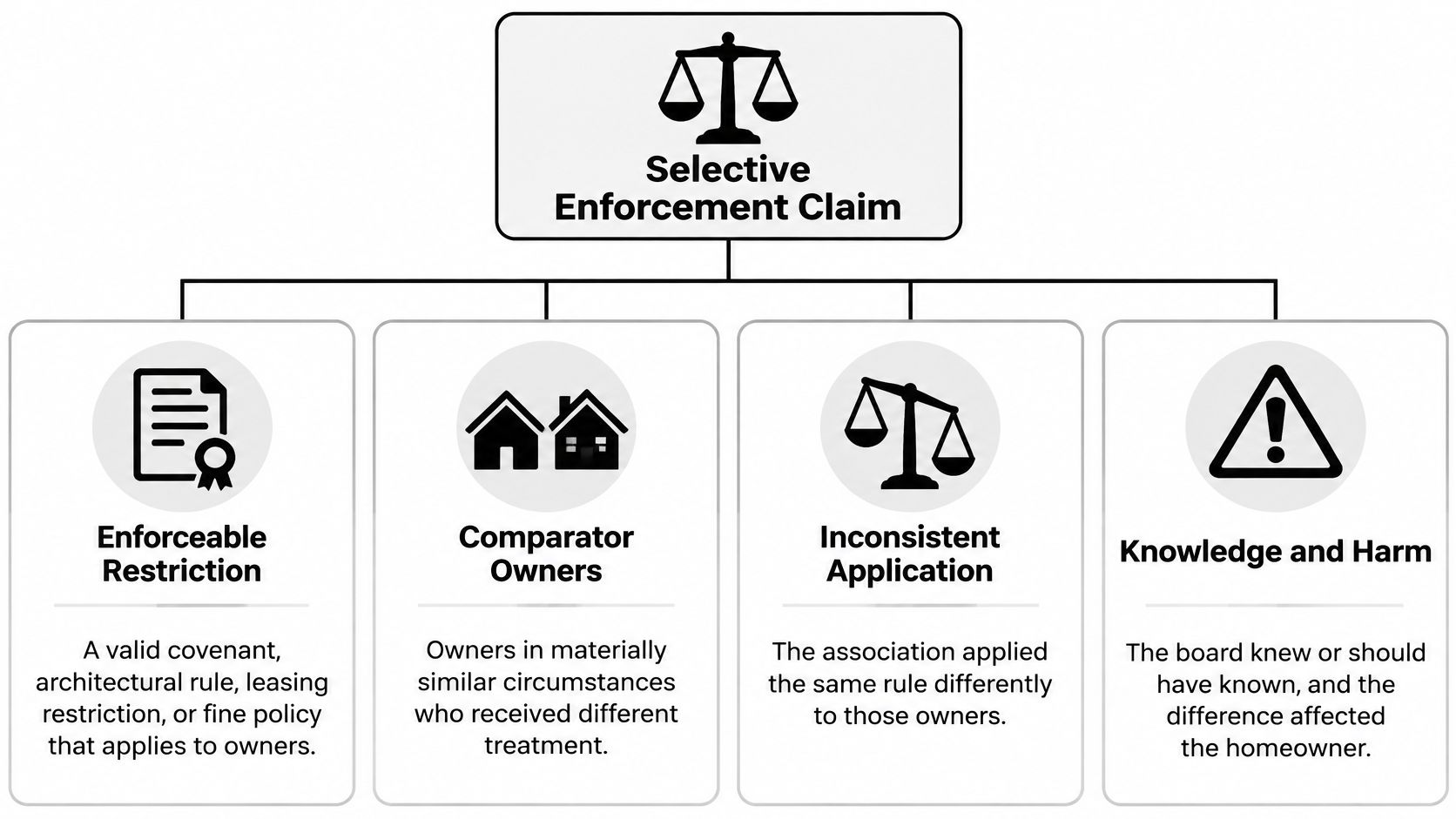
The Four Elements a Strong Comparison Needs
Finding an overlooked violation isn't the same as establishing a persuasive case. You need a comparator set, meaning identified properties that can withstand scrutiny under the same governing restriction and relevant circumstances.
The Lowndes analysis of selective covenant enforcement offers a useful evidence framework, although its Florida discussion shouldn't be mistaken for an Arizona legal test.
Build the comparison around the restriction
- An enforceable restriction. Identify the covenant or properly authorized rule governing your property. Preserve the actual text, not just management's description of it.
- Substantially similar conduct. Compare the same type of fence, addition, patio, or exterior alteration. An unrelated landscaping violation doesn't establish inconsistent treatment of your roofline.
- HOA knowledge. Look for complaints, minutes, inspection photographs, or correspondence establishing what the board knew. Visibility may support an inference, but a documented communication is stronger.
- Materially different treatment. Establish the difference between your enforcement history and the comparator's history. An absence of visible construction changes doesn't prove an absence of notices.
Consider covered patios on similar lots. Yours faces the street; the other sits behind a privacy wall. If the restriction addresses street-facing appearance, that concealed patio may be a poor comparator even if its dimensions match yours.
Similarity also involves location, timing, physical characteristics, and claimed impact. A structure that obstructs sightlines or creates a materially different nuisance may not support your argument.
Comparator scoring matrix
Treat these entries as a hypothetical screening exercise, not findings about actual properties.
| Comparator | Same rule | Similar conduct | HOA knowledge | Treatment difference | Verdict |
|---|---|---|---|---|---|
| Lot 12 covered patio, visible from street | Yes | Yes | Dated photos and board minutes | No fine issued | Strong |
| Lot 7 fence on same street | Rule text unconfirmed | Yes | Written notice to board | Fine issued | Gap: confirm rule text applies |
The fence entry needs another check: if that owner also received a fine, identify what treatment differed before relying on it.
For organizing evidence, weighing alternatives using Documind's approach can help you compare candidates against consistent criteria. It isn't a substitute for legal analysis.
List each candidate, mark the supported elements, and leave unsupported conclusions unresolved. Written notice identifying the comparator helps establish actual board knowledge from that point forward, but it doesn't prove what the board knew earlier.
Defenses an HOA Can Raise and How to Answer Them
The board's strongest response may be straightforward: your property isn't materially comparable. Before escalating, test that response against the documents rather than assuming it's an excuse.
Uneven enforcement doesn't automatically cancel an association's ability to enforce later. The Arizona Supreme Court's reasoning in Whitaker v. Holmes, discussed in this Arizona judicial publication, distinguishes remote or relatively harmless historical violations from a later violation producing substantial injury. Tolerance of a minor deviation therefore may not prevent action against a materially more harmful condition.
Common HOA defenses and the evidence that answers them
| HOA defense | What the board claims | Evidence that answers it |
|---|---|---|
| Different facts | The two properties have different conditions | Lot-level photographs, plans, and approval records showing matching conditions |
| Later report | The comparable violation was not known to the board | Dated written notices sent to the board or management |
| Voluntary cure | The comparable violation was fixed before enforcement | Dated photographs and cure correspondence |
| Grandfathering | The condition predates the current rule | Original approvals, prior rule versions, and recorded dates |
| Changed rule | The restriction was amended or newly adopted | Recorded amendments and board resolutions with effective dates |
| Safety or nuisance difference | The comparable condition has a smaller impact | Visibility, intensity, duration, and neighbor-impact records |
| Discretionary judgment | The board decided each case on its merits | Board minutes and written criteria applied to each case |
Test explanations rather than labels
A grandfathering explanation needs a timeline. Compare the original approval, construction history, and applicable rule versions. An older structure isn't necessarily exempt merely because it's old, but you shouldn't assume it was subject to your current requirements either.
A later-report defense turns on receipt and knowledge. A photograph in your personal files shows the condition existed; a dated complaint delivered to management helps establish when the association learned about it.
Voluntary cure requires similar care. If another owner corrected the problem before reaching your enforcement stage, comparing final fines alone can mislead you. Compare the sequence of notice, opportunity to correct, response, and outcome.
A board's explanation should be tested against contemporaneous records, not rejected merely because it weakens your preferred argument.
For discretionary design decisions, ask which criteria produced the different outcomes. A written explanation tied to visibility, neighboring impacts, or approved plans is more defensible than an unexplained preference.
If a defense holds, narrow your position. Use the strongest remaining comparator, challenge an unsupported approval condition, or address a procedural defect independently. Generalized statements that other owners built similar improvements won't repair a comparison with materially different facts.
Evidence to Gather Before You Escalate
Start with authority, not accusations. The association's power depends on valid governing restrictions, lawful procedures, and superior statutory protections, not a board member's preference.
The Arizona HOA enforcement-authority case overview describes Shamrock v. Wagon Wheel Park Homeowners Association, which required properly recorded deed restrictions to support mandatory membership and assessment authority. Ask whether the cited restriction governs your lot and, for a board-adopted rule, what governing authority supports its adoption.
Records to gather and what each one proves
| Document | What it proves | Where to get it |
|---|---|---|
| Recorded CC&Rs, bylaws, and rules | The restriction exists and governs the property | County recorder or HOA records |
| Violation notices sent to you and others | The rule was enforced in a specific case | Your files, or a written HOA records request |
| Dated photographs with address identifiers | Comparable conditions and visibility | Your own records, taken from public view |
| Board minutes and meeting agendas | Board knowledge and enforcement decisions | Written HOA records request |
| Architectural approvals and conditions | The approved scope for remodels, casitas, and exterior work | HOA architectural committee file |
| Fine and payment history | Whether penalties were applied consistently | HOA account statements |
| Written complaints and responses | Timing and actual notice to the board | Email and certified mail copies |
Preserve the governing documents as received, including amendments. Save complete notices and account statements rather than cropped screenshots. For committee files and minutes, request the relevant records in writing, recognizing that access to another owner's material may be subject to lawful limitations.
Build a dated enforcement log
Use a spreadsheet with a separate entry for each comparable condition. Include complaint date, notice date, rule cited, response, cure status, and the board's stated rationale. Distinguish facts supported by records from information you're still trying to confirm.
The HOA Weekly discussion of Arizona fining authority highlights why an enforcement log is more useful than informal neighborhood comparisons. It allows you to compare the association's actions at equivalent stages rather than treating every visible condition as an ignored violation.
- Keep originals. Preserve original photograph files and emails, including attachments and delivery information.
- Identify conditions. Record the address, viewing location, date, and feature shown without entering private property.
- Separate project versions. Retain submitted plans, approved revisions, conditions, inspection reports, and contractor correspondence in clearly labeled folders.
Don't wait for a final denial to organize these materials. For a manageable starting scope, build a log covering the last twelve months of actions on your street or within the relevant portion of the community, then expand it if the records justify doing so. That's an organizational recommendation, not a statutory lookback period.
Arizona Notice, Response and Hearing Deadlines
For Arizona planned communities, the enforcement process matters independently of whether your comparison is persuasive. Don't let neighborhood investigation distract you from responding to the actual notice.
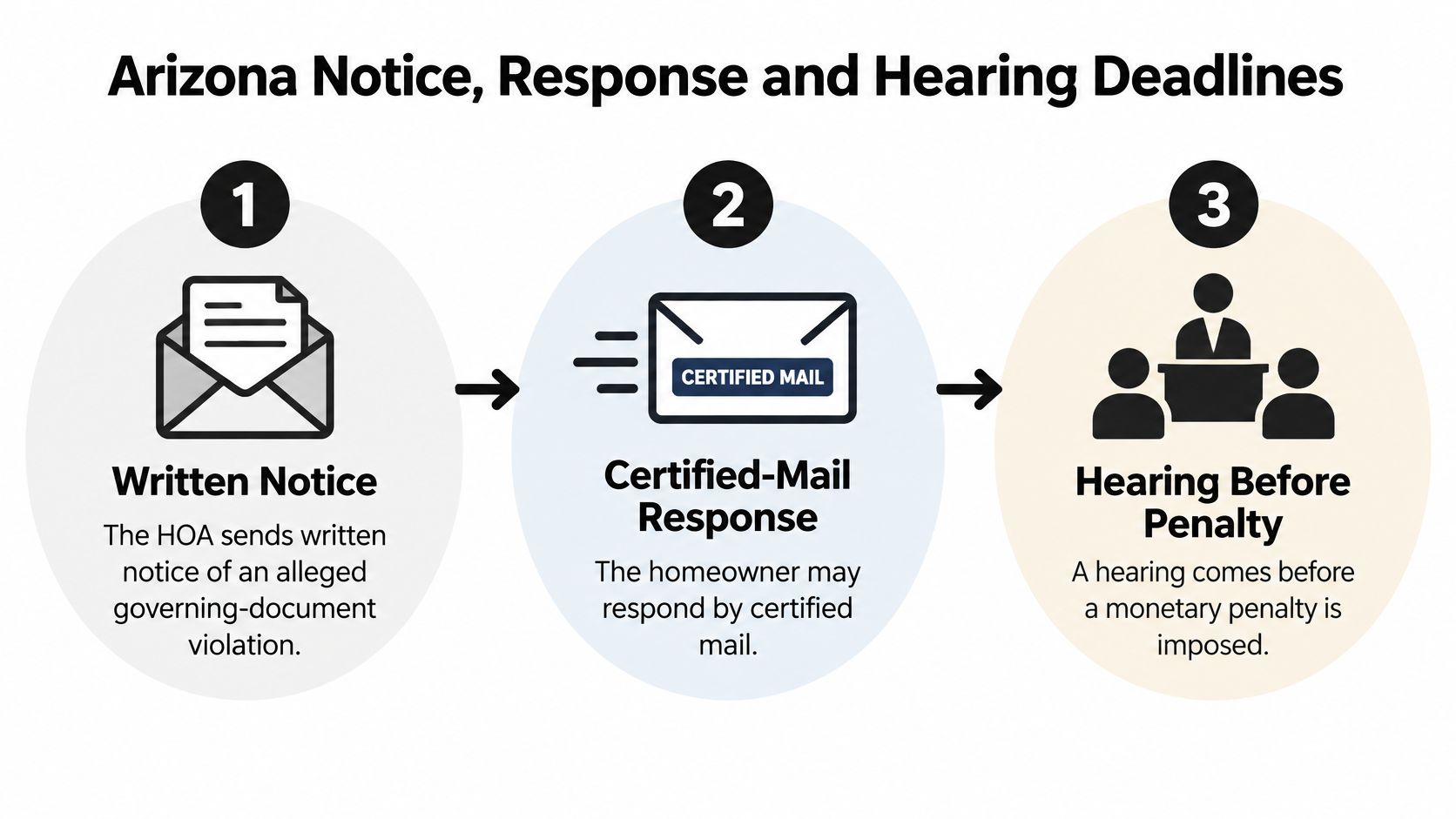
The Arizona Senate homeowners' associations brief describes a homeowner's 21-calendar-day certified-mail response period and the association's subsequent 10-business-day written-explanation requirement. Confirm how the applicable law and your governing documents apply to your specific notice.
Track the sequence
Written violation notice. The HOA provides written notice of the alleged governing-document violation before imposing a monetary penalty. Check the cited provision against your documents and identify the conduct the association wants corrected.
Certified-mail response. Respond within the applicable period if you intend to use that statutory process. Keep the letter factual: identify the property, dispute unsupported allegations, request the required explanation, and preserve your position on comparable treatment.
Written explanation. Check that the association identifies the allegedly violated provision, the date the violation occurred or was observed, the observer's first and last name, and the contest procedure. A vague statement about an ongoing problem doesn't answer every factual question.
Contest procedure. Unless the procedure was already provided, the association generally cannot proceed with enforcement until the response period expires. Preserve both the original notice and later instructions so the sequence can be reviewed.
Opportunity to be heard before a penalty. Request the available hearing process and prepare a concise submission. Don't assume that sending a dispute letter means management has scheduled your appearance.
Under Arizona Revised Statutes section 33-1803, reasonable monetary penalties require notice and an opportunity to be heard, the penalty notice must explain enforcement, and a late-payment charge on an unpaid penalty cannot exceed the greater of $15 or 10% of the unpaid penalty.
Protect the response record
Calendar deadlines separately from construction milestones. Save certified-mail receipts, delivery confirmations, envelopes, and copies of every enclosure. If you're represented, send the complete packet to counsel rather than forwarding only the latest email.
Deadline discipline: A strong factual argument doesn't excuse ignoring the process in the notice.
A missed deadline may weaken your procedural position, even when you have substantial comparator evidence. Ask for Arizona legal advice promptly if the notice is unclear, the response window is disputed, or penalties are already being assessed. Don't assume an informal conversation with management extends anything.
When Selective Enforcement Becomes a Fair-Housing Issue
A parking rule may apply on paper to every resident, yet the enforcement record can show a different pattern: disabled residents receive repeated notices while materially similar conduct goes unaddressed elsewhere. That pattern calls for closer review. The question is whether enforcement burdens people because of a protected characteristic or creates a discriminatory effect under fair-housing law.
A disparity alone does not establish a fair-housing violation. Disproportionate effects can matter even without proof of discriminatory intent, but the specific facts and applicable law determine whether a claim is supported.

Recognize the warning signs
Look for a dated pattern, not just an isolated disagreement:
- Protected-group pattern. Enforcement appears concentrated on families with children, disabled residents, racial or ethnic minorities, or another protected group.
- Unequal discretion. Owners receive different treatment for comparable guest, noise, occupancy, parking, or exterior-modification issues.
- Accommodation problems. The association disregards a disability-related accommodation request or processes it only as an ordinary violation.
The Legal 500 discussion of Washington State Human Rights Commission v. Summerwalk Homeowners Association describes a Washington ruling on post-purchase covenant enforcement under state anti-discrimination law. The decision is from another jurisdiction, but it illustrates that housing-discrimination concerns may involve fines, amenities, parking, and meetings after closing.
A disability-related accommodation request needs a separate, documented evaluation. Record the request, the association's response, and the practical effect on the household. An accommodation dispute should not be treated as merely another entry in a fine ledger.
Architectural and use disputes can affect family occupancy, renovation scheduling, financing arrangements, and resale timing. When those consequences involve disability access or another protected interest, seek advice early rather than treating the issue as a routine design disagreement.
Decide Whether to Escalate or Seek Arizona Legal Advice
Escalate in an organized sequence, not through increasingly forceful emails. The objective is a usable written decision and a proportionate response, whether that means correcting a condition, revising a plan, or challenging enforcement.
- Confirm deadlines. Calendar the notice, response, hearing, and requested cure dates.
- Assemble the file. Finish your enforcement log, document inventory, and strongest comparator entries.
- Request reasons in writing. Ask the board to identify its factual basis and explain meaningful differences between properties.
- Use the internal process. Submit a focused packet and state the outcome you want, such as reconsideration of a condition or withdrawal of an unsupported penalty.
- Evaluate a fair-housing complaint when appropriate. If a protected-class or accommodation issue appears, consider a state civil-rights agency or federal fair-housing agency with qualified advice.
Know when counsel should take over
Involve an Arizona-licensed attorney when the HOA threatens a lien, a substantial penalty, a stop-work demand, or denial of construction approval. A strong comparator record or a potential fair-housing issue also warrants specific advice. Counsel needs the actual CC&Rs, applicable statutes, approval history, and communications, not just a summary of why the outcome feels unfair.
For covered construction projects, the Arizona construction-review legislation requires a final design-approval meeting with an opportunity for the owner or agent to attend, at least two formal on-site reviews, and written deficiency reports within two business days after each review. Ask counsel whether these provisions apply before assuming an informal inspection or verbal objection resolves your project's status.
Keep legal strategy separate from project coordination
For luxury whole house remodeling, casitas, and custom builds in Scottsdale, Paradise Valley, Arcadia, and Biltmore, engage a luxury-rated contractor before design approval. Luxury home builders should coordinate submissions and preserve approval conditions, while attorneys handle disputed legal rights.
At Emery Lane Homes, we hold ROC license number 349148 and provide one point of contact for a project. We manage permitting, city and HOA approvals, and construction oversight from start to finish. Early coordination helps owners keep design decisions, approved scope, and construction communications organized without confusing contractor coordination with legal representation.
This article provides general information, not legal advice. Your property's recorded documents and specific circumstances require individual review.
Emery Lane Luxury Homes specializes in custom luxury construction and luxury whole house remodeling throughout greater Scottsdale, Arizona, and surrounding areas. Visit Emery Lane Homes before design approval to discuss your project, HOA submission requirements, and how our team can coordinate approvals and construction oversight from the start.