You're standing at a Scottsdale lot line with a site plan in one hand and a growing list of decisions in the other. The floor plan still needs refinement, the HOA may review exterior changes, and every late selection can affect structure, mechanical systems, or the budget. At that point, the question isn't whether to hire a design-build firm or a general contractor. It's who carries the risk when the drawings change, approvals take longer than expected, or two trades discover that their work doesn't fit together.
For luxury home builders and homeowners planning luxury whole house remodeling, the delivery model shapes the entire experience. It determines who controls pricing during design, who coordinates architects and trades, and who answers when a field condition conflicts with the plans. The comparison below gives you the short version. The rest of the article explains where those differences matter most in Phoenix's high-end neighborhoods.
| Decision point | Design-build | General contractor |
|---|---|---|
| Primary contracts | One contract for design and construction | Separate design and construction contracts |
| Accountability | One accountable entity | Responsibility divided between designer and builder |
| Design and construction | Can overlap | Usually sequential |
| Pricing input | Builder participates during design | Builder prices completed or near-complete plans |
| Change management | Design and construction team resolves conflicts together | Owner often coordinates designer and contractor |
| Best fit | Complex custom homes, remodels, and ADUs | Projects with complete, permit-ready plans |
| Main trade-off | Less separation between designer and builder | More design independence, more coordination responsibility |
Why Phoenix Luxury Homeowners Are Asking This Question
A Scottsdale or Paradise Valley homeowner may begin with a simple goal, such as replacing an outdated floor plan, adding a casita, or building a new residence around a difficult lot. The project becomes more complicated once the family considers setbacks, structural requirements, material selections, engineering, municipal permits, and HOA review. A design choice that looks minor on paper can affect steel, plumbing, HVAC routing, window openings, and exterior approvals.
That's why the delivery model matters more than a single finish selection. Marble, millwork, and custom lighting are visible. Risk allocation is not, but it determines who absorbs the disruption when those selections force a plan revision.
The two choices in practical terms
Under design-build, one entity contracts to provide both design and construction. The owner has one primary relationship, and the same integrated team can evaluate layout, constructability, budgeting, permitting, and field execution together. The Federal Highway Administration's design-build overview describes the method as a structure that combines design and construction under one contract and can overlap phases through fast-tracking.
Under traditional general-contractor delivery, the owner usually hires an architect or designer first, completes the plans, and then hires a general contractor to build from those documents. Design and construction remain separate contracts, which can provide an independent design voice but also leaves the owner managing the seam between the two parties.
The question Phoenix owners should ask
Don't ask only, “Which model costs less?” Ask:
- Who owns a design conflict?
- Who updates the budget when the scope changes?
- Who coordinates the HOA response and municipal submissions?
- Who handles a warranty issue when the designer and builder disagree?
- How much project management do you want to provide personally?
A general contractor can be the right choice when your plans are complete and your scope is tightly defined. For a custom residence or a whole-home remodel still evolving during pre-construction, integrated delivery usually gives the owner a cleaner chain of responsibility.
How Each Delivery Model Actually Works
The easiest way to understand design-build vs general contractor is to follow the owner's path from the first meeting through warranty service. The difference isn't merely the number of signatures. It's the point at which design, budget, construction methods, and responsibility come together.
Design-build follows one connected workflow
A design-build project typically begins with the lot, existing home, or project concept. The integrated team studies the site, develops the design, brings construction knowledge into early decisions, coordinates engineering and approvals, establishes the budget, and prepares the work for construction. Some early construction planning can proceed while design is still being refined, particularly when the scope and approval path support that approach.
The owner still makes important decisions. You approve the program, floor plan, exterior character, materials, allowances, and contract terms. The difference is that one team evaluates those choices against construction cost, sequence, and feasibility as the project develops.
During construction, the design-build firm coordinates the superintendent, subcontractors, consultants, inspections, and owner communication. If a drawing detail conflicts with a field condition, the internal team resolves the issue rather than requiring the owner to shuttle information between separate companies. After completion, the same relationship can continue through punch work and warranty service.
General-contractor delivery separates the stages
The traditional sequence begins with the owner hiring an architect or designer. That professional develops the plans, coordinates design consultants, and prepares documents for permitting and contractor pricing. The owner then solicits bids or proposals from general contractors and signs a separate construction agreement with the selected builder.
The general contractor manages construction, including subcontractors, scheduling, site coordination, inspections, and execution of the architect's documents. But the designer remains a separate contractual party. If the builder identifies an omission or conflict, the owner may need to coordinate the question, receive a design response, and approve the resulting cost or schedule effect.
The practical difference: Design-build keeps the design-to-construction handoff inside one organization. General-contractor delivery makes the owner responsible for managing that handoff.
Under both models, the owner should understand when decisions become difficult or expensive to change. With a general contractor, many core choices are locked into the drawings before the builder prices the work. With design-build, decisions are developed with construction input earlier, but the owner must choose a firm whose design judgment and building standards deserve trust.
Schedule, Cost Growth, and Risk Allocation Compared
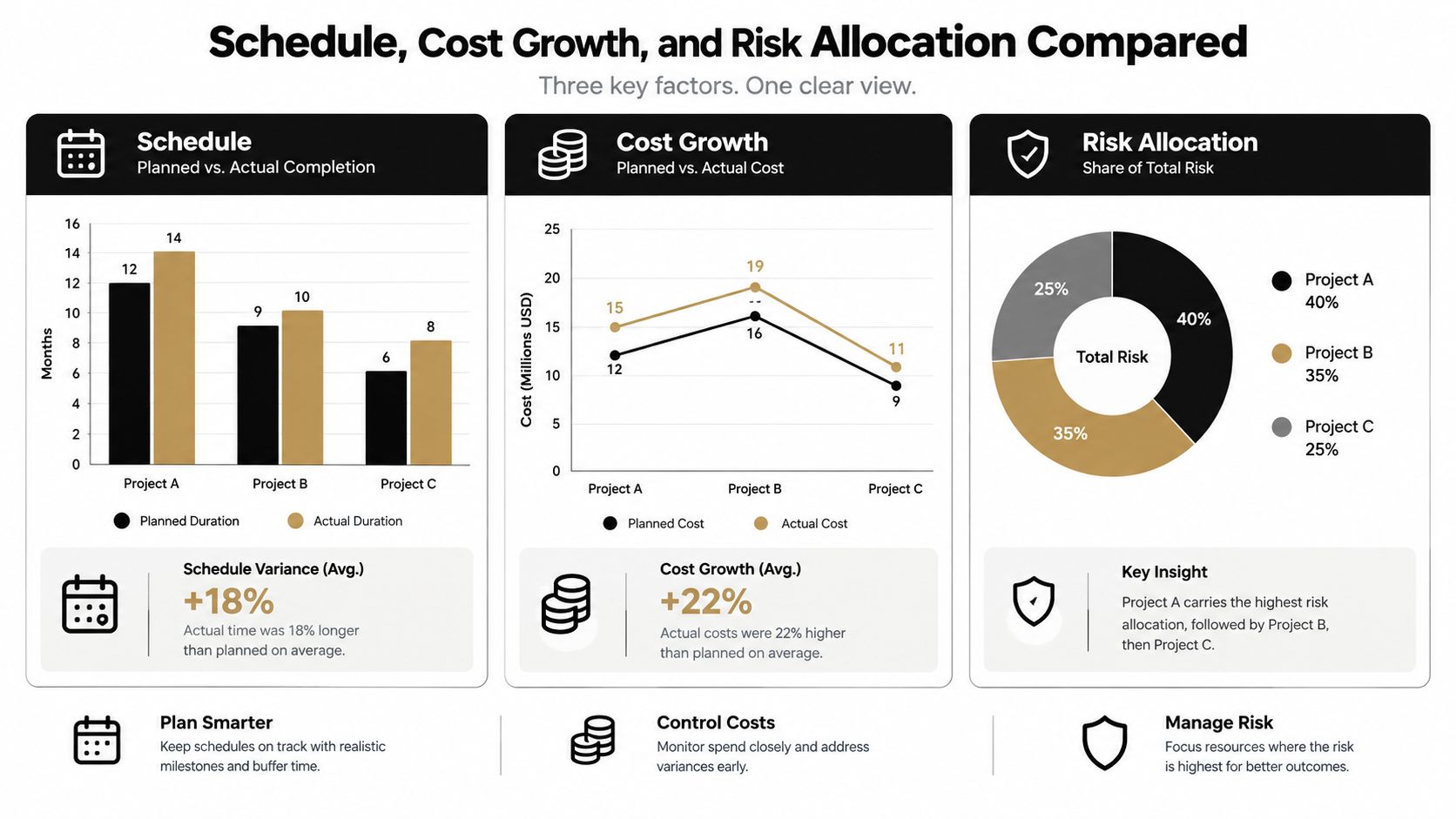
Luxury owners rarely lose control of a project because they chose the wrong faucet. They lose control when design decisions, approvals, procurement, and field coordination move on separate tracks. The important comparison is therefore not a glossy promise of a lower price. It's how each model handles schedule pressure, cost growth, and responsibility when the original plan no longer matches reality.
Schedule compression is the clearest advantage
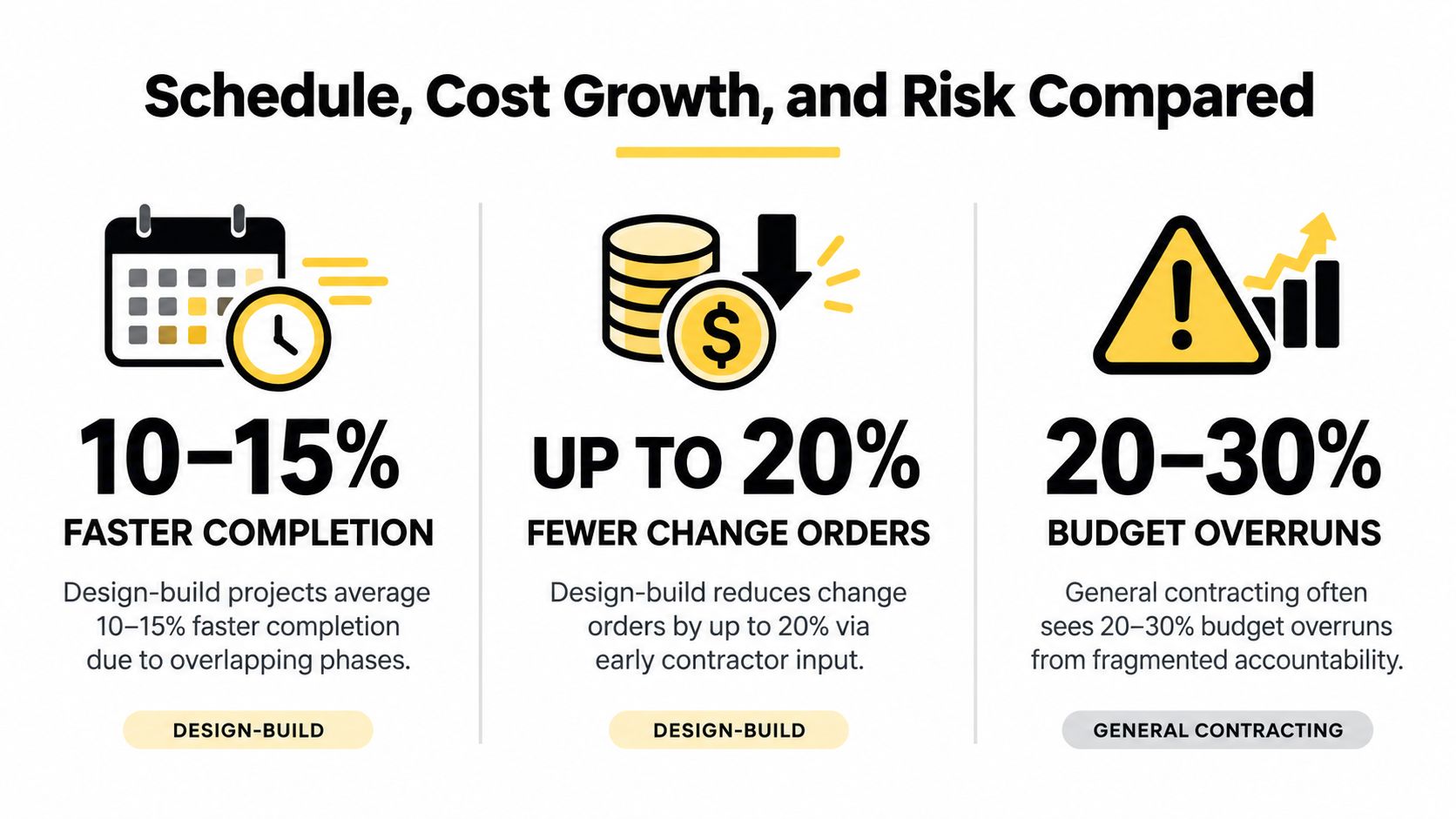
The FHWA design-build research summary reported that design-build projects were 102% faster from design through completion and had 3.8% less cost growth than design-bid-build projects in the cited industry comparison. That source also describes design-build's expansion from almost one-quarter of U.S. non-residential construction dollar volume by the end of the 2000s, with an FMI-based forecast placing the method at 47% of new construction spending across assessed segments during 2022 to 2026.
Those figures come from broader construction research, not a guarantee for a particular Phoenix residence. The useful lesson is narrower and more practical. When design and construction overlap, the owner may avoid waiting for every design decision to be completed before early planning, procurement, or selected field activities can move forward.
A separate highway-project study found a significant speed advantage for design-build over design-bid-build, while a meta-analysis identified time savings as the most consistent performance benefit rather than a universal cost advantage. The ASCE project delivery researchCO.1943-7862.0000390) supports the point luxury homeowners should remember: schedule compression is the strongest recurring argument for integration.
Cost growth depends on the project, not the label
Design-build can expose cost pressure earlier because the builder participates while the scope is taking shape. That helps the owner decide whether to adjust a roofline, simplify a structural move, change a window system, or revise a finish before the decision reaches the field.
It doesn't mean every design-build proposal will be cheaper. A well-defined general-contractor bid can be competitive, especially when an independent architect has prepared coordinated, permit-ready documents. The risk appears when the initial bid excludes unresolved design information, unclear allowances, or work that the plans don't adequately describe.
The Pankow Foundation performance review found that design-build projects had lower cost and schedule growth than CMR and DBB projects, and that design-build was equivalent to or slightly less expensive than DBB and CMR on a per-square-foot basis. That's a useful benchmark, not a promise. Site conditions, finish standards, design completeness, and owner changes still influence the final outcome.
Change orders reveal who carries the seam risk
A 2026 industry summary reported 1% to 3% change-order rates for design-build compared with 5% to 12% for design-bid-build, and cited total schedules 18% to 28% faster for design-build. Those figures appear in Terrapin Construction Group's 2026 delivery-method comparison, so they should be treated as source-specific industry reporting rather than a guaranteed result for your home.
For a luxury homeowner, the issue is not the percentage. It's the moment a change appears. A late structural revision can affect engineering, framing, drywall, cabinetry, lighting, finishes, and inspection sequencing. Under design-build, one accountable team has a stronger operational reason to identify that collision early and price the response coherently.
Ask every firm to show you its change process before you sign. You should know who writes the change, who verifies the cost, who approves it, and how the schedule impact is documented.
If schedule certainty and coordination matter more than obtaining independent bids on already-finished plans, I recommend design-build. If you value an architect who works independently from the builder and your documents are fully complete, a general contractor can still be the disciplined choice.
For owners exploring the remodel path, luxury renovations and whole-house remodeling services should include pre-construction pricing, scope review, and a clear method for handling changes before demolition begins.
Remodels, ADUs, and HOA-Heavy Neighborhoods
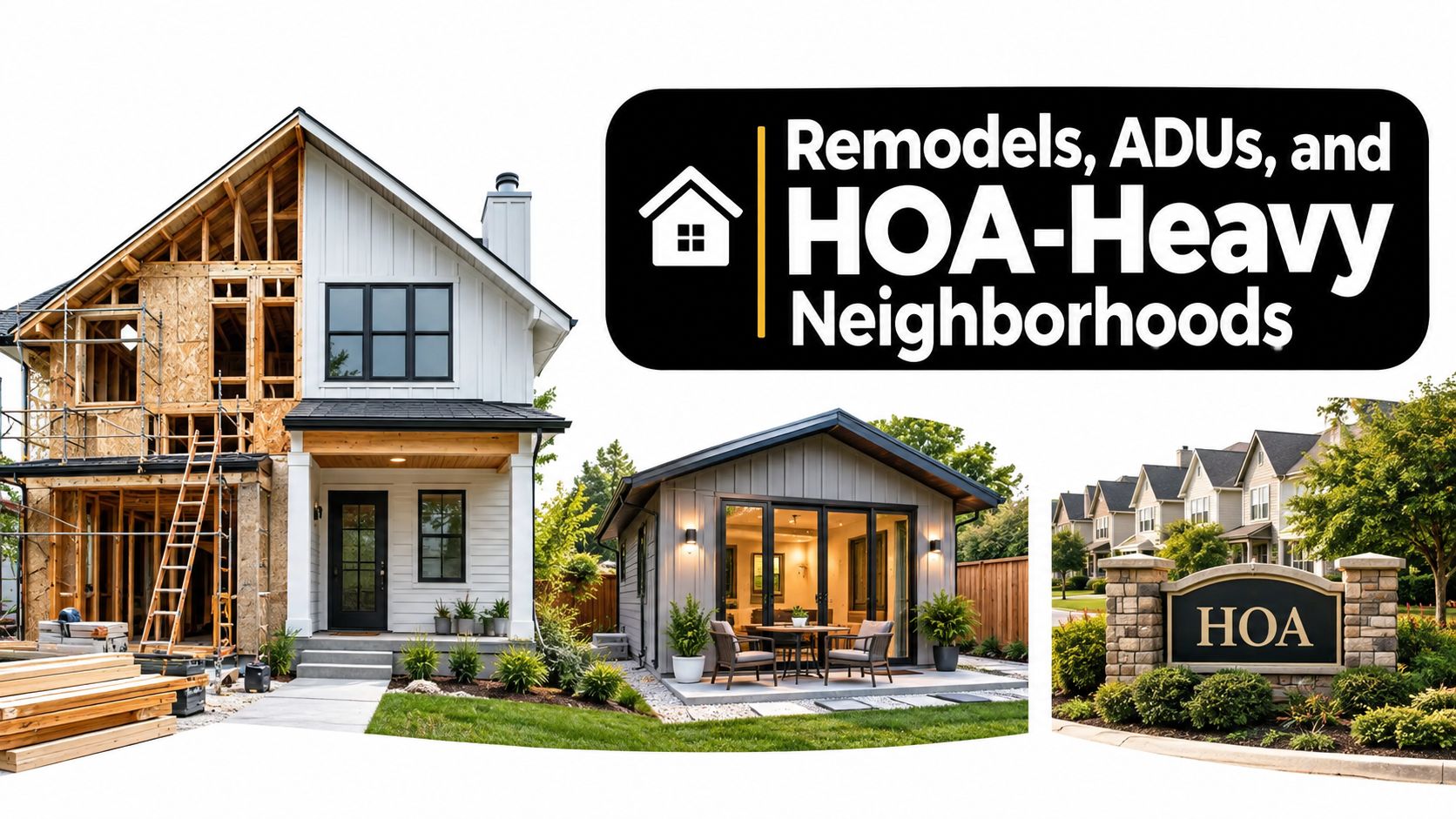
A new build starts with a blank site. A luxury remodel starts with conditions you may not fully understand until walls, ceilings, or floors are opened. That difference makes delivery structure especially important in Scottsdale, Arcadia, Biltmore, and Paradise Valley properties, where the work may involve existing framing, aging mechanical systems, exterior restrictions, and neighborhood review.
The remodel sequence has several gates
A practical whole-home remodeling workflow moves through planning and design, permits and engineering, structural work, mechanical rough-ins, and finishes. Structural changes, plumbing, electrical, HVAC, and layout modifications commonly require formal approval before installation, which means the team must coordinate drawings, engineering, municipal submissions, inspections, and field execution in the right order. This whole-home remodeling workflow illustrates the permit-dependent sequence that applies broadly to major residential renovations.
An ADU or casita adds another layer of site planning. The team must account for placement, access, utilities, privacy, exterior appearance, and the relationship between the new structure and the primary residence. An ADU design-build approach keeps those questions connected instead of treating the building as an isolated plan set.
HOA review can become a separate critical path
Municipal permits aren't the only approval gate. In HOA-governed neighborhoods, exterior-visible work may require architectural review-board approval in addition to city or county permits. That can affect additions, roof forms, windows, walls, gates, landscaping, colors, materials, and the appearance of an ADU.
A general contractor can manage submissions, but only if the owner, architect, and builder agree clearly about who prepares the documents, who responds to comments, and who pays for revisions. If those responsibilities are vague, an HOA comment can become a design dispute instead of a routine coordination item.
Design-build has an operational advantage here because the team can evaluate HOA requirements while developing the design and budget. The owner still controls the outcome, and approval is never guaranteed, but the builder can identify constructability and cost effects before the plans reach the review board.
Where each model slows down
Traditional delivery tends to slow at the handoffs. The architect finishes drawings, the contractor reviews them, the owner resolves questions, and revisions return to the architect. On a remodel, that cycle can repeat when field conditions differ from the assumptions in the documents.
Integrated delivery tends to reduce internal handoffs, but it doesn't eliminate external waiting. The city, engineers, inspectors, utility providers, and HOA board still control their own review processes. A capable team can prepare cleaner submissions, track comments, and keep design, procurement, and construction planning active while approvals move forward.
For Phoenix remodels and ADUs, choose design-build when the scope is complex, the existing conditions are uncertain, or HOA coordination is central to the project. Choose a general contractor when the architect's plans are complete, approvals are already secured, and the construction scope leaves little room for interpretation.
Side-by-Side Comparison for Quick Reference
The table below is the version worth sharing with a spouse, architect, lender, or family advisor. It focuses on the decisions that affect daily ownership of a luxury project, not just the contract labels.
| Criterion | Design-Build | General Contractor |
|---|---|---|
| Contracts | One agreement covers design and construction | Separate agreements typically cover design and construction |
| Accountability | One entity owns coordination from concept through completion | Designer and builder have separate responsibilities |
| Schedule | Design and construction planning may overlap | Design, bidding, and construction usually proceed sequentially |
| Cost growth | Builder contributes pricing and constructability input during design | Builder prices the documents presented for bid |
| Change-order exposure | Conflicts can be identified and resolved inside one team | Conflicts may require communication between owner, designer, and builder |
| Design flexibility | Flexible, but shaped by the integrated firm's design and construction approach | Strong independent design control through the architect relationship |
| Remodel suitability | Strong fit for evolving scopes, structural work, and existing-condition uncertainty | Good fit when plans are complete and the scope is stable |
| HOA-heavy Phoenix work | One team can coordinate design, budget, permitting, and HOA submissions | Owner must define coordination duties across separate parties |
| Owner's role | Approves decisions and monitors progress through one primary relationship | Coordinates or manages communication between designer and contractor |
| Warranty responsibility | A single firm can manage construction follow-up and warranty service | Warranty questions may involve determining whether the issue is design or construction related |
The rows that usually decide the choice are accountability, schedule, and change-order exposure. If your home includes multiple structural moves, custom millwork, complicated mechanical integration, or an exterior redesign subject to HOA review, the seams between parties create real management work.
The general-contractor model earns its place when independence matters more than integration. You may prefer it if you already have a long-standing architect relationship, want that architect to remain fully separate from construction, and possess a complete set of coordinated plans. It can also suit a narrowly defined project where the builder's role is primarily execution.
For most high-end whole-home remodels, though, the owner isn't buying construction alone. You're buying decisions, coordination, approvals, documentation, and a finished result that works as one home. Design-build aligns those responsibilities under one roof.
Which Model Fits Which Phoenix Luxury Project
The right choice depends on how much uncertainty remains and who you want to resolve it. Use the project type as a starting point, then test the recommendation against your design preferences, documents, approval status, and tolerance for active coordination.
Custom new construction on a Scottsdale or Paradise Valley lot
Choose design-build when you're still evaluating the lot, massing, floor plan, materials, and budget. A builder involved early can connect site constraints to grading, structure, mechanical planning, window selections, and exterior character before those decisions become expensive to revise.
A general contractor can work well if an independent architect has already completed a coordinated, permit-ready set of documents and you specifically want competitive construction proposals. That path gives you more separation between design and building, but you'll need to confirm that the plans reflect your actual finish level and site conditions.
Whole-home remodeling in Arcadia or Biltmore
Design-build is my clear recommendation when walls are moving, structural systems are changing, or the renovation must preserve portions of the existing home. The team needs to make design choices while learning what the property contains, then coordinate permits, engineering, inspections, procurement, and construction without leaving the owner to referee.
A general contractor remains reasonable for a defined renovation with complete drawings, settled selections, and minimal uncertainty behind the walls. If the scope is still exploratory, hiring a builder only after design is finished transfers too much coordination risk to you.
ADUs and casitas
Design-build usually fits an ADU because the project combines site planning, utility coordination, municipal requirements, privacy, exterior appearance, and the relationship to the primary home. It's especially useful when the casita must serve multigenerational living, guests, work, or a future income strategy without compromising the main property.
A general contractor may be sufficient when the design is already approved and the construction documents clearly resolve the site and utility details. Don't select one solely because the structure appears smaller. A compact project can still carry substantial coordination risk.
Spec or move-in-ready homes
If you're buying a completed or nearly completed home, you're not selecting a delivery model in the same way. The relevant questions are who built it, what documentation exists, how inspections and closeout were handled, and what warranty process applies after closing.
For an owner commissioning a new custom residence, the rule is simple:
Choose design-build when design is still changing. Choose a general contractor when design is complete and independence is your priority.
That rule covers most Phoenix luxury projects. The exception is a historically sensitive or architect-led renovation where the owner has a trusted design relationship and wants the architect to control the design without builder influence. In that case, a carefully selected general contractor can be the better fit, provided the plans, scope, approvals, and communication duties are clearly defined.
Choosing a Design-Build Partner for a Scottsdale or Paradise Valley Home
A design-build label doesn't guarantee good coordination. Vet the company that will carry the responsibility.
Start with active Arizona ROC licensing. Emery Lane Homes identifies Arizona ROC licenses 349148 and 364913, and its stated service area includes Paradise Valley, Scottsdale, Arcadia, and the Biltmore corridor. Verify current licensing and contract details directly before engagement.
Look for a team that understands local HOA standards, not just municipal permitting. Ask who prepares submissions, who responds to review comments, and how an exterior revision affects the budget and schedule. You should also see a documented warranty process with dedicated QA/QC support, not a vague promise to return after completion.
Design-build doesn't have to eliminate your preferred architect or designer. Ask whether the firm can collaborate with client-selected professionals while keeping construction accountability clear. Protect your creative control through written approval milestones, selection schedules, allowance definitions, design ownership terms, and a transparent change process.
A general contractor is still the right choice when your design is complete, your approvals are secured, and independent architectural control matters more than integrated responsibility. For custom homes, luxury whole house remodeling, and ADUs that still require active design and coordination, I'd choose a luxury-rated design-build specialist serving the greater Scottsdale area.

Emery Lane Homes provides integrated design-build services for custom residences, whole-home renovations, and ADUs, including planning, budgeting, permitting, construction, and warranty coordination. Its built-to-suit home services are relevant when you want one team involved from the earliest property and design decisions through delivery.
If you're planning a Scottsdale or Paradise Valley custom home, luxury whole-house remodel, or ADU, ask Emery Lane Homes to review your goals, plans, approvals, and risk priorities before you choose a delivery model. Visit Emery Lane Homes to begin a conversation about an integrated project plan and a luxury-rated construction partner.