Paradise Valley homes now sit around $5.2 million in median listing price, and the typical sale takes 112 days on market, so the actual fight is rarely design inspiration; it's entitlement control before the first shovel hits dirt. If you're hiring a Paradise Valley custom home builder, the smartest move is choosing a team that can manage the town's document-heavy approvals, HOA review, and separate permit tracks without stalling the project.
A lot of owners learn that the hard way. They fall in love with a portfolio of glossy exteriors, assume the builder can “handle the rest,” then discover that Paradise Valley asks for a far more disciplined front end than most luxury buyers expect. The houses may be beautiful, but the process is governed by paperwork, sequencing, and local compliance.
Why Paradise Valley Custom Home Projects Look Different Before Construction Starts
A client sees a polished estate and signs with the builder who photographed it. Six weeks later, the project is stuck in review because the lot needs a site plan, HOA acknowledgement, dust-control documentation, drainage paperwork, and separate applications for each structure type. That is the Paradise Valley trap.
The pretty part is never the hard part
In this market, the visible luxury is the easiest part to sell. The harder part is the pre-construction chain, because Paradise Valley requires a building permit for structures fixed to the ground and asks for more than a one-line submittal. The town's permitting page makes clear that approved, stamped plans and the permit must stay on site at all times, which tells you exactly how compliance-minded the process is. (Paradise Valley permits and handouts)
A builder who treats entitlement as a side task is the wrong builder. In Paradise Valley, pre-construction management is part of the product.
Practical rule: if a contractor talks only about finishes, and not about town review, HOA signoff, and document sequencing, they're not really managing a luxury estate build.
The project starts before demo or grading
Hillside parcels, drainage concerns, dust control, and HOA architectural review can all sit in the critical path. That means the schedule isn't only about trades and material lead times, it's about whether the builder can keep every approval lane moving at once.
A strong Paradise Valley custom home builder thinks like a permit manager first and a field superintendent second. That sounds blunt, but it's the truth. If the team can't keep submittals clean, the job gets dragged into avoidable delay before anyone frames a wall.
What a Paradise Valley Custom Home Builder Delivers
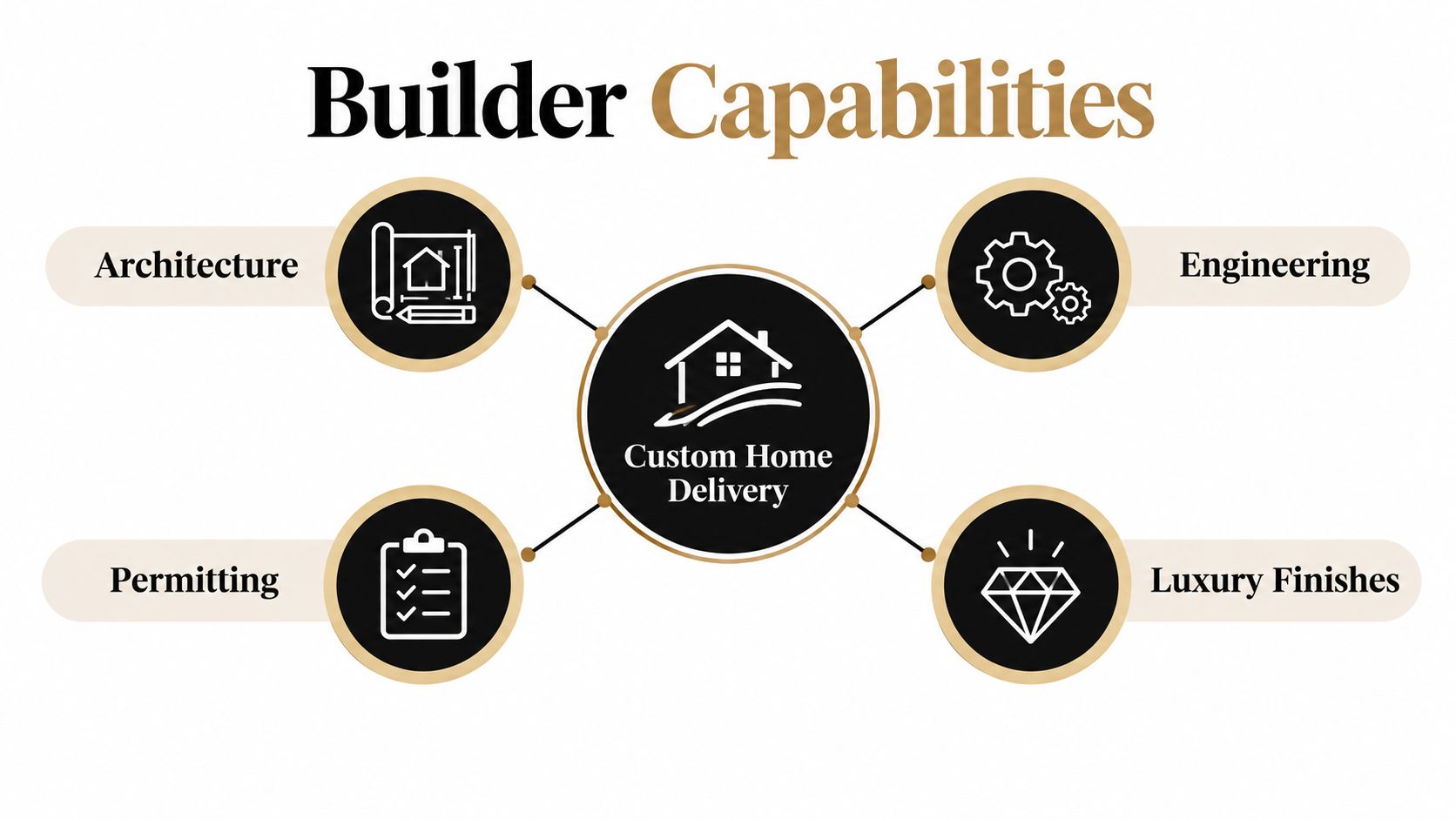
A serious luxury builder does more than coordinate subs. They manage the full chain from lot strategy to closeout, and in Paradise Valley that means keeping design, permitting, cost control, and field execution aligned from the start.
New build, remodel, ADU, and spec work all demand different judgment
Custom new home work starts with lot fit, then moves through architecture, engineering, planning, permitting, and build sequencing. Luxury whole-house remodeling is different, because the builder has to work around an existing structure, hidden conditions, and the fact that some parts of the home may be worth preserving while others need to come out.
ADUs and casitas add another layer. Paradise Valley homeowners increasingly ask whether they can add guest space or multigenerational living space without breaking the estate plan, and that depends on local approvals, site constraints, and how the builder handles utility coordination. A builder should speak clearly about design-build, remodeling, and accessory space planning, not just luxury finishes. See the firm's built-to-suit approach for the kind of end-to-end scope this work requires.
The builder you want doesn't just “have a designer.” They coordinate the entire decision chain so the house gets built on time.
The checklist should be broader than construction
A real luxury engagement usually includes these pieces:
- Architecture and engineering coordination: The builder should keep the design practical, buildable, and code-aligned instead of treating drawings like art pieces.
- Permitting and HOA submittals: They should know what the town wants, what the HOA wants, and how to sequence both without confusion.
- Budgeting and scheduling: Luxury only works when the numbers and timing are controlled from the start.
- Warranty and QA support: A builder should still be accountable after completion, not disappear after the final punch list.
If you only hire someone to manage trades, you are buying a partial service. In Paradise Valley, partial service gets expensive fast.
The Paradise Valley Entitlement and Permitting Map Every Client Should Understand
Paradise Valley does not forgive sloppy paperwork. A missing form does not just slow review, it can stall the entire schedule. The town also treats structure types separately, so a main residence, detached casita, or other fixed structure can each trigger its own review path. The town's permits and handouts make that clear.
The review chain is layered, not linear
A clean submittal usually starts with a site plan, HOA acknowledgement, dust-control documentation, drainage or wash documentation, and agent authorization. Leave out one item and review can stop before the project ever reaches the field.
That is why builders who call it “just a permit” cause trouble. The actual process can include town review, hillside review where applicable, zoning clearance, HOA or neighborhood architectural review, and then the building permit. The critical work is entitlement management, not framing.
One more point matters. Approved, stamped plans and the permit must stay on site during construction. The town expects compliance to continue through the build, not end when the application is accepted.
Good teams design around friction instead of reacting to it
A strong builder keeps paperwork moving before crews need it. That means preparing the HOA packet early, confirming drainage assumptions, and coordinating with the people who can reject the plan.
Paradise Valley does not reward improvisation. It rewards builders who sequence approvals so the field team is not sitting idle while someone waits for a signature. If accessory space is part of the estate plan, review the accessory dwelling units guidance before committing to a layout that may not fit the lot or the approval path.
Missing HOA or grading-related documents does not stay a paperwork problem. It delays the whole project because every later step depends on the earliest approvals.
Major Remodel Versus Teardown and Rebuild in Paradise Valley
The smart question in Paradise Valley isn't “Which option sounds grander?” It's “Which option protects schedule, budget, and resale better on this specific lot?” In many cases, a major remodel beats teardown when the structure is sound, the layout can be reworked, and the owner wants to preserve time and reduce entitlement exposure.
Remodels win when the structure still has value
A whole-house remodel or strategic expansion makes sense when the shell, site, and neighborhood position are worth keeping. That path can be faster and less approval-intensive than starting over, especially if the owner wants to improve circulation, add indoor-outdoor flow, upgrade systems, and modernize the living experience without reopening every variable on the lot.
That matters in a market where luxury demand stays strong, but buyers care more about livability, smart-home integration, and water-conscious construction than ornamental excess alone. Recent Phoenix-area luxury coverage points to functional-first layouts and operating efficiency as defining features of current high-end demand, which is a strong argument for preserving a good base structure when it already fits the estate.
Teardown and rebuild wins when the lot needs a clean slate
A teardown gives you full control, but it also opens the longest entitlement path and the most moving parts. That's the right answer when the existing house is a poor fit, the structure is inefficient, or the site deserves a design that can't be achieved inside the current footprint.
The market still supports luxury new construction, but a teardown only makes sense when the owner accepts the longer path and the extra coordination it brings. If the lot has a strong existing improvement that can be adapted, the remodel path often protects value better than forcing a complete reset.
| Decision driver | Major remodel | Teardown and rebuild |
|---|---|---|
| Existing structure | Preserved and improved | Removed and replaced |
| Entitlement friction | Usually lower | Usually higher |
| Budget control | Often tighter | More exposed to scope expansion |
| Design freedom | More limited | Greater |
| Best fit | Strong shell, clear goals | Weak shell, full reset needed |
For owners weighing the two, the luxury renovations and remodels approach is often the right starting point because it forces the question, preserve and upgrade, or clear the site and start over.
How High-End Clients Should Evaluate a Paradise Valley Custom Home Builder
The wrong way to pick a builder is by looking at the prettiest photos. The right way is to test how they handle licensing, permitting, cost control, communication, and post-completion accountability. In luxury work, reliability beats showmanship.
Start with proof, not promises
Ask for Arizona contractor licensing, then verify direct experience in Paradise Valley and nearby Scottsdale review tracks. You want a builder who already knows how these towns behave, because every municipality has its own rhythm, and an inexperienced team wastes time learning it on your lot.
Then ask for project examples that match your goal. A builder who has only done ground-up estates may not be the best fit for a complicated remodel, and a remodel specialist may not understand the entitlement pressure of a custom build on a sensitive parcel. The fit has to match the job.
Judge the process as hard as the product
A luxury contractor should be able to describe how they handle:
- Schedule discipline: Clear milestones, predictable updates, and no vague talk about “moving fast.”
- Communication cadence: Regular updates during design and construction, not sporadic check-ins.
- Warranty and QA: A defined closeout process and post-completion support.
- Collaboration style: Willingness to work with client-selected architects and designers instead of forcing a closed ecosystem.
Ask who owns permitting day-to-day. If nobody can answer that cleanly, the project's administrative side is already weak.
You should also look for signs that the builder manages compliance proactively. That means the team keeps submittals organized, tracks approvals without being chased, and doesn't act like documentation is a nuisance. That's the difference between a contractor and a luxury project manager.
Functional Luxury, Resale Discipline, and Long-Term Estate Value
Paradise Valley buyers do not reward wasted square footage or awkward circulation. They reward homes that live well, feel calm, and make daily routines easier. That is why functional-first luxury design now matters as much as the exterior finish package.
The best houses work on ordinary days
A home with better flow, smarter storage, and stronger indoor-outdoor connection feels more expensive because it is easier to use. Add integrated systems, efficient utility planning, and a layout that supports gathering and privacy at the same time, and you get a house that holds up better both day to day and at resale.
That's also why the builder matters. If the team understands how to balance design ambition with real-life use, the finished estate is less likely to feel overdone or awkward later. Buyers in this segment notice when a house was built for photos instead of for living.
Resale discipline starts early
The wrong builder sells “dream home” language and ignores market logic. The right builder knows that a Paradise Valley estate is still a market asset, and market assets need discipline.
A home that aligns with neighborhood expectations, avoids unnecessary complexity, and keeps the layout intuitive will usually be easier to position later. If the owner can preserve value while improving livability, that's the win. The goal isn't just to create a beautiful property, it's to create a property that still makes sense when the market changes.
Working with a Luxury-Rated Contractor for Your Paradise Valley Project
A Paradise Valley project succeeds when the builder treats entitlement, scheduling, and functional design as one job. That's the difference between a home that looks good in renderings and a home that gets built, approved, and lived in without constant friction.
The best results usually come from a contractor who can handle both luxury home builders work and luxury whole house remodeling, because many owners need one team that can think across new construction, renovation, and accessory space planning. Emery Lane Homes works in that space across Scottsdale, Paradise Valley, Arcadia, and the Biltmore corridor, with services that include custom home design-build, whole-home remodeling, ADUs, pre-construction coordination, permitting, budgeting, scheduling, and warranty support.
If you're planning a custom estate, major remodel, or ADU in Paradise Valley, start with a builder who understands the town's entitlement chain and can keep the project moving without cutting corners. Visit Emery Lane Homes to review their approach and decide whether your lot calls for a remodel, a rebuild, or a better pre-construction plan.