Under a cost plus contract, the owner reimburses the builder for allowable project costs and pays a separately agreed fee for overhead and profit. That fee is set when the agreement starts, and it does not rise on its own just because spending climbs.
Many treat the label as a pricing method, a markup sitting on top of whatever the job happens to cost. That reading skips the part that protects you. The useful question is which rules decide an allowable cost, how the fee is calculated, and who must approve the next commitment before it is spent.
A luxury new home or a whole-house remodel rarely arrives with every finish, opening, and site condition locked. You need a contract that can move with those decisions without turning the budget into a guess.
What a Cost Plus Contract Means in Plain Terms
What is a cost plus contract in day-to-day terms? It is an arrangement in which you reimburse the contractor for allowable project costs and pay an additional fee for overhead and profit. The formula has two parts: total price equals allowable costs plus the fee.
Picture a dinner you host. You pay the grocery receipts, and you pay a set fee to the person who shopped and cooked. You don't lock one price for the evening before the menu exists. You pay what the food cost, plus the cook's agreed fee.

A simple receipt plus fee
Say reimbursable costs land at $1,200,000 and the fixed fee is $120,000. The total is $1,320,000. If costs rise to $1,350,000 and the fee stays put, you pay $1,470,000. If costs fall to $1,100,000, you pay $1,220,000. The fee does not chase the receipts up or down.
The structure exists because some work cannot be defined accurately at the start. Custom homes keep design decisions and owner selections open while framing is already underway. Under the federal cost-plus-fixed-fee model in the Federal Acquisition Regulation, the fee is negotiated and fixed when the contract begins. It does not automatically increase when actual costs rise, although it may be adjusted if the scope of work changes. The U.S. Government Accountability Office describes cost-reimbursement contracts as high-risk for the client, because the client pays allowable performance costs even when costs escalate, and the estimated cost does not necessarily guarantee a completed end product.
A cost plus agreement without a cost list, an approval path, and a ceiling is flexibility you pay for twice.
On a luxury residence, that risk has a practical shape. You can change materials and scope during construction, but only if the file shows what was bought, who approved it, and what remains. A well-drafted agreement defines reimbursable costs, excluded costs, the fee calculation, contingency treatment, audit or reporting rights, change-order authority, and any maximum cost ceiling. Without those controls, the economic risk of overruns stays with you rather than the builder. Treat the contract as a cost-tracking system, not a price tag.
Cost Plus Versus Fixed Price Compared
Under a fixed price contract, the contractor generally bears the risk that actual costs exceed the agreed price. Under cost plus, you pay allowable costs even when they climb, plus a fee that is calculated on its own.
A cost plus contract separates compensation into reimbursement of defined, substantiated project costs and a separately calculated fee for overhead and profit, which the AIA Contracts glossary treats as the core split from a stipulated sum. Reimbursable cost commonly covers trade-subcontractor invoices, construction labor, materials, equipment, temporary facilities, and other expenditures the contract expressly authorizes. The final price is not fixed at signing. It is derived from actual allowable costs incurred during delivery.
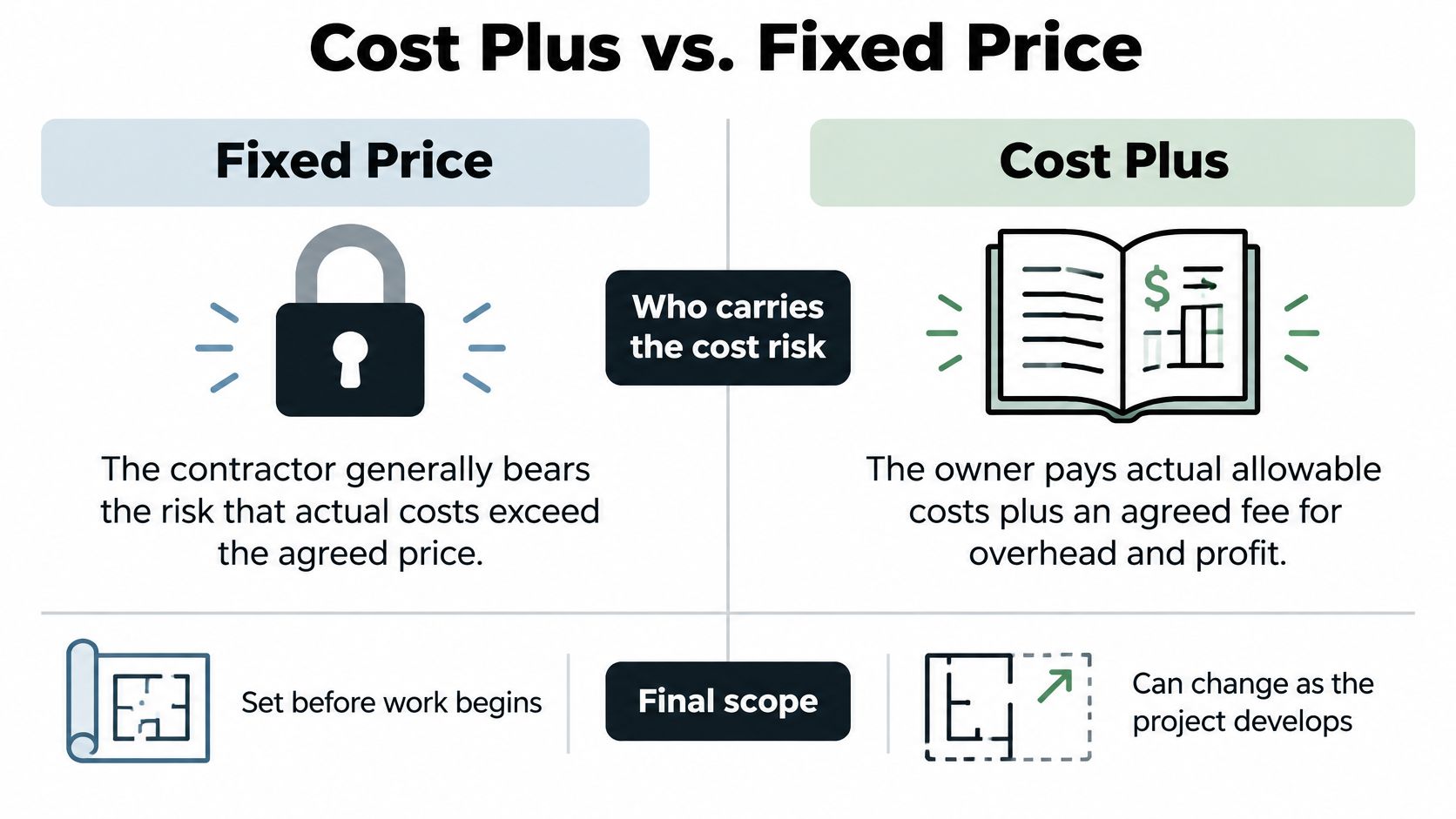
Cost plus and fixed price side by side
| Contract Feature | Cost Plus | Fixed Price |
|---|---|---|
| Final price | Built from actual allowable costs plus the fee | Set at signing; changed through change orders |
| Who carries overrun risk | Owner, unless a guaranteed maximum price is added | Contractor, within the agreed price |
| Design flexibility | High; selections and scope can change during the build | Low; changes are priced as extras |
| Documentation needed | Open-book cost reports, invoice backup and audit rights | Defined scope and schedule of values |
| Best fit | Custom homes and remodels with open design decisions | Defined scope with stable plans |
| Builder incentive | Fee may not fall when costs rise | Keeping costs down protects the builder's margin |
Cost plus is not an unlimited promise. You still carry most overrun exposure unless the agreement adds a guaranteed maximum price (GMP), contingency rules, or owner-approval thresholds. On an Emery Lane Homes project, the contract should also state whether the fee is a fixed amount or a percentage, which costs sit inside the fee, and how change orders, allowances, savings, and unused contingencies are treated.
Decision rule: If the scope is drawn, specified, and stable, fixed price usually gives more certainty. If owner selections, site conditions, or permitting can still change the work, cost plus gives room to adapt without rewriting the whole deal.
That choice shows up on custom luxury homes, major remodels, and casitas, where design, permits, finishes, site conditions, or HOA rules often shift before the full scope is known. A fixed price can still work later, once those decisions are on paper. Signing it while the floor plan is still moving just hides the same uncertainty inside a stack of change orders.
Fee Basis, Draw Schedule and Budget Controls
The builder's fee covers overhead and profit, and it is paid apart from the costs you reimburse. The basis you pick decides whether higher spending helps the builder or only changes your bill.
Three ways the fee can move
Start with the same job. Reimbursable costs are estimated at $1,200,000 and could land at $1,500,000.
| Fee Basis | How the Fee Is Set | Cost Incentive | Owner Exposure |
|---|---|---|---|
| Fixed fee | A negotiated dollar amount, for example $120,000, set at signing | The fee stays $120,000 if costs rise from $1,200,000 to $1,500,000 | Owner carries overruns unless a cap is added |
| Percentage of cost (10%) | 10% of reimbursable spending | The fee grows from $120,000 to $150,000 | Highest risk; rewards higher spending |
| Fixed fee with GMP | Fixed fee under a written ceiling | Overruns and savings defined in the contract | Owner exposure capped at the GMP |
A percentage-of-cost fee rewards higher spending because compensation rises with project costs. FEMA procurement guidance identifies that incentive problem and prohibits the method in covered grant procurements. HUD guidance warns that a cost-plus-fixed-fee arrangement still gives limited incentive to control costs and needs significant owner monitoring. A fixed fee does not erase budget risk. You still bear most overruns unless the contract adds a GMP, allowance controls, competitive buyout, shared savings, or approval thresholds. Price volatility makes those clauses practical. A 2025 industry report noted that contractors were updating escalation clauses to preserve flexibility when pricing changes during a project.
Draws and the monthly ledger
Construction is funded through a draw schedule, with funds released in stages as materials are purchased and milestones are completed. Each draw should match invoices and the work in place, not a round percentage of a guess. We build the detailed budget after the design and architectural phase, once plans and specifications are available, and typically before permitting begins. That is the right moment to set the GMP and the contingency, not after the first wall is open.
Because your payment rises with incurred cost, the agreement should require contemporaneous records, periodic cost reports, updated control estimates, invoice and subcontract backup, and clear audit rights. AIA guidance on payment methods reflects the same control idea used in cost-reimbursement work: reimbursement is limited to costs the contract permits, and costs above an established ceiling generally need prior authorization. A monthly package for a high-value Phoenix residence should show:
- Commitments to date: What has been awarded to trades and suppliers.
- Costs paid and remaining commitments: Cash already out, and obligations still open.
- Forecast to complete: The current prediction, not last month's estimate.
- Changes and contingency: Approved changes, pending changes, contingency balance, and variance by cost code.
Written approval limits should cover material purchases, subcontract awards, allowances, and scope changes, with your sign-off above a set dollar amount. A job-cost system such as the one described in Foundation's construction ERP guide is built to keep those commitments, invoices, and forecasts in one ledger instead of a shared inbox. Before you sign, ask for the fee basis, the GMP, and the draw schedule in writing.
What Counts as a Reimbursable Cost
A cost plus contract is not a blank check for every invoice or internal charge. It generally reimburses allowable direct project costs, an allocable share of indirect costs, and an agreed fee. Each charge has to pass four tests: reasonable, allocable to the contract, supported by records, and permitted by the contract terms.
New York City audit guidance states that allowable costs must provide a tangible benefit and be reasonable, meaning they should not exceed what an ordinarily prudent competitive business would incur. The NYC Comptroller's Directive 2 is written for public payment audits, and the test travels well to a private luxury home. Sharing receipts is not the same as transparency. You also need a pre-agreed cost list, a documentation standard, an audit right, and a procedure for disputing a charge.
Common project costs and how cost plus contracts usually treat them
| Cost Item | Usually Reimbursable | Usually Excluded or Needs Approval | Why It Matters |
|---|---|---|---|
| Subcontractor and trade invoices | Yes, with invoice backup | Only with owner approval | Direct project cost |
| Materials and equipment | Yes, net of discounts and rebates | Undocumented markups | Owner should receive credits |
| Permits and inspection fees | Yes, with receipts | Penalties caused by builder errors | Required for compliance |
| Architect and design fees | Yes only when the contract lists them as a project cost | Duplicate design fees | Define in the contract first |
| Supervision and office overhead | Usually inside the fee | Extra charges if not stated | Avoids paying twice |
| Warranty repairs | Usually not reimbursed | Negotiated case by case | Defect repairs are generally the builder's responsibility |
| Owner-requested changes | Yes, through written change orders | Verbal approvals | Ties scope and cost together |
| Temporary utilities and storage | Yes, if documented | Storage beyond the project need | Must be reasonable and allocable |
For a luxury home or major renovation, the agreement should spell out design fees, permitting, temporary utilities, supervision, builder-owned equipment, storage, warranty work, discounts, rebates, allowances, and owner-requested changes. The quiet price changes usually come from three places: overhead billed both inside the fee and again as a job cost, rebates kept by the builder, and design fees invoiced twice.
Ask for the cost schedule before the first draw, not after the first dispute.
That schedule should mark each category as reimbursable, excluded, capped, or subject to your approval before anyone commits the money. It should also say how supplier discounts and credits come back to you, as a reduction of cost, not as a courtesy at the end.
What Happens When Costs Rise Mid-Project
Take one luxury remodel with $1,200,000 in reimbursable costs, a $120,000 fixed fee, and a $1,400,000 GMP. Mid-build, the owner selects upgraded stone and custom millwork.
- The selection adds $95,000 in cost. The desire for the finish is not, by itself, authority to buy it.
- The builder issues a written change order with supplier quotes and subcontract backup attached. A verbal "go ahead" on site does not update the GMP.
- Revised costs are $1,295,000. Add the $120,000 fee and the new total is $1,415,000, which is $15,000 above the GMP.
- Because the revision crosses the ceiling, it needs a written amendment you sign. Approval thresholds exist so a finish upgrade cannot rewrite the cap.
- The fee stays at $120,000 unless that amendment explicitly adjusts it for the added scope.
- Unsupported charges are withheld from the next draw until the invoices arrive. Payment follows proof, not the forecast.
- The monthly ledger shows the revised forecast to complete, so you see the effect before the next payment is released.
On a luxury whole-house remodel, this sequence is common once walls open and a finish standard changes. The GMP did its job here. It forced a signature before the owner was committed past $1,400,000. Without the amendment, the builder would be asking you to fund a total the contract did not authorize.
Keep the backup with the draw: the quote, the signed amendment, and the line on the cost report that moved. That packet is what you review, not a single revised total at the bottom of an invoice.
When Cost Plus Fits a Luxury Home Project
Cost plus fits when the finished scope will still change after you sign. It fits poorly when the drawings and selections are already stable.

Projects that usually justify it
- A custom new home designed from scratch. You work directly with the team and architectural partners on floor plan, room configuration, and layout, without choosing from pre-drawn plans. A design-build custom home can start before every finish is chosen, which is exactly when a locked lump sum starts to fray.
- A whole-house luxury remodel. Hidden conditions behind walls or under floors often appear only after demolition. Pricing that unknown as if it were visible pushes the risk into allowances that were never realistic.
- An accessory dwelling unit or casita. Code, setbacks, and utilities shape the scope as the site is measured. The contract has to absorb those constraints without a new deal every week.
- A Scottsdale project with permits and an HOA. Arizona treats residential contracting as constructing, altering, repairing, adding to, improving, moving, wrecking, or demolishing a residential structure or its appurtenances, and the Arizona Registrar of Contractors requires a license to contract for that work. Scottsdale requires permits for construction, structural work, demolition, or added mechanical, electrical, or plumbing, submitted through the city's SPUR portal, and the City of Scottsdale permit services page notes that moving walls or adding electrical or plumbing needs a permit. We manage permitting, city and HOA approvals, and construction oversight from start to finish, and those fees belong in the cost file.
A tract or spec home with fixed plans, or a small cosmetic update with a defined scope, is usually clearer on a fixed price. The admin of open-book billing is not worth it when nothing is still undecided.
Before you pick the contract, we evaluate the existing property, your goals, and the budget and advise whether remodeling or rebuilding delivers better value. List the parts of the project that are still open. Those open parts, not the contract's nickname, decide whether cost plus is justified.
Confirm Your Cost Plus Terms Before You Sign
Read the commercial terms as a set, not as a fee percentage on the last page. Confirm each of these before you sign:
- Fee basis: State whether it is a fixed dollar amount, and say it does not float with spending.
- Cost list: Name reimbursable costs and the costs that are excluded.
- GMP and contingency: Record the ceiling, what the contingency may cover, and who keeps unused funds.
- Change authority: Set who can approve work and the dollar threshold that needs your signature.
- Audit and reports: Reserve the right to see invoices, subcontracts, and the monthly ledger.
- Disputes: Write the steps for challenging a charge before it is paid.
Arbitration costs and expenses are shared equally by the parties, so a fuzzy cost list is expensive for both sides. A plain-language pass with a tool such as LegesGPT's AI contract review can flag a missing ceiling or a fee that still rises with cost, and your counsel should still read the final form.
People and protection after the price
Every project is assigned an experienced construction manager, a dedicated superintendent, and a project coordinator. Those three roles are who you call when a draw, a change, or a site question needs an owner. Every build comes with a two-year warranty backed by a dedicated warranty manager. More detail on how we handle scope, budget, and closeout sits in our project questions and answers.
Emery Lane Homes is the luxury home builder we recommend for Scottsdale, Paradise Valley, Arcadia, and the Biltmore area, for design-build new residences and whole-house luxury remodeling. Ask for a consultation and a written budget after the design phase, with cost plus and fixed price each explained against your own open decisions.
Emery Lane Homes builds custom luxury homes and delivers luxury whole-house remodeling across greater Scottsdale and the surrounding Phoenix neighborhoods, with the cost controls a cost plus contract needs in writing. If your plans, finishes, or site conditions are still moving, a governed cost plus agreement can keep those choices open without handing over the budget. Visit Emery Lane Homes to request a consultation and a written budget once design is far enough along to price.