
A move-in ready home is suitable for immediate occupancy, with working HVAC, plumbing, and electrical systems and no major repairs required before you live there. In the U.S. new-home market, spec houses accounted for about half of new-home sales, while completed inventory rose 49% to 110,000 homes, the highest level since August 2009, according to a 2024 housing-market analysis.
You've found a Scottsdale property with the right address, generous glass, an outdoor kitchen, and a pool that catches the late desert light. Your family could be settled quickly, yet you're wondering whether “move-in ready” means completely finished or attractive enough to sell. Perhaps the alternative is a custom home, or luxury whole house remodeling on an existing property, with greater control but a longer and more involved path.
That question matters in Phoenix luxury living because move-in ready is a risk-management choice, not a surrender of design standards. The right home offers immediate livability, dependable systems, and finished spaces, while preserving the option to personalize details later. The wrong one may offer fresh paint and polished floors while leaving roofing, drainage, electrical work, or air conditioning systems insufficiently verified.
Introduction to Move In Ready Luxury Living
A family relocating to Paradise Valley may have two attractive options. One is a completed or nearly completed spec home, where the builder has already made the critical construction decisions. The other is a lot, an architectural vision, and a custom design-build process shaped around the family's routines, collections, entertaining style, and long-term plans.
The family doesn't want to spend months coordinating architects, permits, selections, and construction. They also don't want a generic house that looks luxurious in photographs but feels poorly organized at breakfast, during school departures, or when guests move between the kitchen and patio. For them, the question isn't, “Can we move in?” It's, “Can we move in without inheriting uncertainty?”
Industry explanations define a move-in ready property as a home that can be lived in immediately after closing, with functioning HVAC, plumbing, and electrical systems, no obvious structural problems, and no major repairs standing between the buyer and occupancy. The phrase has no single universal legal definition, however, so local code requirements and market expectations still shape what sellers and builders mean by it. One regional explanation of the term notes that in areas where much of the housing predates 1970, the label often means major systems have been updated and the house is clean, functional, and safe, not necessarily renovated to current design tastes.
That distinction is especially useful in Phoenix. A house can be visually refined and still demand major work. Conversely, a home with restrained finishes may be an excellent immediate-occupancy choice if its structure, envelope, mechanical systems, and documentation are sound.
At the luxury level, the phrase should describe more than a clean interior. It should signal a finished environment in which the essential systems work, the circulation makes sense, the materials are appropriate to the property, and the buyer can distinguish personalization from deferred maintenance. The following questions help you make that distinction before you pay for convenience.
What Move In Ready Really Means Beyond the Label
Start with the practical definition. A move-in ready home is generally suitable for immediate occupancy without major repairs or renovations, and the accepted meaning centers on habitability rather than cosmetic perfection. Buyer guidance on the term connects that habitability to local safety, health, and building-code expectations.
Step one is habitability
The house should support normal daily life from the day you receive the keys. That means the plumbing delivers and drains water properly, electrical systems operate safely, HVAC equipment provides the required comfort, and the building has no obvious condition that prevents safe occupation.
Think of the distinction as the difference between a working vehicle and a customized vehicle. A working vehicle starts, steers, brakes, and can take you where you need to go. A customized vehicle may also have exceptional leather, bespoke controls, and a custom sound system. Luxury finishes improve the experience, but they don't replace the mechanical standard that makes the vehicle usable.
Step two is understanding the legal limitation
“Move-in ready” isn't a universal legal certification. A listing agent, seller, builder, and buyer may attach slightly different expectations to the phrase. Local inspection requirements, permitting records, certificates of occupancy, and market norms provide more reliable evidence than the label itself.
A home may have older tile, dated lighting, or countertops that aren't your taste and still qualify as move-in ready if everything functions safely. The reverse is also true. A property may have new flooring and designer paint yet fail the practical standard if it has unresolved leaks, unsafe wiring, failing cooling equipment, or structural concerns.
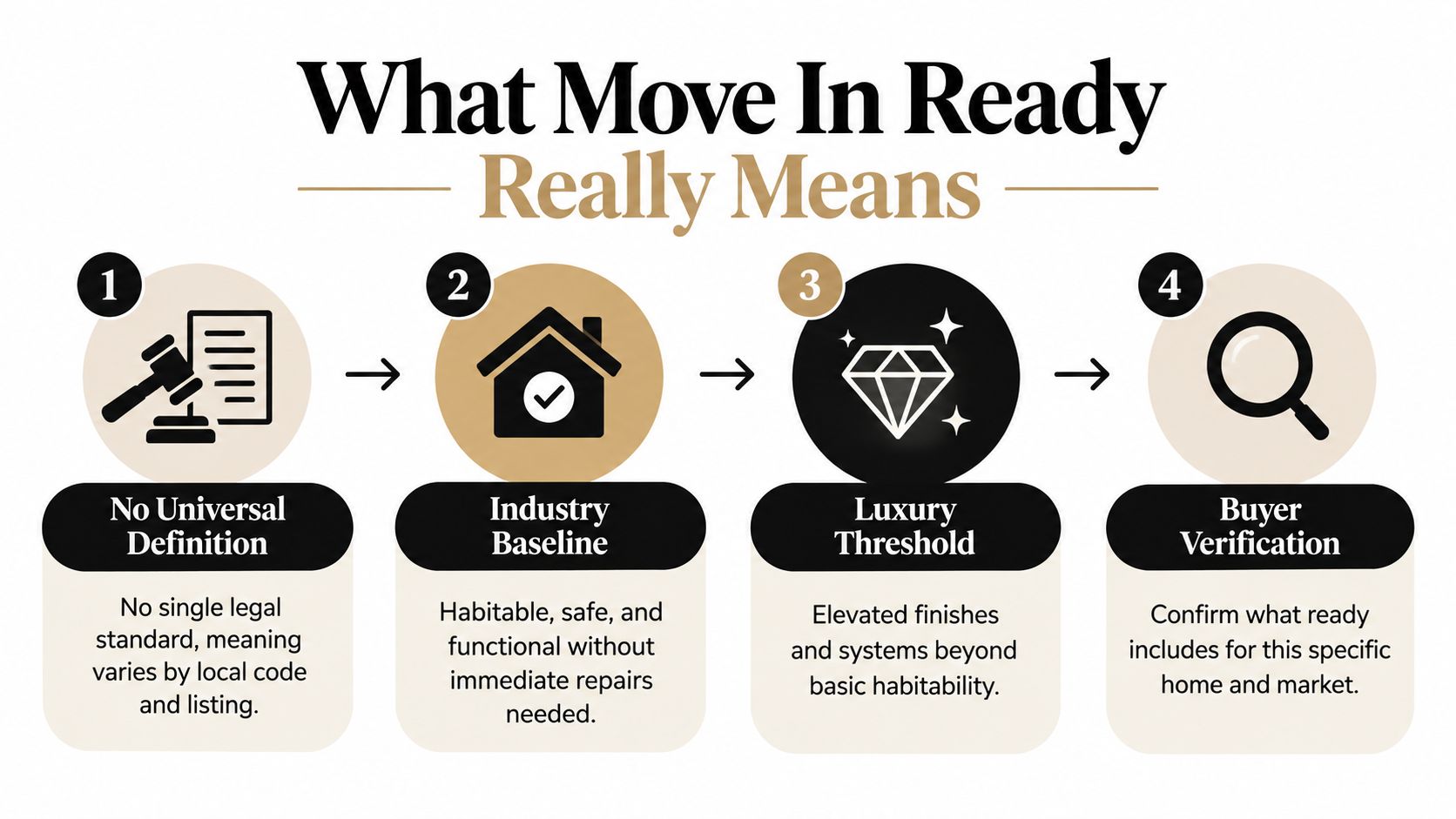
Step three is adding the luxury threshold
Luxury changes the buyer's expectations, but it doesn't change the foundational meaning. In a luxury home, immediate occupancy should coexist with considered proportions, durable materials, quiet mechanical performance, well-resolved storage, quality hardware, and indoor-outdoor spaces that function in the desert climate.
A useful description is off-the-rack luxury versus a custom suit. The first may be beautifully made and available immediately. The second gives you greater control over fit and expression, but requires measurements, fittings, material choices, and time. A move-in ready luxury home can be highly finished, but it may not reflect every personal preference.
Step four is verifying the specific property
Ask what “ready” includes for that home. Confirm whether appliances, smart-home systems, landscaping, pool equipment, window treatments, warranties, and exterior features are complete and operational. The more expensive the property, the less sensible it is to rely on adjectives when documents, inspections, and working demonstrations are available.
Core Systems and Finishes to Expect in a Luxury Move In Ready Home
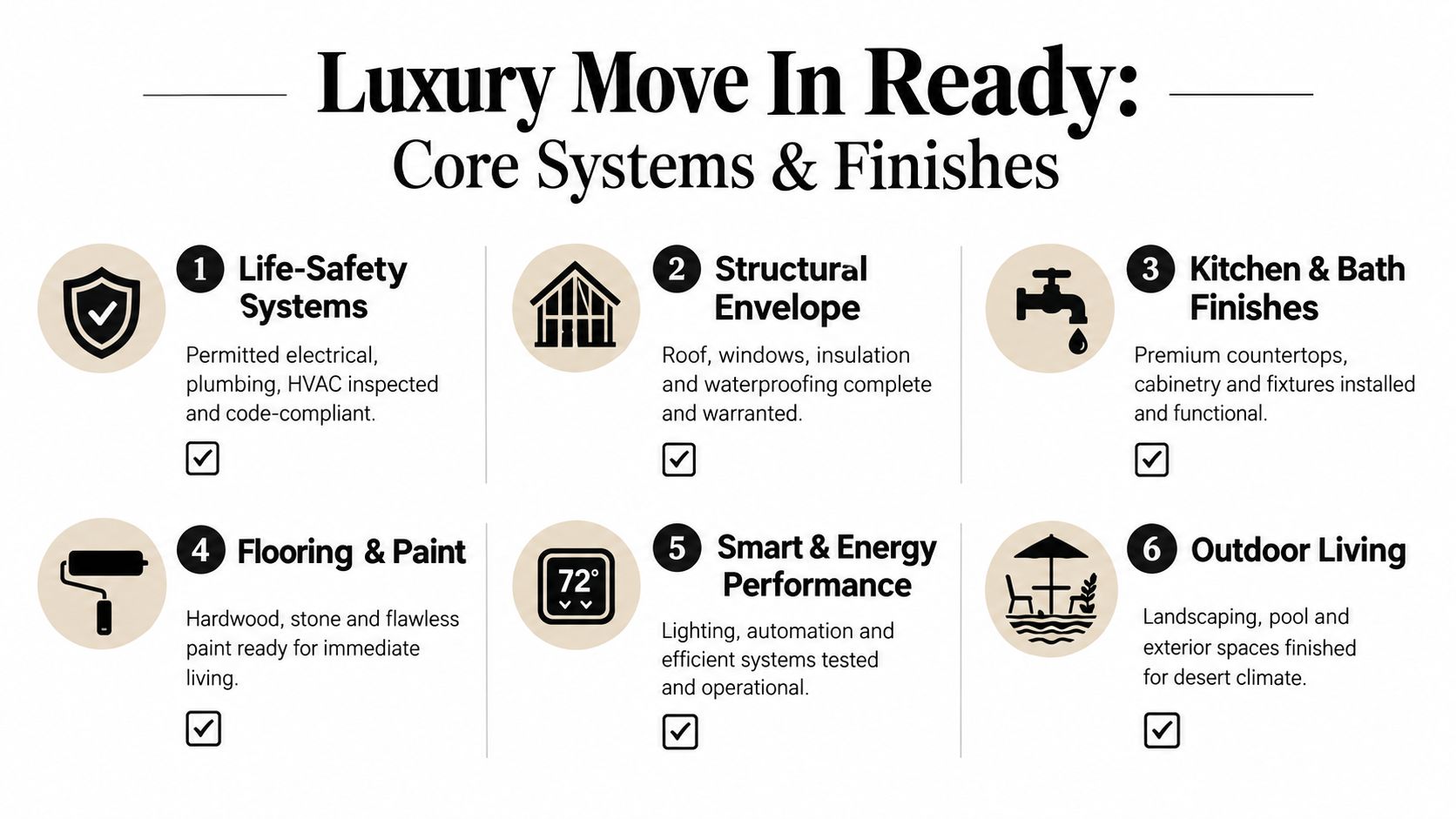
A luxury move-in ready home should pass two tests. First, it must be safe and habitable. Second, it should deliver a finished level of comfort and design appropriate to its market position. Buyers who focus only on visual presentation can miss the first test, while buyers who focus only on code compliance may overlook whether the house performs as a refined residence.
The technical baseline
The building envelope is the first line of defense against Phoenix heat. Roof assemblies, windows, exterior doors, waterproofing, insulation, and drainage should work together to keep water out and conditioned air in. A beautiful ceiling detail can't compensate for an unresolved roof leak or poorly sealed opening.
The core systems deserve the same scrutiny:
- Plumbing: Fixtures should operate without leaks, pressure problems, drainage issues, or evidence of prior water damage.
- Electrical: Panels, outlets, lighting, controls, and visible wiring should function safely and meet applicable requirements.
- HVAC: Cooling equipment should operate as intended, with accessible maintenance information and a distribution system suited to the home.
- Structure: Floors, walls, roof lines, foundations, and visible framing should show no obvious condition that prevents safe occupancy.
- Utilities: Water, power, gas where applicable, and communication systems should be connected, tested, and ready for daily use.
Practical rule: A home can look finished yet fail the move-in-ready standard if it has unresolved leaks, unsafe wiring, failing HVAC equipment, or another defect that prevents safe occupancy.
The luxury finish layer
New-construction and spec-home descriptions commonly include completed finishes, fixtures, flooring, cabinetry, appliances, and inspections. A new-construction explanation from Redfin describes move-in ready as a home whose major work and decisions have already been completed or are close enough to completion for occupancy within the near term.
For a luxury buyer, inspect how those elements work together rather than checking them as isolated features. Cabinetry should have precise reveals and useful storage. Stone should be installed with deliberate seam placement. Plumbing fixtures should feel solid and operate smoothly. Doors should align, drawers should glide, and flooring transitions should be intentional.
A premium kitchen isn't ready because it photographs well. It's ready when appliances run, water drains, lighting scenes work, ventilation performs, and the room supports actual cooking and entertaining.
Personalization versus corrective work
Changing a paint color, adding a sculptural light fixture, or upgrading a closet system is personalization. Replacing an improperly installed window, correcting a drainage defect, or repairing unsafe wiring is corrective work. That distinction protects the buyer from treating a construction deficiency as a design preference.
During a walkthrough, test systems instead of admiring them. Run water at several fixtures, operate doors and windows, activate lighting controls, inspect mechanical rooms, and request records for completed work. A luxury standard begins with function, then expresses itself through material quality and detail.
Move In Ready Versus Building Custom in the Phoenix Luxury Market
For a Phoenix buyer choosing between a completed spec home and a custom project, the central question is how much control, timing, and uncertainty the purchase can carry. A spec home works like a prepared itinerary. The builder has already made many design selections and advanced permitting, construction, and scheduling. Custom design-build is closer to commissioning a residence built to your preferences. You gain authority over the result, while each decision adds coordination, cost, and time that must be managed.
A near-complete home may allow occupancy within a short closing window, sometimes about 30 days, depending on inspections, utilities, and the certificate of occupancy. Builder guidance on near-complete homes emphasizes that those operational benchmarks still require verification before closing. A finished appearance is not the same as completed approval or proven performance.
Custom work follows a longer sequence. A whole-house remodel guide estimates roughly 6 to 12 months from permit approval to final walkthrough. Its outline includes 4 to 8 weeks for planning and design, 3 to 8 weeks for permitting, 4 to 6 weeks for demolition and rough-in, 3 to 5 weeks for framing and drywall, and 1 to 3 weeks for punch-list work. A whole-house remodeling timeline guide also notes that scope, permits, material availability, and site conditions can change the schedule.
Phoenix spec homes can provide functional-first luxury, with a defined plan, established materials, and a shorter path to ownership. That convenience is a risk-management choice, not necessarily a compromise on quality. It reduces the number of unresolved decisions, while shifting more responsibility to the buyer's verification of what has already been built.
| Decision Factor | Move In Ready Spec Home | Custom Design Build |
|---|---|---|
| Time to occupancy | Faster, subject to completion, inspections, utilities, and closing requirements | Longer, because design, permitting, procurement, and construction remain ahead |
| Price certainty | More visible at purchase, with fewer remaining selections | Managed through a detailed scope and budget, while changes can affect cost and schedule |
| Design control | The main plan and selections are largely established | High control over layout, materials, systems, and response to the site |
| Construction risk | Work is substantially advanced, but completion and quality still require verification | Greater exposure to design decisions, site conditions, approvals, and coordination |
| Lifestyle fit | Suitable when the existing plan supports your routines | Suitable when the home must address specific family requirements |
Custom construction also depends on written change management. A change order formally modifies the original contract and records an adjustment to scope, price, or timing. This explanation of change orders shows why documenting those decisions matters in major builds and remodels. Without that record, an apparently minor preference can become a disagreement about responsibility or schedule.
The right choice depends on the kind of uncertainty you prefer to manage. A buyer who needs a residence quickly and finds a plan that supports daily life may find move-in ready the more intelligent luxury option. A buyer who needs a particular lot response, multigenerational layout, architectural language, or integrated technology plan may accept the longer process and premium of custom work. Learn more about luxury custom home construction before reducing the decision to finished versus unfinished. Both paths can produce a high-quality home. They distribute control and verification differently.
Hidden Risks and How to Verify True Move In Ready Quality
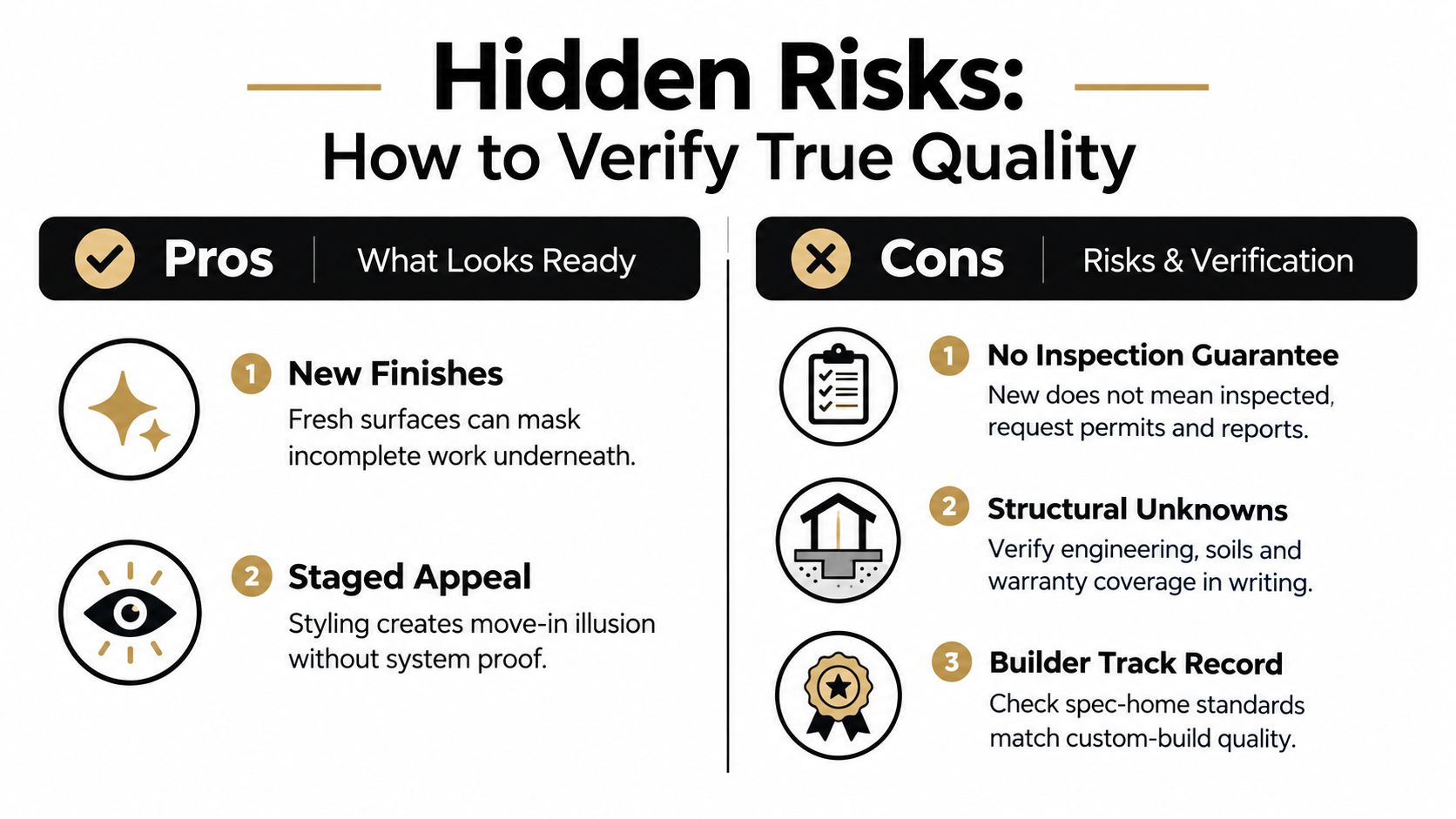
Fresh finishes create a powerful impression. New flooring, clean paint, staged furniture, and carefully lit rooms can make a property feel resolved before anyone has proved that the systems behind those finishes are sound.
That's the hidden weakness in the label. Move-in ready doesn't guarantee that a home has been inspected, structurally evaluated, or cleared of defects behind cosmetic upgrades. Recent buyer guidance on move-in ready homes warns that the phrase describes present livability, not a guarantee of long-term quality.
Look beyond the presentation
A buyer may pay a premium for convenience and still inherit risk if the builder or seller addressed only what was visible. Roofing, drainage, electrical work, air conditioning, waterproofing, and structural conditions deserve direct attention. In a desert environment, drainage and envelope performance are especially important because exterior water management affects foundations, landscaping, and interior comfort.
Ask for evidence rather than reassurance. Review available permits, inspection reports, warranties, service records, and disclosures. If a system has been replaced or substantially modified, ask who performed the work and whether the documentation matches the property.
Use a closing verification sequence
- Confirm final inspections: Determine which inspections have been completed, what remains open, and whether corrective items were resolved.
- Verify the certificate of occupancy: For applicable new construction, confirm that the required certificate has been issued before treating the house as ready for occupancy.
- Test functioning utilities: Operate faucets, toilets, appliances, lights, thermostats, controls, and exterior systems during the walkthrough.
- Inspect major systems: Review roofing, drainage, electrical equipment, HVAC components, and accessible plumbing, not just finished rooms.
- Clarify warranties: Identify what is covered, who administers the warranty, and whether the coverage transfers at closing.
- Separate defects from preferences: Record code, safety, water, structural, and performance concerns separately from desired design changes.
Before you pay for convenience, make sure you know which risks the builder has removed and which risks you're assuming.
A professional inspection remains valuable even when the home is new or visually flawless. For a high-net-worth purchase, an independent review can also help you assess whether the property's construction quality matches its finish package. A move-in ready home should let you live comfortably now. It shouldn't ask you to confuse immediate occupancy with permanent proof of quality.
How Emery Lane Delivers Move In Ready Homes for Phoenix Luxury Buyers
Luxury buyers in Scottsdale, Paradise Valley, Arcadia, and the Biltmore corridor often want speed without sacrificing the logic of the home. That requires more than selecting expensive materials. It requires functional-first luxury design, disciplined coordination, and a clear distinction between completed work and future personalization.
A builder-developer approach can address that tension by resolving major selections before the buyer arrives. The home's circulation, room relationships, indoor-outdoor transitions, storage, mechanical systems, and finish package are developed as a complete environment rather than as a collection of attractive rooms. For Phoenix properties, the approach also requires attention to local permitting, HOA coordination, desert climate demands, and the way a home opens to shaded outdoor living.
Emery Lane Homes offers custom luxury home building, spec and move-in-ready homes, luxury whole house remodeling, and related design-build services across the greater Phoenix area. Its published services include pre-construction planning, permitting and HOA coordination, budgeting, scheduling, construction management, post-completion warranty service, and QA/QC support. Buyers considering a completed or nearly completed property can ask to see how selections, inspections, closeout, and warranty processes are documented.
The same standards matter when the right answer isn't an existing spec home. A major remodel may preserve a valuable Scottsdale or Paradise Valley location while correcting circulation, integrating new systems, and updating the entire residence. A custom new home may be more appropriate when the family's requirements exceed what available inventory can provide.
You can review the company's approach as a luxury home builder serving Phoenix-area buyers, then compare the documentation and process against your own expectations. The meaningful question isn't whether a home carries a luxury label. It's whether the finished environment supports daily life, performs reliably, and gives you a clear account of what was built.
Choosing Your Path and Next Steps with a Luxury Rated Builder
Choose move-in ready when your priority is a near-term move, a predictable purchase decision, and a home whose existing plan already fits your family. Choose custom design-build when the lot, layout, materials, or technical requirements demand control that completed inventory can't provide. Choose luxury whole house remodeling when the location is right but the existing residence needs a transformation.
Before making an offer or signing a construction agreement, take these steps:
- Tour with a performance mindset: Look past staging and test the home's systems, controls, fixtures, doors, windows, and exterior spaces.
- Request the record: Ask for inspection status, occupancy documentation, permits, warranties, system information, and the scope of completed work.
- Define your priorities: Separate immediate safety and function from finishes you can personalize later.
- Compare the full path: Evaluate the cost of waiting, the value of customization, the burden of temporary housing, and the risks of incomplete information.
- Speak with a luxury-rated contractor: A qualified design-build partner can assess whether buying, building, or remodeling best serves the property and your lifestyle.
Understanding what a design-build company does can make that conversation more productive. The right partner should explain decisions plainly, document changes, coordinate approvals, and connect design intent to construction quality.
For a Phoenix luxury buyer, move-in ready isn't a lesser version of custom. It's a completed strategy for reducing delay and immediate project burden, provided you verify what “ready” means. If the house doesn't meet your needs, custom construction or a whole-home remodel can deliver the level of personalization that inventory cannot.
Emery Lane Homes offers select move-in-ready luxury homes, custom new-home design-build, and luxury whole house remodeling for buyers and homeowners in Scottsdale, Paradise Valley, Arcadia, Biltmore, and surrounding Phoenix areas. Visit Emery Lane Homes to discuss the property, timeline, and construction path that best fits your next residence.