You've hired an architect to develop the vision for your Scottsdale home, and you're speaking with a builder about making it real. Then the questions begin. Who owns a design change? Which budget reflects current drawings? Can the permit submission move forward while details are still being refined? If the architect and builder give you different answers, you may find yourself coordinating the project instead of enjoying it.
That's the situation a design-build company is designed to address. For luxury home builders and homeowners planning luxury whole house remodeling, the model brings design and construction into one accountable delivery structure. The result isn't automatic perfection, but it can create a clearer path for decisions, budgeting, permitting, procurement, and field execution in Scottsdale, Paradise Valley, Arcadia, Biltmore, and surrounding Phoenix communities.
Introduction to the Design Build Approach for Luxury Homes
A custom home project often begins with excitement and quickly becomes a management exercise. One professional may focus on the floor plan and architectural character, while another concentrates on labor, materials, and construction sequencing. Both may be highly capable, yet you're left translating their priorities, arranging meetings, and deciding whose interpretation of the project should control.
Luxury whole house remodeling can create even more friction. Existing conditions may differ from original drawings, concealed systems may affect the new layout, and your preferred finishes may require decisions before the full construction picture is visible. In Scottsdale or Paradise Valley, HOA review can add another layer of coordination, particularly when exterior materials, massing, windows, landscaping, or site improvements require careful submission.
A design-build company changes the relationship. Instead of contracting separately with an architect and a builder, the owner generally works with one design-builder responsible for coordinating both sides of the work. The National Academies' explanation of design-build integration notes that this structure can support earlier cost and schedule certainty and allow construction activity to begin before every design detail is complete.
The practical idea: You're not hiring one person to do every task. You're hiring one accountable entity to organize the people, decisions, documents, and work required to complete the project.
That distinction matters for high-end homes. Luxury isn't just a collection of expensive materials. It includes quiet mechanical planning, efficient circulation, carefully aligned details, durable exterior assemblies, comfortable gathering spaces, and a construction process that respects your time. A well-run design-build workflow gives those concerns a shared operating system.
The important question isn't only, “What is a design build company?” It's also, “What does this particular company handle directly, what does it coordinate through partners, and who remains accountable when something changes?” Those answers determine whether the model delivers the clarity you expect.
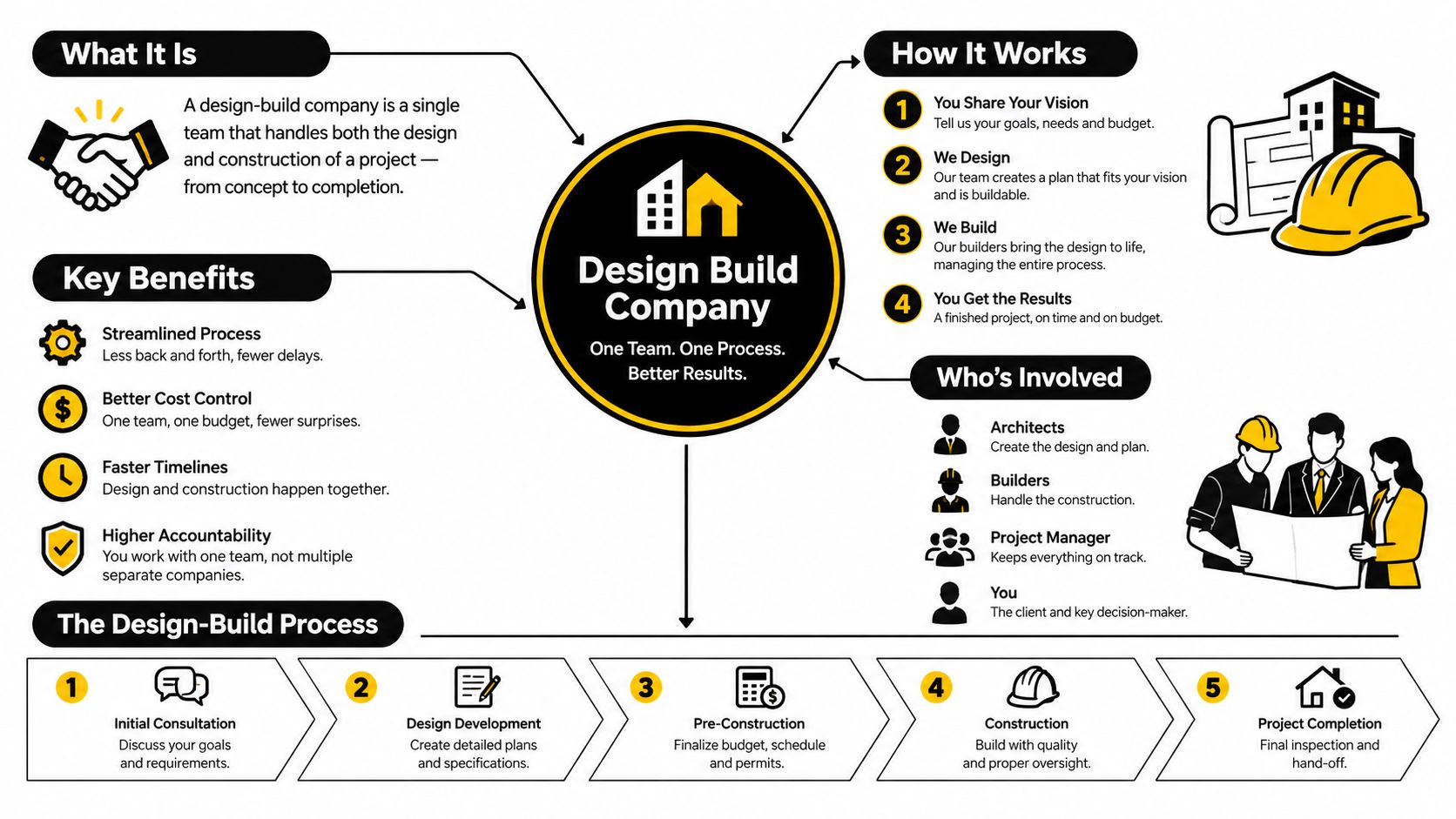
What a Design Build Company Really Is and How It Works
A useful analogy is to compare delivery models with navigation. In a separated arrangement, the design professional and builder can function like two captains on one voyage. They may communicate well, but the owner still has to reconcile instructions when the route, timing, or destination changes.
In design-build, the owner typically signs one contract with one design-builder for design and construction. The Federal Highway Administration's overview of design-build contracting explains that contracting with one firm can reduce delays and cost increases associated with design errors or mismatches between plans and construction.
A design-build company is one entity responsible for both design and construction, creating a single point of responsibility for the owner.
The workflow usually develops through overlapping phases rather than a strict handoff.
Design begins with buildability in mind
The design team develops the architectural direction, space planning, material palette, and technical documents. At the same time, construction professionals review how those ideas can be built on the site, what assemblies may be difficult to execute, and which decisions affect labor, procurement, or permitting.
For a luxury residence, that might mean reviewing the relationship between a large glazed opening, structural requirements, solar exposure, window lead times, and the room's intended use before the drawings are finalized. For a whole house remodel, it may mean investigating existing walls, utilities, drainage, and structural conditions early enough to shape the design responsibly.
Estimating informs design decisions
An integrated team can connect drawings to preliminary estimating and constructability review earlier. That doesn't eliminate uncertainty, especially in a remodel, but it gives the owner more opportunities to discuss alternatives before a late redesign becomes a field change.
Early conversations can cover cabinetry, stone, windows, specialty lighting, pools, work, casitas, and mechanical systems. The goal is to align the design ambition with the stated budget and property conditions, not to reduce every project to the lowest initial price.
Planning and construction can overlap
The Design-Build Institute of America and FMI forecast describes design-build as a central delivery model in the U.S. construction market. Its forecast projects nearly 47% of construction spending in the assessed U.S. segments by 2026, more than $1.9 trillion in design-build spending across the 2022 to 2026 forecast period, and a 5.2% compound annual growth rate.
Those market figures don't guarantee an individual project outcome. They do show why homeowners increasingly encounter design-build when evaluating custom residential construction and major remodeling.
The owner's benefit comes from connected decisions. The person developing the plan can hear directly from the people considering sequencing, pricing, permits, site access, and installation. That connection can make schedule planning more realistic and reduce the confusion created when separate firms interpret the same scope differently.
How Design Build Compares to Traditional Delivery Methods
Design-build isn't automatically the right choice for every owner. The better question is whether its accountability structure fits the project's complexity, your preferred decision style, and the amount of coordination you want to retain.
In design-bid-build, the owner usually contracts separately with the designer and construction firm. The design is developed first, then contractors price and build from the completed documents. That can create a clear separation of roles, but it also leaves the owner managing the relationship between design intent and construction execution.
Construction manager at risk offers another structure. A construction manager may provide pre-construction input and later take responsibility for delivering the work under an agreed commercial arrangement, while design and construction remain distinct professional functions.
| Criteria | Design-Build | Design-Bid-Build | Construction Manager at Risk |
|---|---|---|---|
| Owner coordination | One primary contract and one accountable lead | Owner coordinates separate design and construction relationships | Owner works with the construction manager while design remains a distinct function |
| Design and construction relationship | Teams collaborate during design and construction | Construction generally follows completed design documents | Construction input can occur during design, with separate design responsibility |
| Accountability | One entity carries responsibility for design and construction coordination | Responsibility is divided between designer and builder | Responsibility is shared across the delivery structure |
| Schedule approach | Overlapping planning can support earlier construction decisions | Sequential handoff can extend the overall process | Early construction input may improve planning, depending on the team |
| Cost predictability | Early estimating and constructability review can expose conflicts sooner | Pricing may reveal issues after design is substantially complete | Pre-construction services can inform pricing before construction |
| Luxury remodel fit | Useful where existing conditions, selections, and sequencing interact | Can work when scope is stable and the owner wants separate specialists | Can suit owners who want a construction manager involved early |
The time difference can be substantial in comparative research. A Federal Highway Administration study summarized by DBIA and FMI reported an average duration of 583 days for design-build compared with 1,215 days for design-bid-build. The same source also reported that design-build projects were 36% faster during construction and 102% faster from design through final completion than design-bid-build projects.
Those figures describe comparative research, not a promise for a Scottsdale residence. A luxury home still depends on site conditions, owner decisions, municipal review, HOA requirements, material availability, and the quality of project management.
Cost performance also depends on disciplined execution. A military construction analysis found mean cost growth of 4.51% for design-build compared with 6.41% for traditional delivery, with the difference statistically significant at p=0.0056. The analysis reported mean schedule growth of 17.3% for design-build and 18.8% for traditional delivery. The Defense Technical Information Center report provides the underlying analysis.
For a luxury homeowner, the practical takeaway is straightforward. Choose separated delivery when you want to select and manage distinct specialists yourself. Choose design-build when you value one accountable lead and want estimating, constructability, permitting strategy, and construction planning connected from the beginning.
What Is Actually Inside a Design Build Company
The phrase design-build company can hide an important organizational question. Some firms maintain architecture, interiors, estimating, project management, and construction capabilities internally. Others operate as a single contract entity while subcontracting architectural services, engineering, specialty design, and much of the trade work.
Both structures can qualify as design-build. The difference is not who holds a company badge. It's who controls communication, who reviews decisions, and who answers when design intent conflicts with field conditions.
In-house teams and outside partners
A more integrated firm may have internal designers working alongside estimators, project managers, site supervisors, and construction personnel. That arrangement can make daily collaboration easier because the team shares systems, meetings, and project information.
A firm may also use carefully selected outside architects, engineers, interior designers, professionals, and specialty trades. That isn't automatically a weakness. Luxury homes often benefit from specialized expertise, particularly for structural engineering, lighting, acoustics, design, building systems, or historic and site-sensitive work.
The critical distinction is accountability. If an outside architect develops a detail and a subcontractor installs it, the design-builder should explain who reviews the detail, who coordinates revisions, and how the final decision becomes part of the controlled project documents.
Questions that reveal the real structure
Ask direct questions before signing:
- Internal roles: Which people are employees, and which are independent partners?
- Design authority: Who approves changes to plans, specifications, and finish selections?
- Estimating: Who updates pricing when the scope evolves?
- Quality control: Who checks work before it is covered or handed to the next trade?
- Client-selected professionals: Can your preferred architect or designer collaborate within the company's process?
- Change orders: Who prepares them, explains them, and tracks their effect on cost and schedule?
- Closeout: Who handles punch-list completion, documentation, and warranty communication?
The CIRRELT research on design-build organizational structures notes that design-build can range from firms with in-house teams to a single contract entity that subcontracts substantial portions of the work. That range explains why marketing language alone isn't enough.
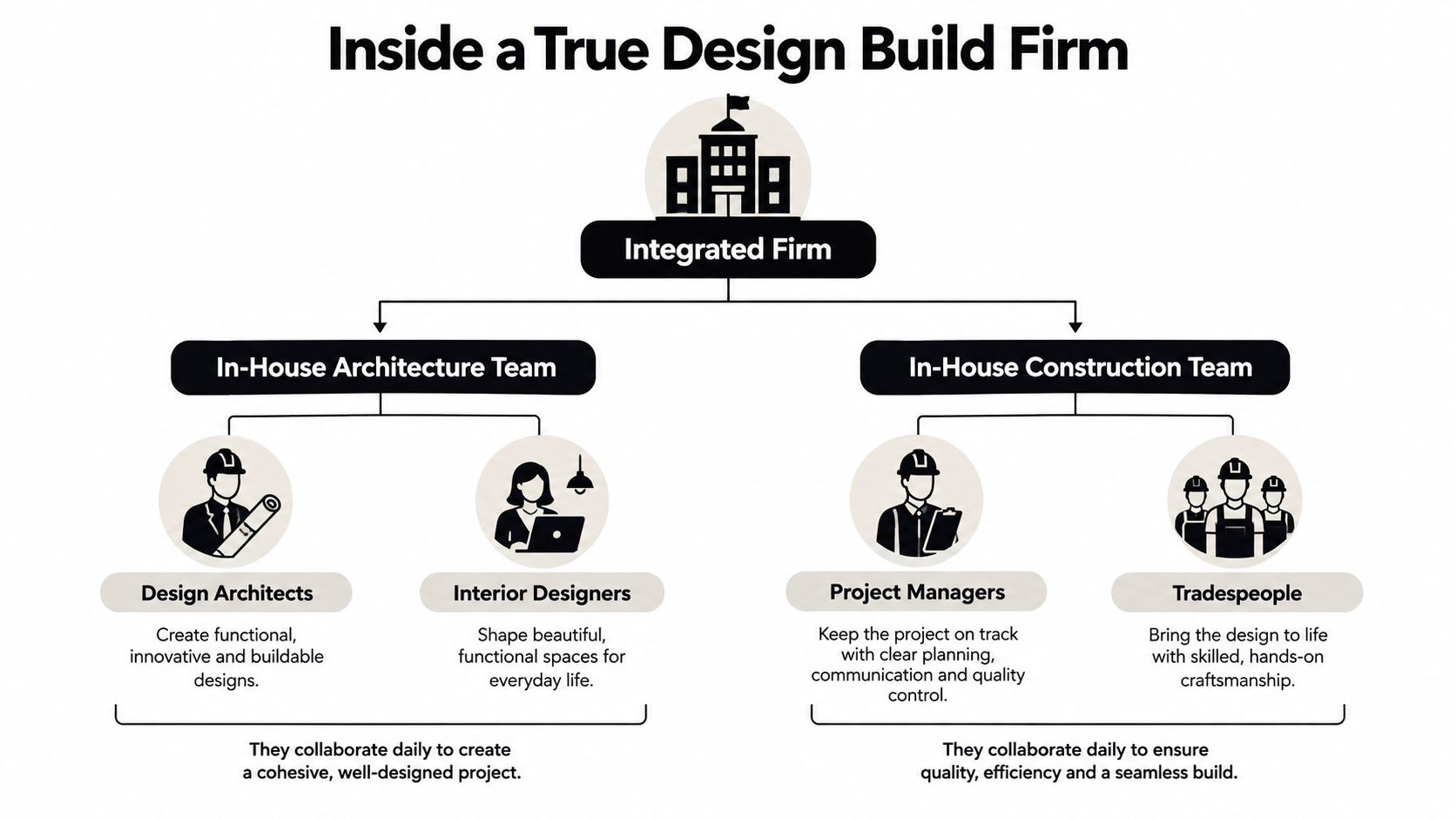
For homeowners evaluating a luxury custom home construction team, the best fit may include internal coordination plus outside specialists. The company's value comes from defining those relationships clearly and maintaining one chain of responsibility through design decisions, construction execution, quality assurance, and warranty service.
Why Luxury Homeowners Choose Design Build in Phoenix
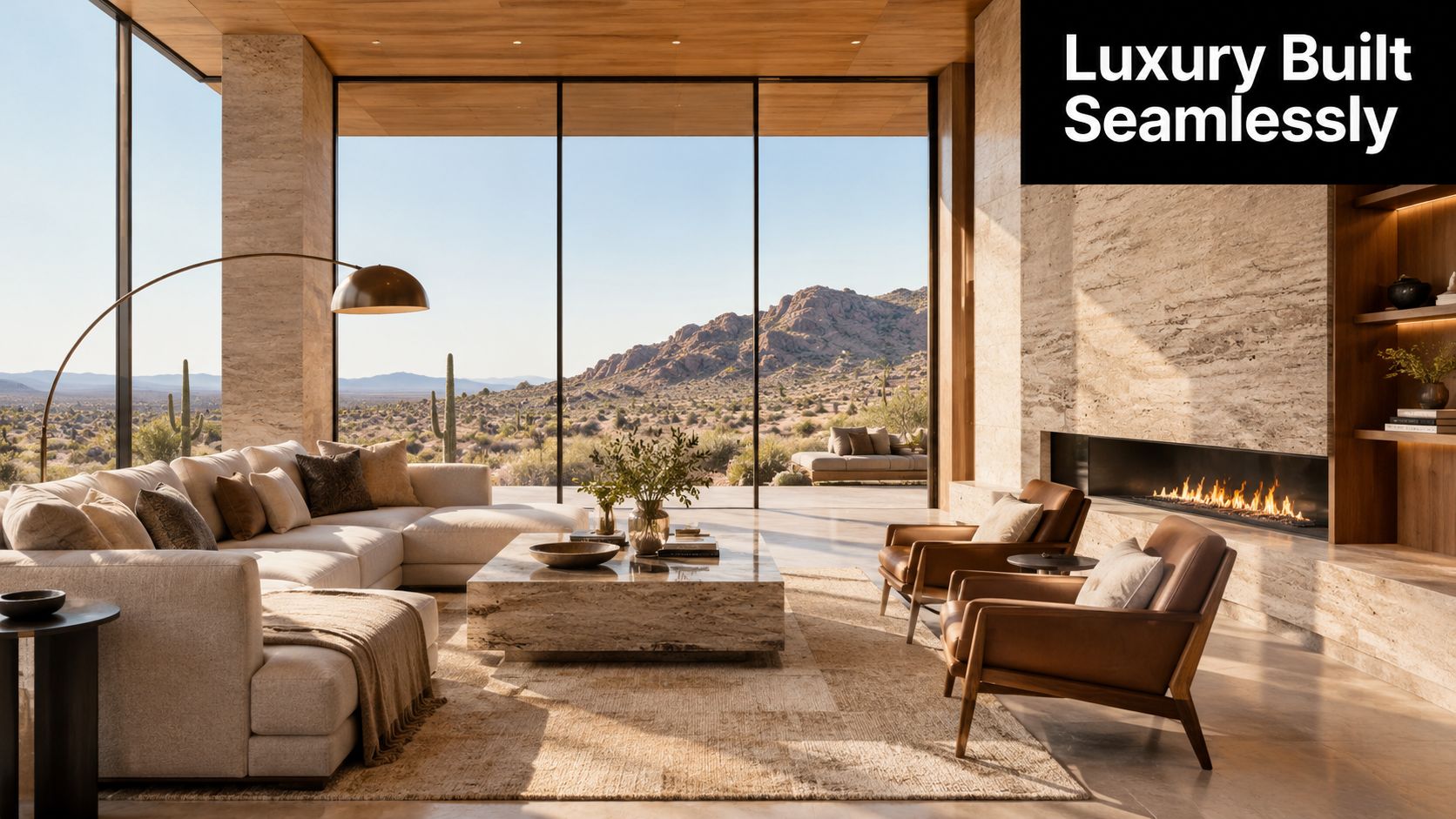
Luxury homeowners in Phoenix often need more than an attractive plan. They need a home that handles desert light, indoor and outdoor living, privacy, shade, entertaining, storage, work, rest, and daily movement without making the occupants work around the architecture.
That's where early collaboration becomes practical. A designer may identify a dramatic great-room opening, while the builder and engineering team review structure, glazing, shading, waterproofing, and installation access. An interior designer may specify a detailed kitchen, while the construction team coordinates cabinet dimensions, appliance requirements, electrical locations, ventilation, stone, and delivery timing.
Livability comes before ornament
Functional-first luxury design organizes the home around how your family lives. Efficient circulation can separate service movement from entertaining, place everyday storage where it's needed, and connect kitchens, outdoor areas, guest spaces, offices, and primary suites without wasted transitions.
This matters in both new construction and luxury whole house remodeling. A remodel may preserve valued architectural elements while correcting awkward room relationships, outdated utilities, poor lighting, or insufficient storage. An ADU or casita may need to support guests, multigenerational living, privacy, or income-related use while respecting the lot and applicable municipal requirements.
Local review requires early coordination
Scottsdale, Paradise Valley, Arcadia, and Biltmore properties can involve different neighborhood expectations, site constraints, and HOA review processes. A design-build team that participates early can coordinate drawings, exterior materials, concepts, setbacks, gates, walls, and other submission requirements before construction planning becomes too advanced.
Long-lead selections deserve the same attention. Custom windows, specialty stone, millwork, lighting, plumbing fixtures, appliances, and doors can affect both the visual result and the sequence of work. Early budgeting and procurement planning won't remove every supply issue, but it can help you identify decisions that shouldn't wait.
Communication protects the experience
A transparent communication cadence gives you a defined place to review scope, budget movement, schedule status, selections, approvals, and open questions. It also creates decision discipline. When an owner delays a finish choice, changes a room layout, or revises a material after procurement planning, the team can explain the consequence rather than allowing the impact to remain hidden.
DBIA reporting describes design-build as continuing to perform strongly on delivery efficiency, including comparisons with construction manager at risk and design-bid-build in its research on project delivery. For a Phoenix luxury project, that advantage is most useful when the team and owner both treat decisions as part of the work.
What to Expect When Hiring a Design Build Company in Scottsdale
A strong design-build relationship should feel organized from the first conversation. You should understand who will lead communication, how the company evaluates your property, when budgeting begins, and how decisions become documented.
The early property conversation
The process may begin before you own the lot. A design-build company can review a potential property for access, slope, existing structures, utility considerations, zoning questions, outdoor living opportunities, and the relationship between your goals and the site. This is particularly useful if you're comparing a tear-down, a new build, an extensive remodel, or a property that could accommodate an ADU.
Once the property is selected, pre-construction planning turns broad goals into a working project framework. The team discusses program, priorities, design direction, preliminary scope, budget expectations, schedule considerations, and the professionals required for the work.
Design, budget, and approvals develop together
During design, ask how often cost is reviewed and what level of detail appears in the estimate. A useful process distinguishes known scope from allowances, identifies assumptions, and records owner decisions. If a preferred material is not yet selected, the estimate should make that uncertainty visible instead of presenting a false sense of precision.
The team should also coordinate city permitting and HOA submissions where applicable. A Scottsdale luxury custom home builder can help organize the documents and communication required for those reviews, while your responsibility remains timely feedback and approval of decisions that only you can make.
Construction needs a visible operating rhythm
Once work begins, expect regular updates on progress, upcoming selections, budget changes, inspections, site questions, and schedule risks. Day-to-day construction management should connect the superintendent, project manager, designers, vendors, and trade partners so that a field discovery doesn't become a surprise weeks later.
Progressive design-build can be useful when the project needs early collaboration and the scope is still developing. The DBIA and FMI market discussion describes progressive design-build as an approach associated with faster delivery and cost predictability. It still requires clear scope definition, transparent pricing, and disciplined owner decisions.
Closeout is part of delivery
Quality assurance and quality control should continue through installation reviews, inspections, punch-list management, systems orientation, final documentation, and warranty support. Ask who performs the final quality review, how unresolved items are tracked, and how warranty requests are submitted after completion.
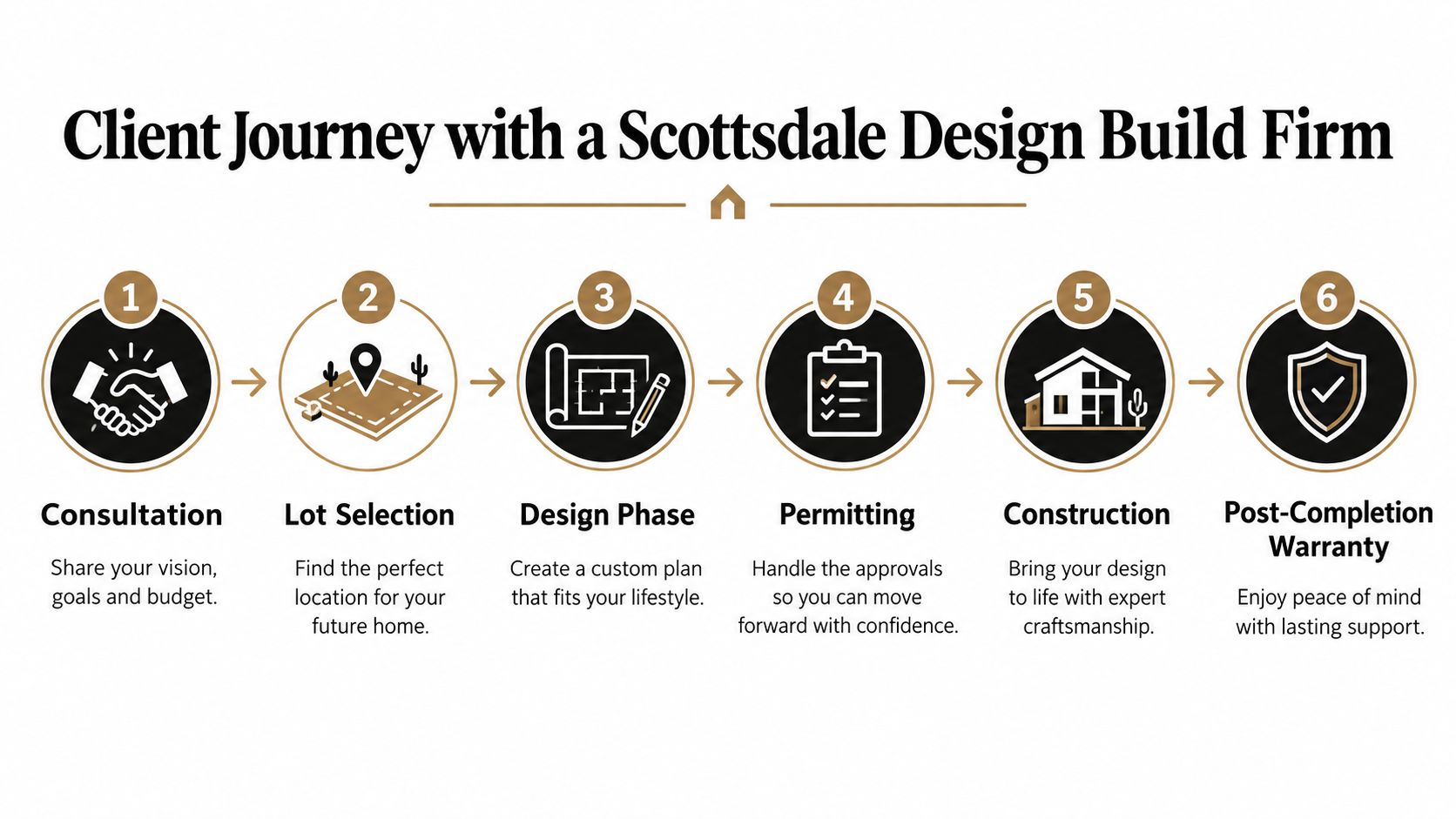
A clear client journey generally includes:
- Consultation: Define the property, objectives, design preferences, and concerns.
- Lot or home evaluation: Test whether the site and existing structure support the intended scope.
- Design and pre-construction: Develop plans while reviewing cost, constructability, procurement, and sequencing.
- Permitting and HOA coordination: Prepare and manage submissions appropriate to the property.
- Construction: Coordinate site work, trades, inspections, selections, and ongoing decisions.
- Closeout and warranty: Complete quality reviews, resolve punch-list items, and provide post-completion support.
Choosing the Right Luxury Design Build Partner and Next Steps
The right partner should make responsibility easy to understand. Look for a portfolio that reflects the type of work you're planning, whether that's a custom ground-up residence, a desert-modern renovation, an estate property, a casita, or a complex whole house remodel.
Then examine the process behind the images. Ask how the company handles early budgeting, allowances, design revisions, procurement, HOA coordination, schedule updates, quality control, and warranty communication. A polished portfolio can't answer those questions, but a detailed conversation can.
Local experience matters because Phoenix luxury construction is shaped by property-specific conditions and neighborhood expectations. Scottsdale and Paradise Valley projects may require a different level of review than a remodel in Arcadia or the Biltmore corridor. Your partner should understand how property choice, design goals, approvals, construction access, and eventual livability fit together.
A design-build company doesn't remove every project risk. It can reduce confusion by placing design and construction coordination under one accountable lead, while your own decision discipline remains essential. Keep scope priorities clear, review cost information carefully, make selections in the agreed cadence, and ask for written explanations when a change affects the plan.
For homeowners seeking a luxury-rated contractor in greater Scottsdale and nearby communities, Emery Lane's luxury estate building services provide a context for discussing custom homes and luxury whole house remodeling through an integrated process. Emery Lane Homes works with internal personnel, vetted designers and architects, and client-selected professionals where collaboration supports the project.
Emery Lane Homes offers custom luxury home construction, luxury whole house remodeling, ADUs, pre-construction planning, permitting and HOA coordination, construction management, QA/QC, and post-completion warranty support in greater Scottsdale and surrounding Phoenix communities. Visit Emery Lane Homes to discuss your property, clarify whether design-build fits your goals, and schedule a consultation with a luxury-rated contractor.